10 Results for "

late endosomes/lysosomes

" in MedChemExpress (MCE) Product Catalog:
Products (10)

10 Results for "late endosomes/lysosomes" in MCE Product Catalog:

18
18 Cited Publications
Cat. No.: HY-D1300
CAS No.: 231946-72-8
Synonyms: LysoTracker Red DND-99
LysoTracker Red is a Red fluorescently labeled lysosomal probe with a maximum excitation/emission wavelength of 577/590 nm. The structure is composed of a fluorescein group and linked weak bases, which can freely cross the cell membrane and gather on spherical organelles. It is suitable for observing the internal biosynthesis and related pathogenesis of lysosomes .
loading...
    loading...
Cat. No.: HY-DY1040
CAS No.: 231946-72-8
LysoTracker Red (solution) is a Red fluorescently labeled lysosomal probe with a maximum excitation/emission wavelength of 577/590 nm. The structure is composed of a fluorescein group and linked weak bases, which can freely cross the cell membrane and gather on spherical organelles. It is suitable for observing the internal biosynthesis and related pathogenesis of lysosomes .
Solvent and concentration: DMSO: 1 mM
loading...
    loading...
Cat. No.: HY-162160
CAS No.: 1221739-85-0
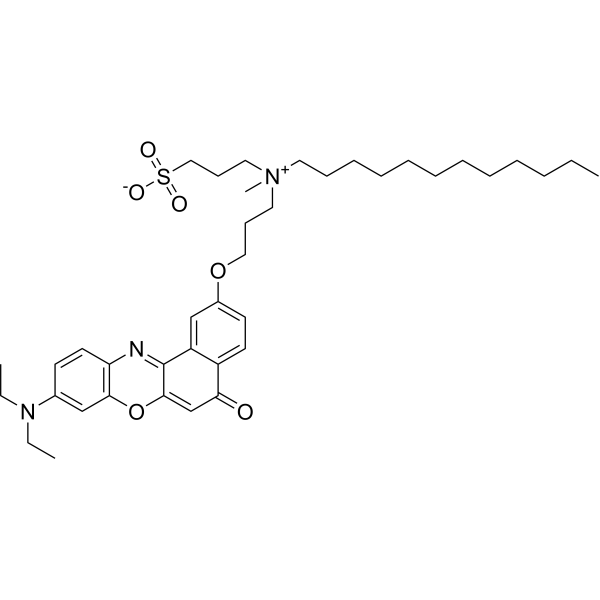
NR12S is a fluorescent probe that specifically binds to the outer leaflet of membranes. NR12S exhibits phase-sensitive red edge excitation shift, emission wavelength shift and lifetime changes, which depend on membrane phase, cholesterol content and lipid acyl chain properties. NR12S can be used to study cholesterol and lipid order in biological membranes .
loading...
    loading...
Cat. No.: HY-D2465
Target:  

Fluorescent Dye

Research Areas:  

Infection

CY5-Dextran (MW60-80k) is a fluorescent probe formed by covalent conjugation of the cyanine dye Cy5 to dextran. It is a pH-insensitive fluid-phase endocytosis tracer (the pH of endosomal lumen is precisely quantified by the fluorescence ratio of FITC/Cy5). CY5-Dextran (MW60-80k) is internalized by cells via a clathrin-independent fluid-phase pinocytosis pathway, and is sequentially evidenced by early endosomes, late endosomes are transported to lysosomes. CY5-D I cannot pass through the limited pore size formed by uncoating of human rhinovirus type 2 (HRV2), but can be released into the neutral cytoplasm upon adenovirus-mediated endosomal rupture, thus distinguishing between the two viral modes of "pore-forming escape" and "lysis escape". CY5-Dextran (MW60) -80k) has an excitation wavelength of 635 nm, and it can also be used for time-lapse imaging of endocytosis dynamics of stromal cells in tissues such as rat salivary glands under in vivo two-photon microscopy .
loading...
    loading...
Cat. No.: HY-177120
CAS No.: 133156-42-0
Target:  

Autophagy

Research Areas:  

Cancer

DMBP is a VPS41 inhibitor. DMBP induces methuosis and inhibits autophagy in cancer cells. DMBP inhibits the fusion of late endosomes and autophagosomes with lysosomes. DMBP effectively inhibits metastasis in a mouse metastatic melanoma model. DMBP can be used for the study of melanoma .
loading...
    loading...
Cat. No.: HY-D2321
CAS No.: 2324152-35-2
Lyso Flipper-TR 29 is a Flipper probe that can label lysosomes. Lyso Flipper-TR 29 enters lysosomes and late endosomes by transient deprotonation to cross their membranes in neutral form .
loading...
    loading...
Cat. No.: HY-165426
CAS No.: 3031522-14-9
Research Areas:  

Inflammation/Immunology

HB-230 is a Transglutaminase-2 (TG2) (human IC50 = 4.9 μM) inhibitor and a selective fluorescent imaging probe for active TG2 localization. HB-230 modifies TG2 Cys277 to sustain the enzyme open conformation. HB-230 forms a ternary complex with TG2 and α2-macroglobulin, undergoes receptor-mediated endocytosis, and trafficks directly to lysosomes without early/late endosome fusion. HB-230 exhibits TG2 activity-dependent and α2-macroglobulin-dependent uptake. HB-230 can be used for the research of celiac disease, (Ex/Em = 649/665 nm) .
loading...
    loading...
Cat. No.: HY-D3163
Target:  

Fluorescent Dye

Research Areas:  

Others

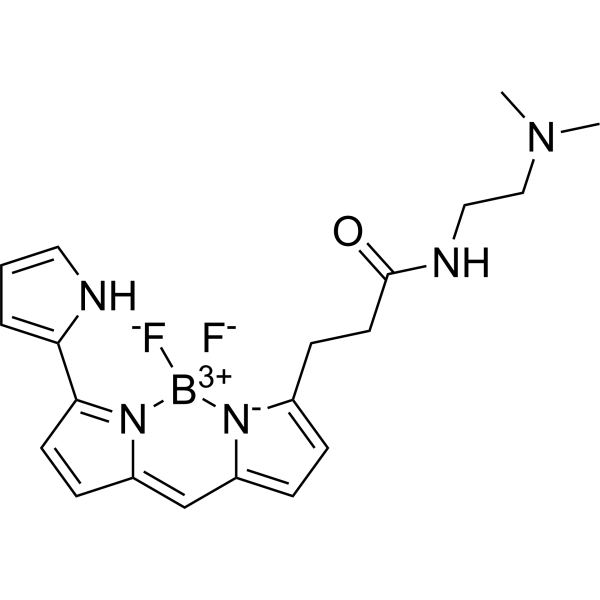
Endo-pH is a cell-permeable, pH-responsive fluorescent probe based on BODIPY, with a pKa of 5.08. When pH decreases from 7.32 to 4.97, Endo-pH undergoes protonation under acidic conditions, resulting in a 79-fold increase in fluorescence intensity at 786 nm. The detection wavelengths of its protonated form are Ex/Em=688/786 nm, while the absorption wavelength of its non-protonated form is 745 nm. Endo-pH can be used for staining late endosomes in live cells and determining the fusion time of late endosomes and lysosomes .
loading...
    loading...
Cat. No.: HY-W339816
CAS No.: 325466-03-3
Research Areas:  

Others

(S,R)-Bis(monomyristoylglycero)phosphate ammonium actively contributes to cargo sorting by promoting the degradation and sorting of lipids, and it plays a critical role in the sorting of polyunsaturated fatty acids (PUFAs) within acidic organelles. This phospholipid features two phosphate-linked glycerol molecules arranged in a unique sn-1 glycerophospho-sn-1′ glycerol stereoconformation, with each glycerol molecule esterified to a myristic acid. Typically, it is found in the intraluminal vesicles (ILVs) of late endosomes and lysosomes.
loading...
    loading...
Cat. No.: HY-D3130
Target:  

Fluorescent Dye

Research Areas:  

Others

Mem-pH is a ratiometric fluorescent probe used for measuring vesicular pH. Mem-pH inserts into the plasma membrane bilayer and localizes to the vesicular lumen, switching between its basic and acidic forms via protonation during vesicular acidification to enable ratiometric pH readout. In aqueous media, Mem-pH forms non-emissive aggregates through aggregation-induced quenching, and then depolymerizes and recovers its fluorescent activity upon binding to the plasma membrane. The excitation/emission wavelengths of the basic form of Mem-pH are 405/450-550 nm, while those of the acidic form are 488/500-700 nm .
loading...
    loading...

