



NR12S

Based on 1 Customer Validation
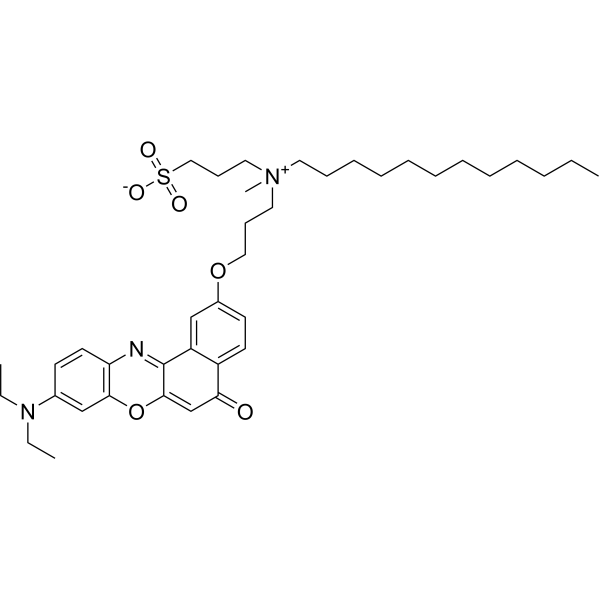
NR12S is a fluorescent probe that specifically binds to the outer leaflet of membranes. NR12S exhibits phase-sensitive red edge excitation shift, emission wavelength shift and lifetime changes, which depend on membrane phase, cholesterol content and lipid acyl chain properties. NR12S can be used to study cholesterol and lipid order in biological membranes.
For research use only. We do not sell to patients.
- Purity : 98.75%
- CAS No.: 1221739-85-0
- Formula: C39H57N3O6S
- Molecular Weight:695.95
-
Storage:
-20°C, protect from light
* In solvent : -80°C, 6 months; -20°C, 1 month (protect from light)

To place orders, for customer services and technical support, please contact: MedChemExpress USA
Tel: 609-228-6898 E-mail: [email protected] [email protected]


-
 Biological Activity
-
Chemical Information
-
Solvent & Solubility
- Purity & Documentation
- References
-
 Help & FAQs




Biological Activity
Description
In Vitro
NR12S selectively stains the outer leaflet of U87MG human glioblastoma cell plasma membranes, with emission spectra that correlate with membrane cholesterol content, enabling quantitative monitoring of cholesterol depletion and enrichment dynamics[1].
NR12S orientation is strongly conditioned by lipid environment (two orientations in disordered bilayers, one vertical orientation in ordered bilayers) and interacts transiently with cholesterol, which likely influences its fluorescence response[6].
NR12S stains both liquid ordered (Lo) and liquid disordered (Ld) phases of model GUV membranes, with a preference for the Ld phase[7].
NR12S (40 nM) binds to the plasma membrane of living HeLa cells, reports on lipid order via green/red fluorescence ratio, and is not significantly quenched by bQ10S due to its partitioning into both ordered and disordered membrane environments[7].
NR12S (40 nM) reports on heterogeneous lipid order environments (resembling model Lo and Ld phases) in the plasma membranes of living HeLa, CHO, and 293T cells, with bQ10S selectively quenching its fluorescence in disordered (Ld-like) domains to reveal ordered (Lo-like) domain signal[7].
NR12S (0.5-1 mol%; 12 h) exhibits phase-dependent intensity-averaged mean fluorescence lifetimes in POPC (3.86 ns), DPPC (3.48 ns), and POPC/40 mol% cholesterol (4.25 ns) LUVs, with the longest lifetime in liquid-ordered phase membranes[2].
NR12S (10-20 nM; room temperature) shows HeLa cell plasma membranes saturate with it more rapidly than lipid vesicles, and the probe exhibits no detectable phototoxicity when used at 10-20 nM, making this the optimal concentration range for cellular studies[4].
NR12S (0.05 μM; 7 min) enables two-photon ratiometric microscopy to visualize decreased outer plasma membrane lipid order in HeLa cells induced by cholesterol extraction and apoptosis[4].
NR12S (0.02 μM; 7 min) specifically stains the outer plasma membrane of HeLa cells and detects reduced lipid order in cholesterol-depleted or apoptosis-induced (Camptothecin, IPA-3) HeLa cells via a decreased green/red fluorescence intensity ratio[6].
NR12S (0.01 μM; 7 min) detects apoptosis in HeLa cells via flow cytometry, showing a strong correlation with caspase-3 activation (FITC-DEVD-FMK) and phosphatidylserine exposure (GFP-Annexin V) over the 0-24 h time course of camptothecin-induced apoptosis, and detects plasma membrane lipid order changes from membrane-modifying agents via population-wide shifts in the green/red fluorescence intensity ratio[6].
NR12S (40 nM) identifies Ld-like phase domains in the form of apoptotic blebs in IPA-353-treated apoptotic HeLa cells, with bQ10S selectively quenching NR12S fluorescence in these blebs to confirm their disordered lipid environment[7].
MedChemExpress (MCE) has not independently confirmed the accuracy of these methods. They are for reference only.


Chemical Information
-
CAS No. 1221739-85-0
-
Appearance Solid
-
Molecular Weight 695.95
-
Formula C39H57N3O6S
-
Color Brown to black
-
SMILES
O=C1C=C2OC3=C(N=C2C4=CC(OCCC[N+](CCCCCCCCCCCC)(CCCS(=O)([O-])=O)C)=CC=C14)C=CC(N(CC)CC)=C3
-
Shipping
Room temperature in continental US; may vary elsewhere.
-
Storage
-20°C, protect from light
* In solvent : -80°C, 6 months; -20°C, 1 month (protect from light)


Solvent & Solubility
In Vitro:
DMSO : 50 mg/mL (71.84 mM; Need ultrasonic; Hygroscopic DMSO has a significant impact on the solubility of product, please use newly opened DMSO)
Please refer to the solubility information to select the appropriate solvent. Once prepared, please aliquot and store the solution to prevent product inactivation from repeated freeze-thaw cycles.
Storage method and period of stock solution: -80°C, 6 months; -20°C, 1 month (protect from light). When stored at -80°C, please use it within 6 months. When stored at -20°C, please use it within 1 month.
Please refer to the solubility information to select the appropriate solvent. Once prepared, please aliquot and store the solution to prevent product inactivation from repeated freeze-thaw cycles.
Storage method and period of stock solution: -80°C, 6 months; -20°C, 1 month (protect from light). When stored at -80°C, please use it within 6 months. When stored at -20°C, please use it within 1 month.
Concentration (start) × Volume (start) = Concentration (final) × Volume (final)


Purity & Documentation
-
Data Sheet (277 KB)
-
SDS (252 KB)
- English - EN (252 KB)
- Français - FR (252 KB)
- Deutsch - DE (252 KB)
- Norwegian - NO (252 KB)
- Español - ES (252 KB)
- Swedish - SV (252 KB)
- Italian - IT (252 KB)
- Korean - KR (252 KB)
- Portuguese - PT (252 KB)
-
Handling Instructions (2659 KB)
References


Complete Stock Solution Preparation Table
Please refer to the solubility information to select the appropriate solvent. Once prepared, please aliquot and store the solution to prevent product inactivation from repeated freeze-thaw cycles.
Storage method and period of stock solution: -80°C, 6 months; -20°C, 1 month (protect from light). When stored at -80°C, please use it within 6 months. When stored at -20°C, please use it within 1 month.
| Optional Solvent | Concentration Solvent Mass | 1 mg | 5 mg | 10 mg | 25 mg |
|---|---|---|---|---|---|
| DMSO | 1 mM | 1.4369 mL | 7.1844 mL | 14.3688 mL | 35.9221 mL |
| 5 mM | 0.2874 mL | 1.4369 mL | 2.8738 mL | 7.1844 mL | |
| 10 mM | 0.1437 mL | 0.7184 mL | 1.4369 mL | 3.5922 mL | |
| 15 mM | 0.0958 mL | 0.4790 mL | 0.9579 mL | 2.3948 mL | |
| 20 mM | 0.0718 mL | 0.3592 mL | 0.7184 mL | 1.7961 mL | |
| 25 mM | 0.0575 mL | 0.2874 mL | 0.5748 mL | 1.4369 mL | |
| 30 mM | 0.0479 mL | 0.2395 mL | 0.4790 mL | 1.1974 mL | |
| 40 mM | 0.0359 mL | 0.1796 mL | 0.3592 mL | 0.8981 mL | |
| 50 mM | 0.0287 mL | 0.1437 mL | 0.2874 mL | 0.7184 mL | |
| 60 mM | 0.0239 mL | 0.1197 mL | 0.2395 mL | 0.5987 mL |


NR12S Related Classifications
HY-162160 Related Classifications
 Powered by Bioz