
17 Results for "

lysine acetylation

" in MedChemExpress (MCE) Product Catalog:
Products (17)

17 Results for "lysine acetylation" in MCE Product Catalog:

5
5 Cited Publications
Cat. No.: HY-19541
CAS No.: 1640282-31-0
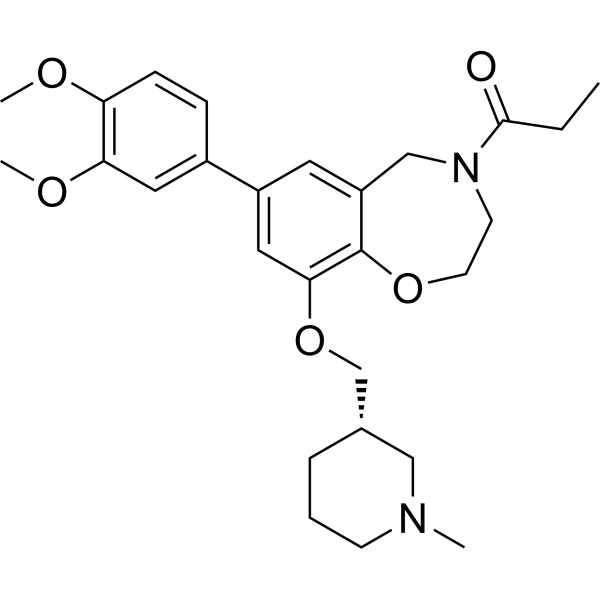
I-CBP112, a chemical probe, is a specific and potent acetyl-lysine competitive protein-protein interaction inhibitor, that inhibits the CBP/p300 bromodomains, enhances acetylation by p300.
loading...
    loading...
4
4 Cited Publications
Cat. No.: HY-160818
CAS No.: 1844889-12-8
Target:  

Sirtuin

Research Areas:  

Cancer

MC3138 is a selective SIRT5 activator. MC3138 has antitumor activity on human PDAC cells, with IC50 values of 25.4-236.9 μM. MC3138 combined with Gemcitabine (HY-17026) significantly inhibits tumor growth in mice .
loading...
    loading...
1
1 Cited Publications
Cat. No.: HY-128730
CAS No.: 94249-01-1
Purity:  ≥98.0%
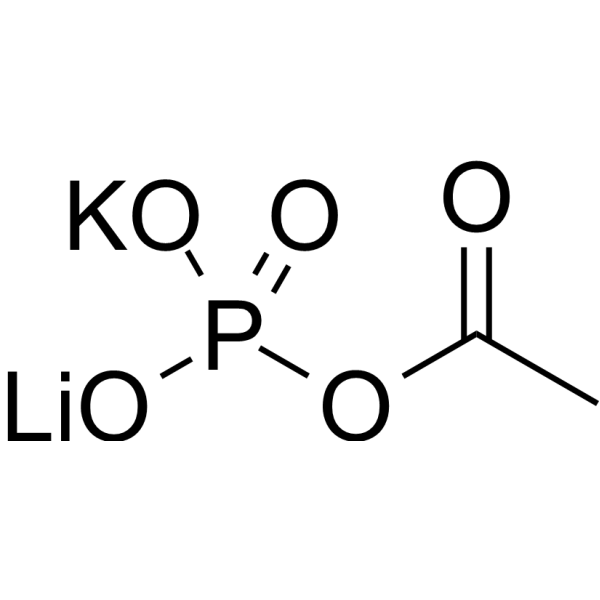
Acetyl phosphate lithium potassium is an endogenous metabolic product. Acetyl phosphate lithium potassium is a key substance in bacterial metabolic regulation, particularly in Lysine acetylation, and plays an important role in bacterial responses to environmental stress and adaptive reactions .
loading...
    loading...
Cat. No.: HY-W414799
CAS No.: 79416-87-8
Nε,Nε-Dimethyl-L-lysine monohydrochloride is an unnatural amino acid with the activity of regulating protein post-translational modification. Nε,Nε-Dimethyl-L-lysine monohydrochloride can be used as a tool for epigenetic research to promote the research process of acetylation and methylation. Nε,Nε-Dimethyl-L-lysine monohydrochloride is also widely used in compound development and biochemical research.
loading...
    loading...
Cat. No.: HY-P1958
CAS No.: 667899-73-2
Research Areas:  

Others

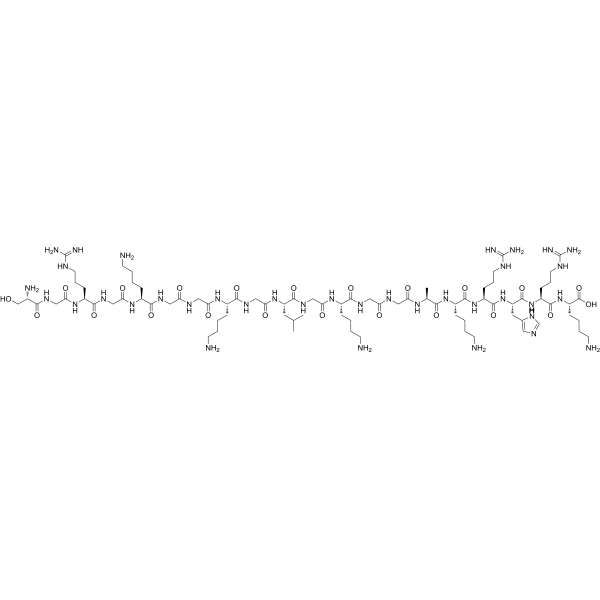
Histone H4 (2-21) is a substrate peptide derived from the N-terminal region of histone H4, which serves as an acyl acceptor for lysine acetyltransferases of the MYST family (KAT). Histone H4 (2-21) participates in enzymatic reactions together with acyl-coenzyme A (acyl-CoA, and undergoes lysine acetylation and propionylation modifications catalyzed by KATs such as MOF. The apparent Km of Histone H4 (2-21) for MOF is 788.8 μM, while in the picNuA4 catalytic system, the Km and Kd values of the H4 peptide are 192 μM and 251 μM, respectively. Histone H4 (2-21) can be used in studies related to histone post-translational modifications, epigenetic regulation, and lysine acylation .
loading...
    loading...
Cat. No.: HY-146346
CAS No.: 2978763-95-8
Purity:  98.75%
Target:  

PROTACs HDAC NF-κB

Research Areas:  

Infection Inflammation/Immunology

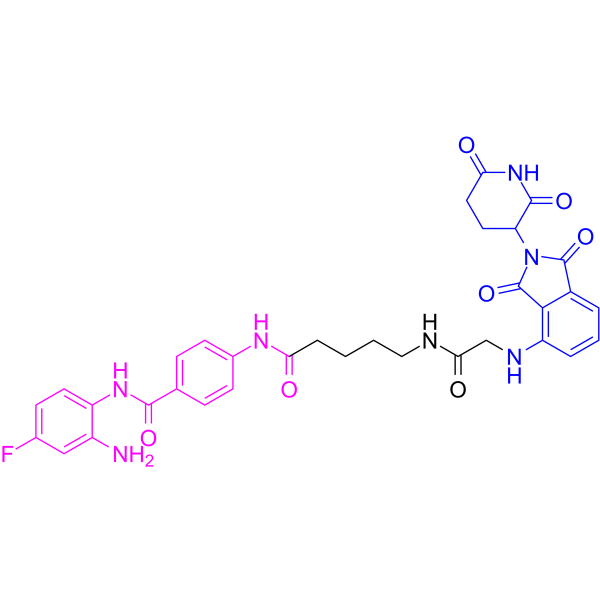
HD-TAC7 is a selective HDAC3 PROTAC degrader with an IC50 of 1.1 μM. By recruiting the CRBN E3 ligase, HD-TAC7 induces ubiquitin-proteasome degradation and selective downregulation of HDAC3, which in turn increases H3K27 acetylation levels and downregulates the NF-κB subunit p65, exerting anti-inflammatory activity. HD-TAC7 is used in research on COVID-19, SARS-CoV-2 infection, asthma, chronic obstructive pulmonary disease, and colon cancer .
loading...
    loading...
Cat. No.: HY-162837
Target:  

Aurora Kinase

Research Areas:  

Cancer

AURKA against 1 is an inhibitor of AURKA (IC50 less than 0.5 nM), targeting endogenous lysine (K162) acetylation, and has anti-proliferation activity against tumor cells. AURKA against 1 induces K162 acetylation, and the kinase activity of AURKA is reversibly restored in HCT116 cells transfected with SIRT3 .
loading...
    loading...
Cat. No.: HY-145818
CAS No.: 2669785-84-4
Target:  

HDAC PROTACs

Research Areas:  

Cancer

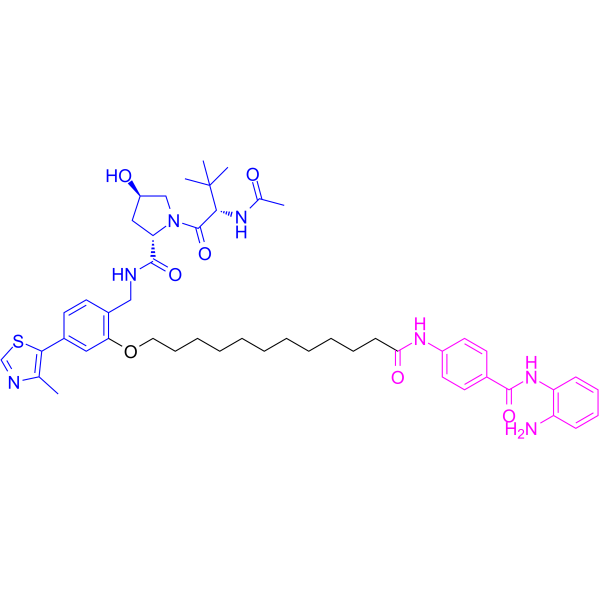
JPS035 is a HDAC1, HDAC2 and HDAC3 PROTAC degrader, with a DC50 value of 3.58 μM against HDAC1 and 1.38 μM against HDAC3. JPS035 recruits the VHL E3 ligase to mediate the ubiquitination and degradation of HDAC1, HDAC2 and HDAC3. JPS035 increases the acetylation level of histone H3 lysine 56 and regulates global gene expression. JPS035 can be used in colon cancer-related research .
loading...
    loading...
Cat. No.: HY-P2555
CAS No.: 2130981-29-0
Target:  

Inhibitory Antibodies

Research Areas:  

Others

Histone H3 (23-34) is the histone H3 amino acid residues 23 to 34. Histone H3 (23-34) contains lysine residues at positions 23 and 27 that are subject to methylation and acetylation .
loading...
    loading...
Cat. No.: HY-187169
Research Areas:  

Cancer

KAT2A degrader-2 is a selective molecular glue degrader targeting KAT2A, with a DC50 of 22 nM in Kelly cells. KAT2A degrader-2 acts as a molecular glue to recruit KAT2A to CRBN, forming a ternary complex that drives the polyubiquitination and proteasome-dependent degradation of KAT2A. KAT2A degrader-2 reduces the acetylation level of histone H3 lysine 9 via the ubiquitin-like and proteasome-dependent pathway. KAT2A degrader-2 can be used for the research of acute myeloid leukemia .
loading...
    loading...
Cat. No.: HY-187168
CAS No.: 2407654-72-0
Research Areas:  

Cancer

KAT2A degrader-1 is a molecular glue degrader targeting KAT2A, with a DC50 of 89 nM in Kelly cells. KAT2A degrader-1 recruits KAT2A to cereblon (CRBN) in a degron-independent manner, forms a ternary complex with KAT2A and CRBN, and drives the polyubiquitination and proteasome-dependent degradation of KAT2A. KAT2A degrader-1 reduces the level of histone H3 lysine 9 acetylation (H3K9Ac). KAT2A degrader-1 induces antiproliferative effects in acute myeloid leukemia cells, while enhancing KAT2A-CRBN dimerization activity and eliminating the targeting effect on GSPT1. KAT2A degrader-1 can be used for research related to acute myeloid leukemia .
loading...
    loading...
Cat. No.: HY-NP012B
Synonyms: Ac LDL
Acetylated human low-density lipoprotein (Ac-LDL) is a form of human LDL that has undergone acetylation. Acetylation of lysine residues on the LDL apolipoprotein prevents it from binding to the standard LDL receptor; instead, it is recognized and taken up by scavenger receptors. Since endothelial cells and microglia express these scavenger receptors, Ac-LDL is used to study endothelial and microglial function.
loading...
    loading...
Cat. No.: HY-121009
CAS No.: 748777-47-1
Research Areas:  

Cancer

CCT077791 is a PCAF (IC50: 7.3 μM (FlashPlate); 2.2 μM (Filter assay)) and p300 histone acetyltransferase inhibitor. CCT077791 reduces total acetylation of histones H3 and H4, levels of specific acetylated lysine marks, and acetylation of α-tubulin. CCT077791 can be used in the research of colorectal cancer .
loading...
    loading...
Cat. No.: HY-136112
CAS No.: 14464-29-0
Synonyms: Succinimidyl acetate; Ac-OSu
Research Areas:  

Others

N-Succinimidyl acetate (Succinimidyl acetate; Ac-OSu) is a bioconjugation and peptide synthesis reagent. N-Succinimidyl acetate performs acetylation modification on the N-terminus and lysine side chains of proteins. N-Succinimidyl acetate is applicable to research fields including protein labeling, vaccine development and targeted drug delivery .
loading...
    loading...
Cat. No.: HY-NP012C
Synonyms: Ac-Dil LDL
Dil acetylated low density lipoprotein, human (Ac-Dil LDL) is human acetylated LDL (Ac-LDL) tagged with the fluorescent dye DiI. Acetylation of lysine residues on the LDL apolipoprotein prevents it from binding to the standard LDL receptor; instead, it is recognized and taken up by scavenger receptors. Since endothelial cells and microglia express these scavenger receptors, Dil acetylated low density lipoprotein, human is used to study endothelial and microglial cell function (Ex/Em = 554/571 nm).
loading...
    loading...
Cat. No.: HY-CE00983A
Synonyms: 4-Pentynoyl-CoA TFA
4-Pentynoyl-Coenzyme A (4-Pentynoyl-CoA) TFA is an analog of the natural substrate acetyl-CoA (Acetyl-CoA) (HY-114293). 4-Pentynoyl-Coenzyme A TFA can replace acetyl-CoA to be recognized and utilized by lysine acetyltransferases such as p300. 4-Pentynoyl-Coenzyme A TFA can be conjugated to azide probes carrying fluorescent groups (e.g., Rhodamine-azide) or biotin (Biotin-azide) via Cu (I)-catalyzed azide-alkyne cycloaddition (CuAAC) .
loading...
    loading...
Cat. No.: HY-L024
931 compounds

A histone modification, a covalent post-translational modification (PTM) to histone proteins, includes methylation, phosphorylation, acetylation, ubiquitylation, and sumoylation, etc. In general, histone modifications are catalyzed by specific enzymes that act predominantly at the histone N-terminal tails involving amino acids such as lysine or arginine, as well as serine, threonine, tyrosine, etc. The PTMs made to histones can impact gene expression by altering chromatin structure or recruiting histone modifiers. Histone modifications act in diverse biological processes such as transcriptional activation/inactivation, chromosome packaging, and DNA damage/repair. Deregulation of histone modification contributes to many diseases, including cancer and autoimmune diseases.

MCE owns a unique collection of 931 bioactive compounds targeting Epigenetic Reader Domain, HDAC, Histone Acetyltransferase, Histone Demethylase, Histone Methyltransferase, Sirtuin, etc. Histone Modification Research Compound Library is a useful tool for histone modification research and drug screening.

  • 1

