



667899-73-2
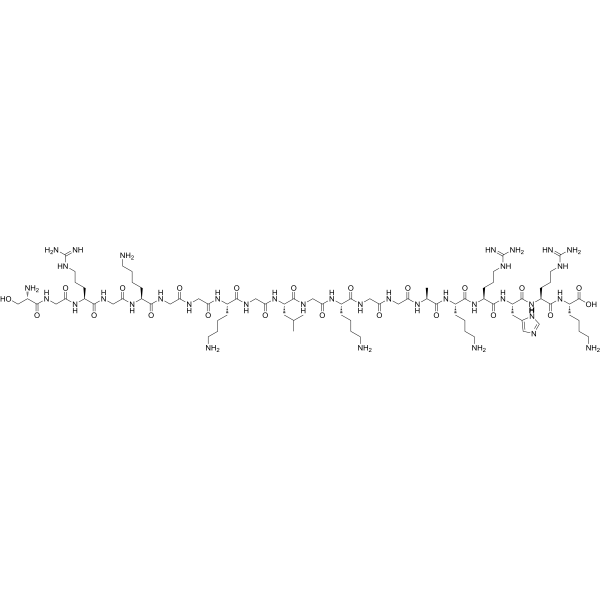
Chemical Structure
Histone H4 (2-21)
- CAS. Nr.: 667899-73-2
- Formula:C82H150N36O22
- Molecular Weight:1992.30
InChIKey: RLPPOYIZNQZTDS-IVVDQZOQSA-N
SMILES: NCCCC[C@@H](C(O)=O)NC([C@H](CCCNC(N)=N)NC([C@@H](NC([C@H](CCCNC(N)=N)NC([C@H](CCCCN)NC([C@H](C)NC(CNC(CNC([C@H](CCCCN)NC(CNC([C@H](CC(C)C)NC(CNC([C@H](CCCCN)NC(CNC(CNC([C@H](CCCCN)NC(CNC([C@H](CCCNC(N)=N)NC(CNC([C@@H](N)CO)=O)=O)=O)=O)=O)=O)=O)=O)=O)=O)=O)=O)=O)=O)=O)=O)=O)CC1=CN=CN1)=O)=O
Biological Activity: Histone H4 (2-21) is a substrate peptide derived from the N-terminal region of histone H4, which serves as an acyl acceptor for lysine acetyltransferases of the MYST family (KAT). Histone H4 (2-21) participates in enzymatic reactions together with acyl-coenzyme A (acyl-CoA, and undergoes lysine acetylation and propionylation modifications catalyzed by KATs such as MOF. The apparent Km of Histone H4 (2-21) for MOF is 788.8 μM, while in the picNuA4 catalytic system, the Km and Kd values of the H4 peptide are 192 μM and 251 μM, respectively. Histone H4 (2-21) can be used in studies related to histone post-translational modifications, epigenetic regulation, and lysine acylation[1][2][3].
| Art. -Nr. | Produktname | Reinheit | Beschreibung | Pricing | |||||||||||||||||||
|---|---|---|---|---|---|---|---|---|---|---|---|---|---|---|---|---|---|---|---|---|---|---|---|
|
|
Histone H4 (2-21) | 99.22% | Histone H4 (2-21) is a substrate peptide derived from the N-terminal region of histone H4, which serves as an acyl acceptor for lysine acetyltransferases of the MYST family (KAT). Histone H4 (2-21) participates in enzymatic reactions together with acyl-coenzyme A (acyl-CoA, and undergoes lysine acetylation and propionylation modifications catalyzed by KATs such as MOF. The apparent Km of Histone H4 (2-21) for MOF is 788.8 μM, while in the picNuA4 catalytic system, the Km and Kd values of the H4 peptide are 192 μM and 251 μM, respectively. Histone H4 (2-21) can be used in studies related to histone post-translational modifications, epigenetic regulation, and lysine acylation. | ||||||||||||||||||||
|
loading...
/
|
|||||||||||||||||||||||
-
Similarity Score 0.92
 HY-P11724Histone H4 peptide substrate (1-21)
-
Similarity Score 0.72
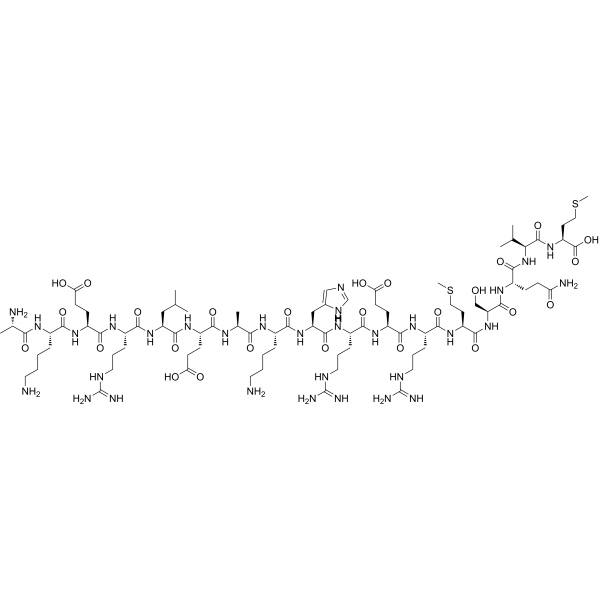 HY-P10180β-Amyloid/A4 Protein Precusor (319-335)
-
Similarity Score 0.71
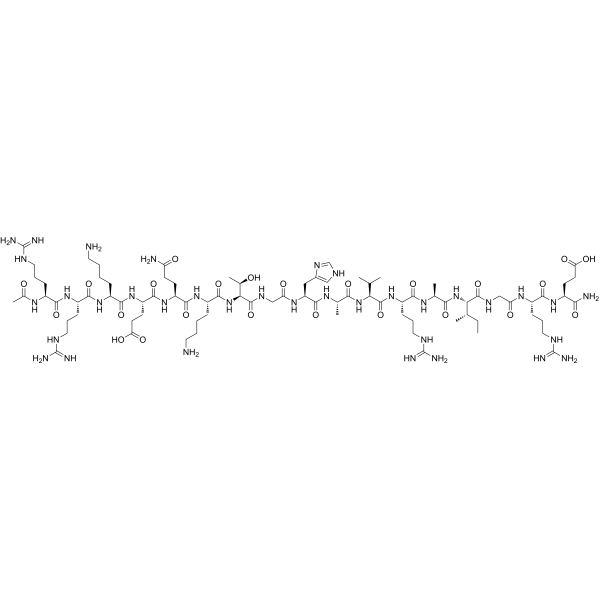 HY-P10166MLCK Peptide, control
-
Similarity Score 0.70
 HY-P10510R5 peptide
-
Similarity Score 0.69
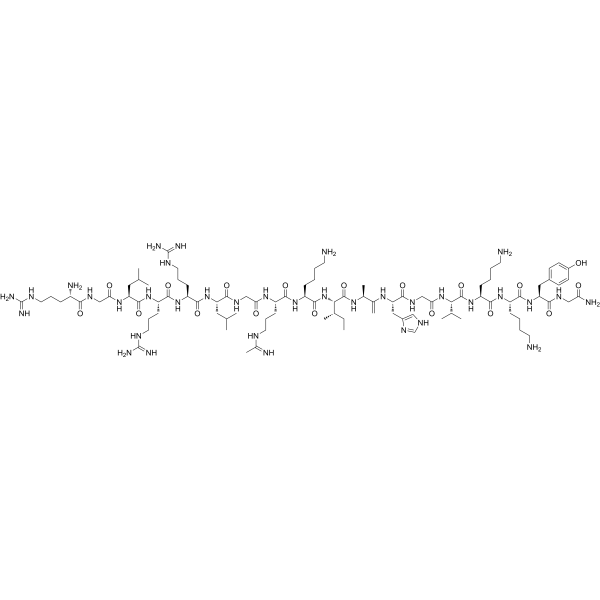 HY-P5484SMAP-18
-
Similarity Score 0.69
 HY-P4984Toxic Shock Syndrome Toxin-1 (TSST-1) (58-78)
-
Similarity Score 0.68
 HY-P10400AtPep1
-
Similarity Score 0.68
 HY-P4104pVEC (Cadherin-5)
-
Similarity Score 0.68
 HY-P0136SAMS
-

Explore the MedChemAI to find more analogs


References
- [1]. Yang C, et al. Autoacetylation of the MYST Lysine Acetyltransferase MOF Protein. J Biol Chem. 2012;287(42):34917-34926. [Content Brief]
- [2]. Han Z, et al. Revealing the protein propionylation activity of the histone acetyltransferase MOF (males absent on the first). The Journal of biological chemistry. 2018 Mar 02;293(9):3410-3420. [Content Brief]
- [3]. Berndsen CE, et al. Catalytic mechanism of a MYST family histone acetyltransferase. Biochemistry. 2007 Jan 23;46(3):623-9. [Content Brief]



