1. Search Result
Search Result
Results for "

methyl oxidation product

" in MedChemExpress (MCE) Product Catalog:

17

Inhibitors & Agonists

7

Natural
Products

1

Isotope-Labeled Compounds

2

Oligonucleotides

Cat. No. Product Name Target Research Areas Chemical Structure
  • HY-100807R
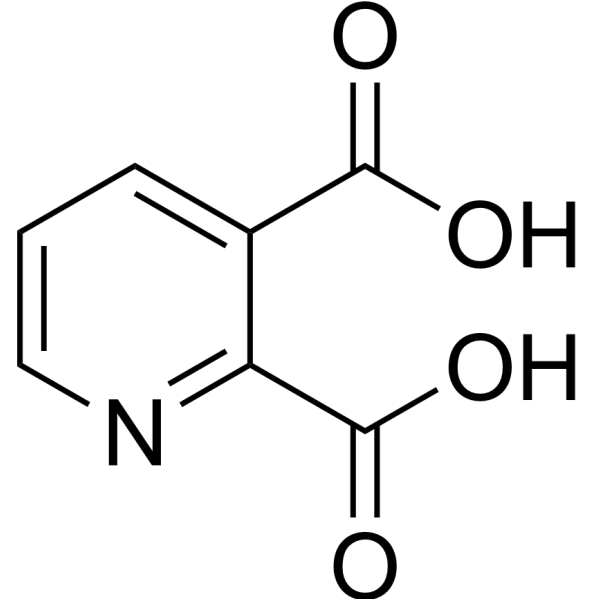
    Quinolinic acid (Standard)
    5+ Cited Publications

    Reference Standards iGluR Endogenous Metabolite Reactive Oxygen Species (ROS) NO Synthase Apoptosis Neurological Disease Inflammation/Immunology
    Quinolinic acid (Standard) is the analytical standard of Quinolinic acid. This product is intended for research and analytical applications. Quinolinic acid, an endogenous metabolite of tryptophan, is a N-methyl-D-aspartate receptor (NMDA receptor) agonist. Quinolinic acid increases glutamate efflux, induces the generation of ROS, activates nitric oxide synthase, produces excessive NO, leading to calcium ion influx and neuronal apoptosis.
    Quinolinic acid (Standard)
  • HY-W424779

    Drug Metabolite Infection
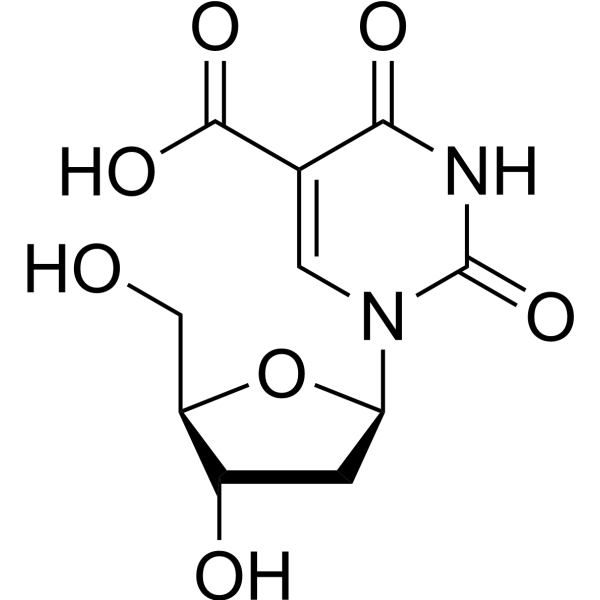
    5-Carboxy-2′-deoxyuridine is a metabolite of Trifluridine . 5-Carboxy-2′-deoxyuridine is a methyl oxidation product of Thymidine that can be formed by menadione-mediated photosensitization of Thymidine .
    5-Carboxy-2′-deoxyuridine
  • HY-W341499

    Endogenous Metabolite Others
    5-Formyl-2'-deoxyuridine is a product formed when the 5-methyl group of thymine in DNA undergoes oxidation due to exposure to gamma radiation or certain chemical agents. Serving as a biomarker of oxidative DNA damage, 5-formyl-2'-deoxyuridine is employed in investigations of DNA damage and repair mechanisms. Additionally, 5-Formyl-2'-deoxyuridine can be used in studies involving chemically crosslinking with peptides derived from the RecA protein .
    5-Formyl-2'-deoxyuridine
  • HY-W013507R

    Reference Standards NF-κB Reactive Oxygen Species (ROS) Glutathione Peroxidase Phytohormone Apoptosis Neurological Disease Inflammation/Immunology Cancer
    (rac)-Methyl jasmonate (Standard) is the analytical standard of Methyl jasmonate. This product is intended for research and analytical applications. (rac)-Methyl jasmonate is the racemate of Methyl jasmonate (HY-135663). Methyl jasmonate is a phytohormone that regulates the defense response of plants under biotic and biotic stress through jasmonate signaling pathway. Methyl jasmonate inhibits the activation of NF-κB signaling pathway. Methyl jasmonate can promote the mitochondrial ROS production, but also scavenges free radicals and reduces the oxidative stress. Methyl jasmonate exhibits anti-inflammatory, antitumor, anticonvulsant, antinociceptive and sedative activities .
    (rac)-Methyl jasmonate (Standard)
  • HY-Y0511R
    N,N-Dimethylglycine (Standard)
    1 Publications Verification

    Dimethylglycine (Standard); DMG (Standard); N-methylsarcosine (Standard)

    Reference Standards Endogenous Metabolite iGluR Amino Acid Derivatives Neurological Disease Metabolic Disease
    N,N-Dimethylglycine (Dimethylglycine) (Standard) is the analytical standard of N,N-Dimethylglycine (HY-Y0511). This product is intended for research and analytical applications. N,N-Dimethylglycine (Dimethylglycine), a natural N-methylated glycine, is a nutrient supplement and acts as an NMDAR glycine site partial agonist. N,N-Dimethylglycine is a methyl donor that can improve immunity, act as an antioxidant to prevent oxidative stress, and scavenge excess free radicals. N,N-Dimethylglycine has antidepressant-like and surfactant effects.
    N,N-Dimethylglycine (Standard)
  • HY-W087919

    Cytochrome P450 Others
    5-Methyl-2-furanmethanol is a natural product that can be isolated from the essential oil of D. rupicola Biv.. 5-Methyl-2-furanmethanol also acts as a oxidative product of 2,5 dimethylfuran (DMF) by cytochrome P450 (CYP) .
    5-Methyl-2-furanmethanol
  • HY-W424779R

    Reference Standards Drug Metabolite Infection
    5-Carboxy-2′-deoxyuridine (Standard) is the analytical standard of 5-Carboxy-2′-deoxyuridine. This product is intended for research and analytical applications. 5-Carboxy-2′-deoxyuridine is a metabolite of Trifluridine . 5-Carboxy-2′-deoxyuridine is a methyl oxidation product of Thymidine that can be formed by menadione-mediated photosensitization of Thymidine .
    5-Carboxy-2′-deoxyuridine (Standard)
  • HY-136374R

    Herbicide Reference Standards Others
    Haloxyfop-P-methyl (Standard) is the analytical standard of Haloxyfop-P-methyl. This product is intended for research and analytical applications. Haloxyfop-P-methyl is an aryloxyphenoxypropionate herbicide. Haloxyfop-P-methyl can be absorbed by roots or foliage and hampers lipogenesis and increases oxidative stress in target plants .
    Haloxyfop-P-methyl (Standard)
  • HY-B2053R

    Reference Standards Bacterial Infection
    Tolclofos-methyl (Standard) is the analytical standard of Tolclofos-methyl (HY-B2053). This product is intended for research and analytical applications. Tolclofos-methyl is an organophosphorus fungicide. Tolclofos-methyl undergoes photoinduced oxidative degradation to form oxo-analog derivatives. Tolclofos-methyl inhibits spore division in fungi and oomycetes, induces cytoplasmic leakage, and interferes with flagellar movement. Tolclofos-methyl is rapidly metabolized and excreted in rodents. Tolclofos-methyl can be used in studies related to fungal infections .
    Tolclofos-methyl (Standard)
  • HY-Z3685R

    Reference Standards
    4-((4-ethoxy-3-(1-methyl-7-oxo-3-propyl-6,7-dihydro-1H-pyrazolo[4,3-d]pyrimidin-5-yl)phenyl)sulfonyl)-1-methylpiperazine 1-oxide (Sildenafil Impurity) (Standard) is the analytical standard of 4-((4-ethoxy-3-(1-methyl-7-oxo-3-propyl-6,7-dihydro-1H-pyrazolo[4,3-d]pyrimidin-5-yl)phenyl)sulfonyl)-1-methylpiperazine 1-oxide (Sildenafil Impurity). This product is intended for research and analytical applications.
    Sildenafil impurity 1 (Standard)
  • HY-167926S

    Isotope-Labeled Compounds Inflammation/Immunology
    Mycophenolic Acid-d3 beta-D-Glucuronide is the deuterium labeled 3-Bromo-4,5-dihydroxybenzoic acid methyl ester (HY-167926). 3-Bromo-4,5-dihydroxybenzoic acid methyl ester is a marine-derived natural product known for its biological activity, specifically showcasing antioxidant properties and potential therapeutic applications against oxidative stress-related diseases.
    Mycophenolic Acid-d3 beta-D-Glucuronide
  • HY-W087919R

    Reference Standards Others Others
    5-Methyl-2-furanmethanol (Standard) is the analytical standard of 5-Methyl-2-furanmethanol. This product is intended for research and analytical applications. 5-Methyl-2-furanmethanol is a natural product that can be isolated from the essential oil of D. rupicola Biv.. 5-Methyl-2-furanmethanol also acts as a oxidative product of 2,5 dimethylfuran (DMF) by cytochrome P450 (CYP)[1][2].
    5-Methyl-2-furanmethanol (Standard)
  • HY-W016099R

    MQCA (Standard)

    Drug Metabolite Reference Standards Cancer
    3-Methyl-2-quinoxalinecarboxylic acid (Standard) is the analytical standard of 3-Methyl-2-quinoxalinecarboxylic acid. This product is intended for research and analytical applications. 3-Methyl-2-quinoxalinecarboxylic acid (MQCA), an important N-oxide reductive metabolite of Quinocetone or Olaquindox, potently inhibits the growth of Chang liver cells through S phase arrest of the cell cycle .
    3-Methyl-2-quinoxalinecarboxylic acid (Standard)
  • HY-N6669R

    M3OMG (Standard)

    Others Reference Standards Neurological Disease
    Methyl 3-O-methylgallate (Standard) (M3OMG (Standard)) is the analytical standard of Methyl 3-O-methylgallate (HY-N6669). This product is intended for research and analytical applications. Methyl 3-O-methylgallate (M3OMG) possesses antioxidant effect and can protect neuronal cells from oxidative damage .
    Methyl 3-O-methylgallate (Standard)
  • HY-167926

    Others Inflammation/Immunology
    3-Bromo-4,5-dihydroxybenzoic acid methyl ester is a marine-derived natural product known for its biological activity, specifically showcasing antioxidant properties and potential therapeutic applications against oxidative stress-related diseases.
    3-Bromo-4,5-dihydroxybenzoic acid methyl ester
  • HY-W585888

    Reactive Oxygen Species (ROS) Others
    Fructose-isoleucine, an amadori compound, is an aroma precursor that formed in the initial phase of the Maillard reaction (MR). Fructose-isoleucine can be isolated from tobacco. Fructose-isoleucine can be isolated from tobacco, miso and white wine. Fructose-isoleucine significantly induces oxidative browning and correlates Maillard product (such as Maltol, furaneol and 5-methyl furfural) with a roasted and sweet aroma. Fructose-isoleucine can be used for food industry and tobacco processing research .
    Fructose-isoleucine
  • HY-A0169AR

    Reactive Oxygen Species (ROS) Reference Standards Photosensitizer Inflammation/Immunology Cancer
    Methyl aminolevulinate hydrochloride (Standard) is the analytical standard of Methyl aminolevulinate hydrochloride. This product is intended for research and analytical applications. Methyl aminolevulinate hydrochloride is a sensitizer used in photodynamic therapy (PDT). Methyl aminolevulinate hydrochloride penetrates the skin and induces the production of photoactive porphyrins including protoporphyrin IX in cells; upon exposure to appropriate light, it generates ROS, which triggers cellular oxidation and cell death. Methyl aminolevulinate hydrochloride acts as a photo-damage reversing agent through epidermal reconstruction, cytokine-mediated activation of dermal fibroblasts, elastin breakdown, new collagen formation, and compression of dilated capillaries. Methyl aminolevulinate hydrochloride reduces the expression of the proliferation marker Ki-67 and the early skin carcinogenesis marker TP53. Methyl aminolevulinate hydrochloride delays the onset of ultraviolet-induced skin tumors and reduces tumor burden in hairless mice. Methyl aminolevulinate hydrochloride is applicable to research related to actinic keratosis and basal cell carcinoma .
    Methyl aminolevulinate hydrochloride (Standard)

Inquiry Online

Your information is safe with us. * Required Fields.

Salutation


Country or Region *

Applicant Name *


Organization Name *

Department *


Email Address *


Product Name *

Cat. No.


Requested quantity *

Phone Number *


Remarks

Inquiry Online

Inquiry Information

Product Name:
Cat. No.:
Quantity:
MCE Japan Authorized Agent:

