14 Results for "

orthosteric pocket

" in MedChemExpress (MCE) Product Catalog:
Products (14)

14 Results for "orthosteric pocket" in MCE Product Catalog:

1
1 Cited Publications
Cat. No.: HY-W011417
CAS No.: 606-59-7
Research Areas:  

Others

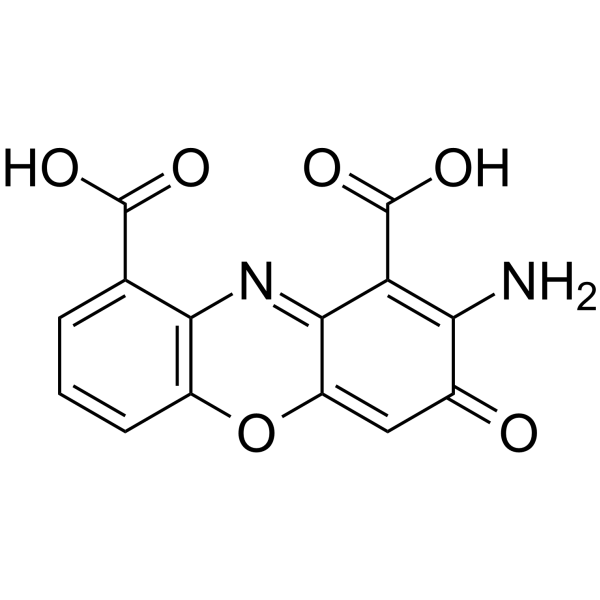
Cinnabarinic acid is a specific orthosteric agonist of mGlu4 by interacting with residues of the glutamate binding pocket of mGlu4, has no activity at other mGlu receptors. Cinnabarinic acid is an endogenous metabolite of the kynurenine pathway of tryptophan. Cinnabarinic acid induces cell apoptosis .
loading...
    loading...
Cat. No.: HY-156815
CAS No.: 3077715-58-0
Purity:  99.96%
Target:  

Orphan GPCR

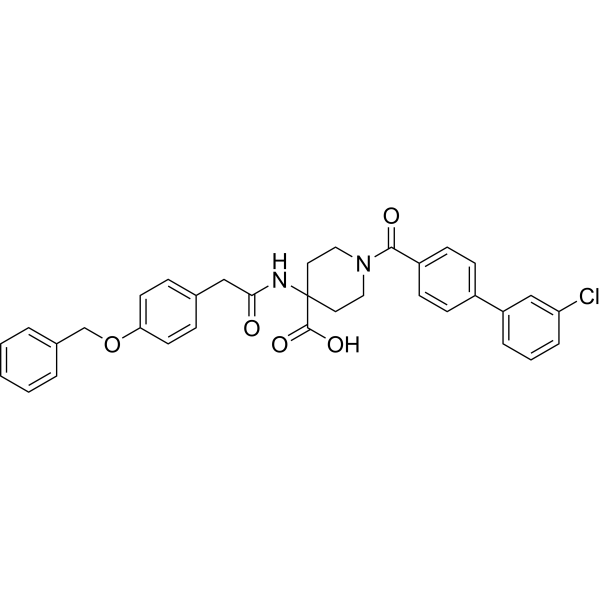
YL-365 is a potent and selective GPR34 antagonist with an IC50 of 17 nM. YL-365 binds to a portion of the orthosteric binding pocket of GPR34 and induces allosteric changes that stabilize the receptor in an inactive conformation. YL-365 down-regulates expression of the proinflammatory gene iNOS in M1 microglia and suppresses proinflammatory responses. YL-365 reduces mechanical allodynia in a dose-dependent manner in a mouse model of neuropathic pain. YL-365 can be used for the research of neuropathic pain .
loading...
    loading...
Cat. No.: HY-W011417R
CAS No.: 606-59-7
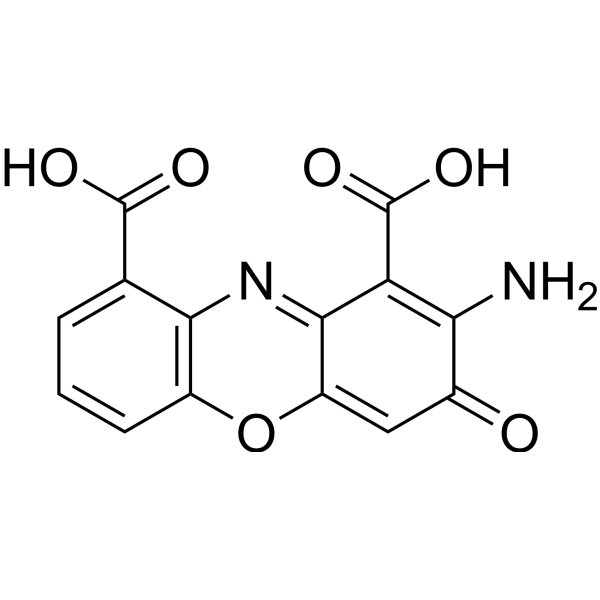
Cinnabarinic acid (Standard) is the analytical standard of Cinnabarinic acid. This product is intended for research and analytical applications. Cinnabarinic acid is a specific orthosteric agonist of mGlu4 by interacting with residues of the glutamate binding pocket of mGlu4, has no activity at other mGlu receptors. Cinnabarinic acid is an endogenous metabolite of the kynurenine pathway of tryptophan. Cinnabarinic acid induces cell apoptosis .
loading...
    loading...
Cat. No.: HY-123813
CAS No.: 1226686-36-7
Purity:  98.73%
Target:  

CXCR Arrestin

Research Areas:  

Cancer

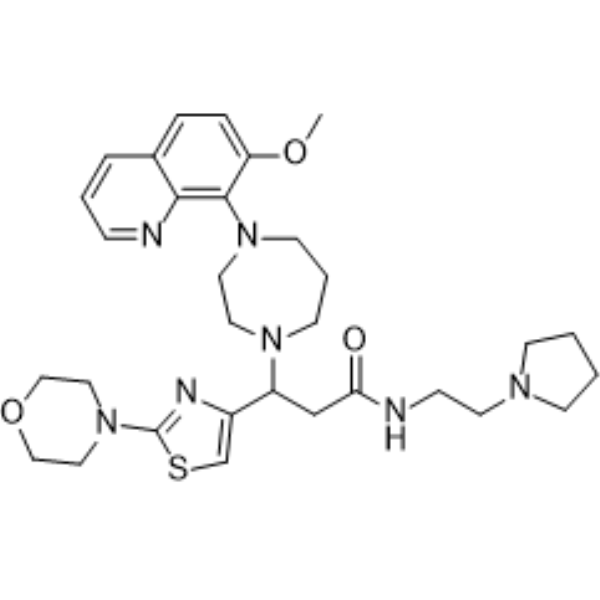
CCX-777 is an orthosteric binder and partial agonist of CXCR7/ACKR3. CCX-777 induces the recruitment of β-arrestin 2 and affects the rebinding of chemokines to ACKR3. CCX-777 functions to stabilize the ACKR3 receptor and promotes the formation of a monodisperse, stable complex of the receptor in DDM/CHS micelles. CCX-777 is widely used in cancer-related research .
loading...
    loading...
Cat. No.: HY-W668775
CAS No.: 871100-12-8
Quin-C7 is an orally active FPR2/ALX antagonist. Quin-C7 binds to the orthosteric ligand-binding pocket of FPR2/ALX, modulates receptor activation, and inhibits pro-inflammatory ERK signaling mediated by serum amyloid A (SAA). Quin-C7 reduces pro-inflammatory mediators TNF-α levels, increases anti-inflammatory IL-10, decreases inflammatory neutrophils and pro-inflammatory M1 macrophages, downregulates ERK1/2 phosphorylation, and upregulates JNK1/2/3 phosphorylation. Quin-C7 blocks FPR2/mFpr2 signaling, reduces brain lesion volume. Quin-C7 can be used for the research of inflammatory bowel disease and neuromyelitis optica spectrum disorder .
loading...
    loading...
Cat. No.: HY-178234
CAS No.: 1892576-07-6
Target:  

GPR84

Research Areas:  

Inflammation/Immunology

LY237 is a potent GPR84 full agonist, with EC50 values of 0.189 nM and 0.07 nM in cAMP inhibition assay and calcium flux assay, respectively. LY237 binds to the amphipathic orthosteric pocket of GPR84, stabilizes the active conformation of the receptor, and promotes its coupling with Gαi protein. LY237 can be used in research related to ulcerative colitis, fibrotic diseases, non-alcoholic steatohepatitis, and acute respiratory distress syndrome .
loading...
    loading...
Cat. No.: HY-187560
Target:  

5-HT Receptor

Research Areas:  

Neurological Disease

VCU-1012 is a serotonin 2A receptor (5-HT2AR) agonist, with a pEC50 of 5.81 and a pKi of 5.75 against human receptors. VCU-1012 binds to the canonical orthosteric binding pocket of 5-HT2AR, triggers intracellular calcium release and Gαq protein dissociation, and its agonistic activity depends on specific amino acid residues in the receptor binding pocket. VCU-1012 can be used in research related to depression, anxiety disorders, and chemotherapy-induced mood disorders .
loading...
    loading...
Cat. No.: HY-L942
1,626 compounds

Unlike highly conserved orthosteric sites, allosteric sites exhibit low conservation, high hydrophobicity, weak polarity, confined geometry, and dynamic cryptic properties. Rather than rigid keyhole-like cavities, they typically appear as flexible grooves, subunit interface clefts, or shallow depressions formed by protein conformational changes.

Based on the dynamic, hydrophobic, and elongated nature of allosteric pockets, MCE has carried out targeted fragment modification and screening under strict physicochemical criteria: MW 120–280 Da, HBD ≤ 2, HBA ≤ 3, PSA 30–80 Ų, rotatable bonds ≤ 2, cLogP 1–3.5. High 3D diversity was further ensured by PMI analysis, yielding fragments with excellent shape complementarity to allosteric pockets.

This library contains 1,800 structurally diverse, drug-like fragments, this library supports allosteric drug development and pocket optimization. It significantly improves screening hit rates and enables efficient, precise early-stage R&D of allosteric drugs.

Cat. No.: HY-187536
CAS No.: 129281-28-3
Research Areas:  

Neurological Disease

SYA16263 is a dopamine D2 receptor (D2R) and serotonin 1A receptor (5-HT1AR) ligand, with Ki values of 1.24 nM and 0.67 nM for D2R and 5-HT1AR, respectively. SYA16263 stabilizes the inactive conformation of D2R and 5-HT1AR via interactions with specific amino acid residues in their orthosteric binding pockets, thereby blocking downstream signal transduction. SYA16263 can be used in research related to schizophrenia and psychosis .
loading...
    loading...
Cat. No.: HY-187537
5-HT2AR ligand-2 is a serotonin 2A receptor (5-HT2AR) ligand with a Ki value of 11.4 nM. 5-HT2AR ligand-2 stabilizes the inactive conformation of receptors by interacting with specific amino acid residues in the orthosteric binding pockets of D2R and 5-HT2AR, thereby blocking downstream signal transduction. 5-HT2AR ligand-2 can be used in studies related to schizophrenia .
loading...
    loading...
Cat. No.: HY-L928
7,106 compounds

G protein-coupled receptors (GPCRs) are membrane proteins in humans and one of the most important targets in drug discovery. Approximately 35% of launched drugs are targeted GPCRs, making them a crucial class of targets in drug discovery.

The orthosteric site of a GPCR is its endogenous ligand’s (such as neurotransmitters or hormones) binding site. This site plays a central role in signal transduction. Small molecules binding to this site typically contain a protonatable amino group, enabling the formation of salt bridges or hydrogen bonds with acidic residues in the binding pocket. In contrast, the allosteric site does not directly initiate signaling but modulates the signal intensity of the GPCR by altering or stabilizing the conformation of the orthosteric site. Small molecules binding to the allosteric site often contain multiple aromatic rings to occupy hydrophobic pockets and achieve their functional effects.

MCE has collected over 7,106 reported bioactive molecules targeting GPCRs, covering Class A, B, and C GPCRs. These small molecules were subjected to AI representation to extract 2D and 3D features. Subsequently, we do screening by AI score based on similarity to identify molecules in diversity library highly similar to the reported bioactive molecules in both 2D and 3D, with a threshold greater than 0.7. Further screening based on cLogP was applied to select molecules with good lipophilicity, which facilitates the binding of small molecules to GPCRs. This diversity library can be widely applied to the discovery of compounds targeting GPCR proteins.

Cat. No.: HY-182404
CAS No.: 337495-81-5
Research Areas:  

Cancer

Anticancer agent 316 (Compound 1) is an anticancer agent. Anticancer agent 316 exerts anticancer activity against colorectal cancers expressing GPR120. Anticancer agent 316 can be used in the research of colorectal cancer .
loading...
    loading...
Cat. No.: HY-W414109
CAS No.: 1172882-21-1
Research Areas:  

Neurological Disease

ID110460002 possesses both full agonist activity at the μ-opioid receptor (OPRM) and agonist activity at the δ-opioid receptor (OPRD). ID110460002 acts as a potent agonist for the G protein pathways of both receptors, but exhibits only very weak partial agonist activity towards the β-arrestin-2 pathway. The agonistic potency of ID110460002 at OPRM has extremely high intrinsic activity and is unaffected by reduced receptor expression levels, while its potency at OPRD depends on receptor expression levels. ID110460002 displays tissue- or organ-dependent properties, and serves as a critical compound for investigating pain mechanisms and analgesia .
loading...
    loading...
Cat. No.: HY-L941
4,236 compounds

Orthosteric sites are highly conserved, leading to poor subtype selectivity, off-target toxicity and drug resistance in traditional drugs. By contrast, allosteric sites show low conservation, high hydrophobicity, weak polarity, confined geometry and dynamic cryptic properties, granting modulators high selectivity, functional tunability and safety. Thus, allosteric therapy has become a major focus in drug discovery.

MCE curated nearly 1,000 clinical-stage allosteric modulators, analyzed PDB complex structures to identify key pharmacophores and privileged scaffolds, then designed and filtered compounds using rational “scaffold derivation + physicochemical screening” with strict property criteria. The resulting compounds show high rigidity and shape complementarity to shallow, dynamic, hydrophobic allosteric pockets.

This library comprises 4,315 diverse, lead-like compounds ideal for allosteric drug discovery and target screening, covering kinases, GPCRs and more. All are analogs of clinical-stage molecules with similarity > 0.6, combining high druggability and allosteric binding potential to support efficient early-stage R&D.

  • 1

