1. Search Result
Search Result
Results for "

photocatalytic

" in MedChemExpress (MCE) Product Catalog:

23

Inhibitors & Agonists

5

Fluorescent Dyes

7

Biochemical Assay Reagents

1

Isotope-Labeled Compounds

Cat. No. Product Name Target Research Areas Chemical Structure
  • HY-W075707
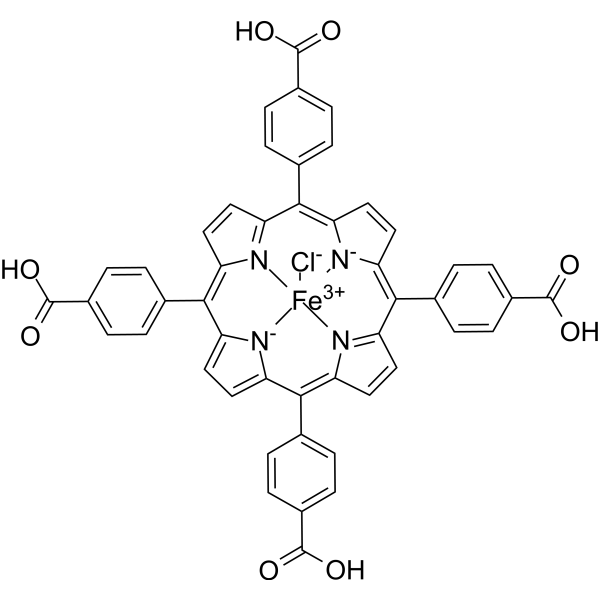
    FeTCPP chloride
    1 Publications Verification

    Iron(III) meso-Tetra(4-carboxyphenyl)porphine chloride

    MOFs Others
    FeTCPP chloride (Iron(III) meso-Tetra(4-carboxyphenyl)porphine chloride) is a metallic porphyrin compound formed by the coordination of a central iron ion (Fe 3+) with four 4-carboxyphenylporphyrins (TCPP). FeTCPP chloride can be used as a catalyst for catalytic, electrochemical, photochemical and biomedical research. FeTCPP chloride has high photocatalytic performance for p-nitrophenol under visible light. FeTCPP chloride also has peroxisase-like activity, which is used in bionic catalysis research .
    FeTCPP chloride
  • HY-N1442

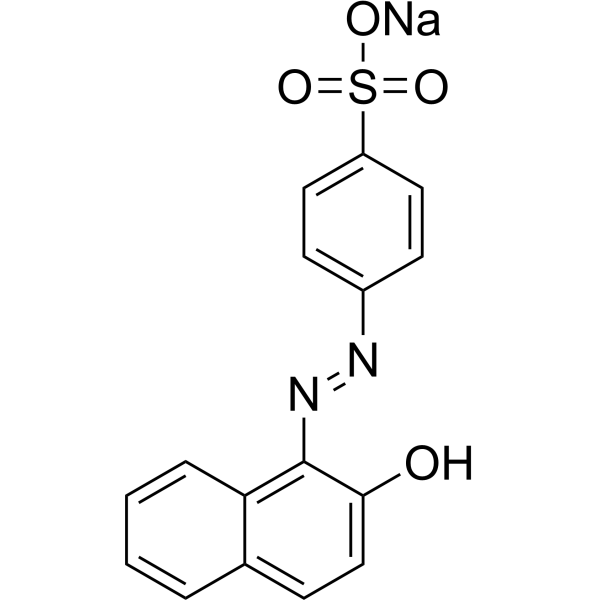
    Orange II; D&C Orange NO. 4

    Environmental Pollutants Biochemical Assay Reagents Others
    Acid Orange 7 (Orange II; D&C Orange NO. 4) is an azo dye widely used in the textile, food and cosmetic industries. Acid Orange 7 is mainly used as a colorant by combining with fibers and other substances through azo bonds. Acid Orange 7 has a maximum absorption wavelength at 484-485 nm, and the concentration is measured using a UV-visible spectrophotometer. Acid Orange 7 is difficult to degrade and has a certain degree of toxicity. It is often used to study various sewage treatment technologies and photocatalytic degradation reactions, and to evaluate the removal effects of different treatment methods on organic pollutants .
    Acid orange 7
  • HY-W110929

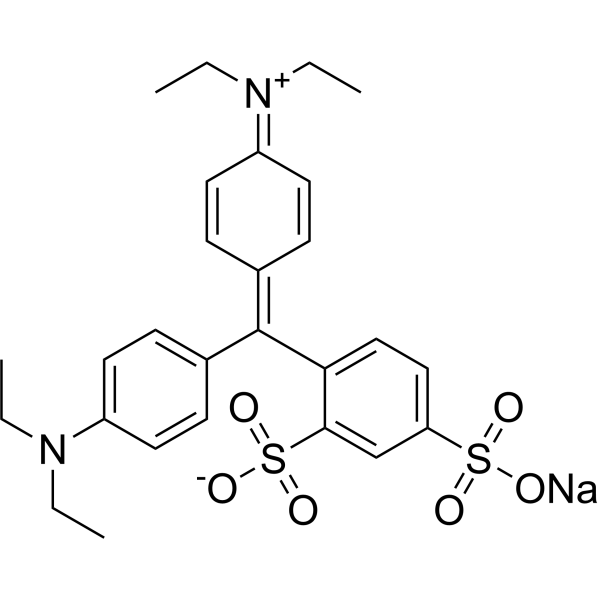
    Xylene blue; C.I. Acid blue 1

    Environmental Pollutants Biochemical Assay Reagents Others
    Acid blue 1 (Xylene blue) is an anionic triarylmethane dye and substrate for photocatalytic degradation .
    Acid blue 1
  • HY-W540000

    Biochemical Assay Reagents Others
    Graphitic carbon nitride is a metal-free photocatalyst with a semiconductor absorption wavelength of 460 nm. Graphitic carbon nitride can be applied to photocatalytic water splitting, degradation of organic pollutants, and carbon dioxide reduction .
    Graphitic carbon nitride
  • HY-34515

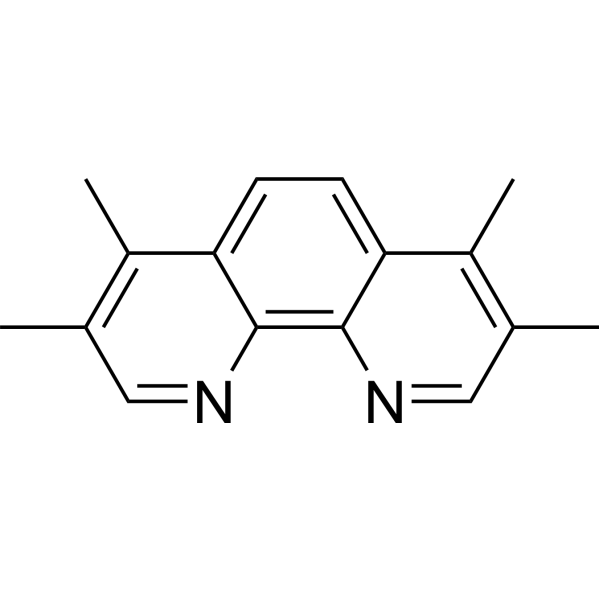
    TMPhen; 3,4,7,8-Tetramethyl-1,10-phenanthroline

    Biochemical Assay Reagents Others
    3,4,7,8-Tetramethyl-1,10-phenanthroline (TMPhen) is an organic molecule commonly used as a ligand or catalyst. It has a wide range of applications in different fields, such as organometallic chemical reactions, electrochemical detection, and organic optoelectronic devices. Due to its excellent performance in fluorescent probes, biosensors and photocatalytic reactions, it has been widely used in research in the fields of chemistry and life sciences.
    3,4,7,8-Tetramethyl-1,10-phenanthroline
  • HY-W010610

    Drug Intermediate Others
    2-Cyclopropylacetic acid is a substrate. 2-Cyclopropylacetic acid can produce a ring-opening product, which serves as an important precursor for the preparation of fused-ring molecules .
    2-Cyclopropylacetic acid
  • HY-W110910

    Biochemical Assay Reagents Infection
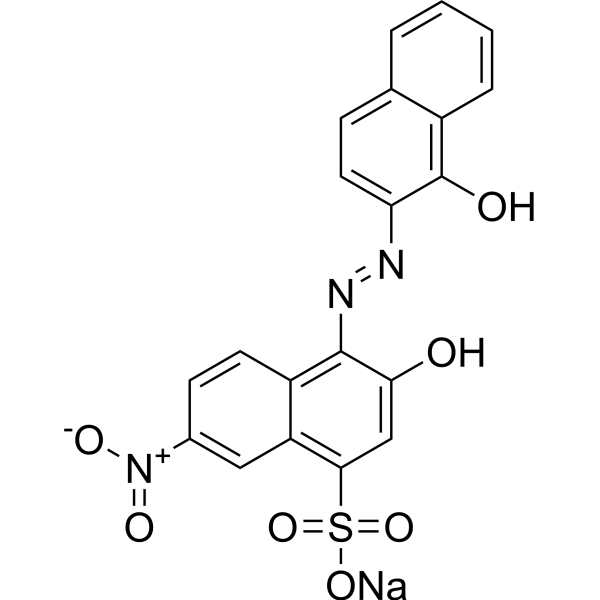
    Eriochrome black T, Indicator is a complexing agent for metal ions (e.g., Ca 2+, Mg 2+) and is used as an indicator in complexometric titrations. Eriochrome black T, Indicator forms colored complexes with metal ions through covalent coordination bonds, and indicates the endpoint of the titration by color change. Eriochrome black T, Indicator can be used as an anionic azo dye in photocatalytic degradation studies to evaluate the performance of photocatalysts. The reaction solution of Eriochrome black T, Indicator combined with Mg 2+ is initially purple. During loop-mediated isothermal amplification (LAMP), the color changes from purple to sky blue due to the consumption of Mg 2+ by the formation of magnesium pyrophosphate, indicating a positive reaction. The optimal concentration of Eriochrome black T, Indicator in LAMP is 60 μM, and the detection limit for Mycobacterium tuberculosis is 1 pg DNA/reaction .
    Eriochrome black T, Indicator
  • HY-W015777

    P-Methoxy-benzyl alcoho; (4-Methoxyphenyl)methanol

    Biochemical Assay Reagents Others
    4-Methoxybenzyl alcohol (P-Methoxy-benzyl alcohol; (4-Methoxyphenyl)methanol) is a Benzyl alcohol (HY-B0892) derivative, which is photocatalytically oxidized into p-anisaldehyde (PAA) in water. 4-Methoxybenzyl alcohol can undergo esterification reaction with α-lipoic acid .
    4-Methoxybenzyl alcohol
  • HY-W018584

    o-Phenoxyphenol

    Drug Derivative Others
    2-Phenoxyphenol (o-Phenoxyphenol) is the main product in the photocatalytic reduction and dechlorination reaction of Triclosan (HY-B1119). 2-Phenoxyphenol has low toxicity and can be recycled and utilized as a chemical raw material .
    2-Phenoxyphenol
  • HY-W008388

    N6-Benzoyladenosine

    Nucleoside Antimetabolite/Analog Others
    Bz-rA (N6-Benzoyladenosine) is a nucleoside derivative with an N6 protecting group. Bz-rA is mainly used as a synthetic intermediate to participate in photocatalytic oxidative cyclization reactions and synthesize oligoribonucleotides. Bz-rA can be used to efficiently construct heterocyclic skeletons in photochemical conversions and protect the ribose moiety to regulate the cyclization pathway .
    Bz-rA
  • HY-W017519

    Quinoxalin-2-one

    Drug Intermediate Others
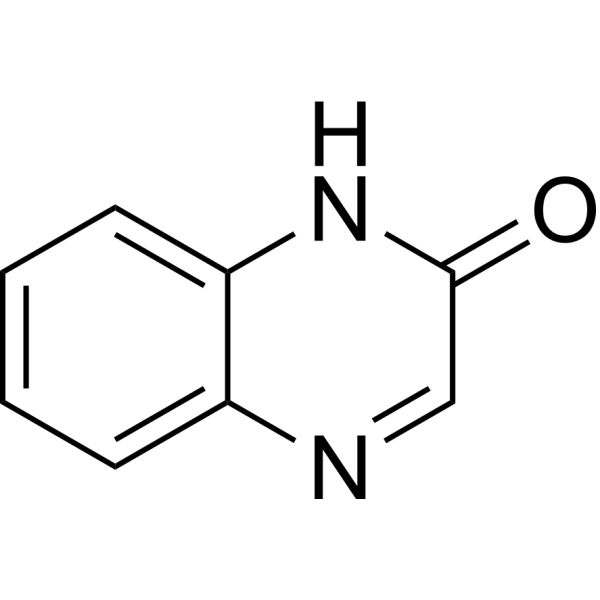
    2-Quinoxalinol (2-hydroxyquinoxaline) is a 2-hydroxylated quinoxaline that possesses photocatalytic activity and interacts with various compounds, such as antioxidant vitamins and aromatic metabolites, including neurotransmitters and the pineal hormone melatonin .
    2-Quinoxalinol
  • HY-W034041

    Tris(2-(4-fluorophenyl)pyridine)iridium; Tris[5-fluoro-2-(2-pyridinyl-kN)phenyl-kC]iridium(III)

    Endogenous Metabolite
    Ir(pF-ppy)3 (Tris(2-(4-fluorophenyl)pyridine)iridium) is a compound that catalyzes photoreactions and has excellent photocatalytic activity. Ir(pF-ppy)3 can be used as a catalyst in organic reactions, especially in photocatalytic synthesis. Ir(pF-ppy)3 shows its unique advantages in promoting electron transfer and improving reaction selectivity. Ir(pF-ppy)3 is also used to improve the efficiency of displays and solar cells.
    Ir(p-F-ppy)3
  • HY-W591060

    Biochemical Assay Reagents Endogenous Metabolite
    Bis(bipyridine)-(5-aminophenanthroline) is an organic catalyst with photocatalytic activity. The use of Bis(bipyridine)-(5-aminophenanthroline) in hematology involves its use as a stain for tissue diagnosis. Bis(bipyridine)-(5-aminophenanthroline) can be used as a transition metal catalyst in catalytic reactions. Bis(bipyridine)-(5-aminophenanthroline) has also been used in the study of ruthenium catalysts.
    Bisbipyridine-(5-aminophenanthroline)
  • HY-W145116

    Biochemical Assay Reagents
    [Ru(phen)3]Cl2 is an important photocatalyst with photosensitivity and has the activity of promoting reactions in the fields of organic synthesis and photoelectrochemistry. [Ru(phen)3]Cl2 can drive chemical reactions under light conditions and shows good catalytic performance. [Ru(phen)3]Cl2's applications include photocatalytic water decomposition and synthesis of complex organic molecules.
    [Ru(phen)3]Cl2
  • HY-W017519R

    Quinoxalin-2-one (Standard)

    Drug Intermediate Reference Standards Others
    2-Quinoxalinol (2-hydroxyquinoxaline) is a 2-hydroxylated quinoxaline that possesses photocatalytic activity and interacts with various compounds, such as antioxidant vitamins and aromatic metabolites, including neurotransmitters and the pineal hormone melatonin .
    2-Quinoxalinol (Standard)
  • HY-W015777R

    P-Methoxy-benzyl alcoho (Standard); (4-Methoxyphenyl)methanol (Standard)

    Reference Standards Biochemical Assay Reagents Others
    4-Methoxybenzyl alcohol (Standard) is the analytical standard of 4-Methoxybenzyl alcohol. This product is intended for research and analytical applications. 4-Methoxybenzyl alcohol (P-Methoxy-benzyl alcohol; (4-Methoxyphenyl)methanol) is a Benzyl alcohol (HY-B0892) derivative, which is photocatalytically oxidized into p-anisaldehyde (PAA) in water. 4-Methoxybenzyl alcohol can undergo esterification reaction with α-lipoic acid .
    4-Methoxybenzyl alcohol (Standard)
  • HY-162824

    Apoptosis Cancer
    Antitumor photosensitizer-6 (Compound Ru2) shows synergetic type I/II photosensitization and photocatalytic activity upon 595 nm light excitation. Ru2 induces intracellular redox imbalance and affects the biosynthetic and metabolic processes, leading to cell apoptosis. Antitumor photosensitizer-6 can be used for research of photodynamic therapy (PDT) .
    Antitumor photosensitizer-6
  • HY-W750212

    Orange II-13C6; D&C Orange NO. 4-13C6

    Isotope-Labeled Compounds Biochemical Assay Reagents Others
    Acid Orange 7- 13C6 (Orange II- 13C6) is the 13C-labeled Acid orange 7 (HY-N1442). Acid Orange 7 (Orange II; D&C Orange NO. 4) is an azo dye widely used in the textile, food and cosmetic industries. Acid Orange 7 is mainly used as a colorant by combining with fibers and other substances through azo bonds. Acid Orange 7 has a maximum absorption wavelength at 484-485 nm, and the concentration is measured using a UV-visible spectrophotometer. Acid Orange 7 is difficult to degrade and has a certain degree of toxicity. It is often used to study various sewage treatment technologies and photocatalytic degradation reactions, and to evaluate the removal effects of different treatment methods on organic pollutants .
    Acid Orange 7-13C6
  • HY-N1442R

    Orange II (Standard); D&C Orange NO. 4 (Standard)

    Biochemical Assay Reagents Reference Standards Others
    Acid orange 7 (Standard) is the analytical standard of Acid orange 7 (HY-1442). This product is intended for research and analytical applications. Acid Orange 7 (Orange II; D&C Orange NO. 4) is an azo dye widely used in the textile, food and cosmetic industries. Acid Orange 7 is mainly used as a colorant by combining with fibers and other substances through azo bonds. Acid Orange 7 has a maximum absorption wavelength at 484-485 nm, and the concentration is measured using a UV-visible spectrophotometer. Acid Orange 7 is difficult to degrade and has a certain degree of toxicity. Acid Orange 7 is often used to study various sewage treatment technologies and photocatalytic degradation reactions, and to evaluate the removal effects of different treatment methods on organic pollutants .
    Acid orange 7 (Standard)
  • HY-W072530

    Fluorescent Dye Others
    [Ir (ppy)2 (bpy)]PF6 is a cyclometalated iridium (III) photosensitizer. [Ir (ppy)2 (bpy)]PF6 can be used in homogeneous photocatalytic systems to achieve visible light-induced water splitting for hydrogen production. [Ir (ppy)2 (bpy)]PF6 functions in homogeneous photocatalytic systems for visible light-driven water splitting to produce hydrogen .
    [Ir(ppy)2(bpy)]PF6
  • HY-W075731

    Biochemical Assay Reagents Others
    (Ir[dF (F) ppy]2 (dCF3)) PF6 is a cyclometalated iridium (III) complex that is used in visible light-mediated photocatalytic organic transformations .
    (Ir[dF(F)ppy]2(dCF3))PF6
  • HY-W034053

    Fluorescent Dye Others
    Ir[p-F (Me) ppy]2 (dtbbpy) PF6 is a cyclometalated iridium (III) complex. Ir[p-F (Me) ppy]2 (dtbbpy) PF6 absorbs visible light (460 nm) to form a long-lived charge-separated excited state. Ir[p-F (Me) ppy]2 (dtbbpy) PF6 is applicable to visible light-mediated photocatalytic organic transformation reactions .
    Ir[p-F(Me)ppy]2(dtbbpy)PF6
  • HY-W441531

    Biochemical Assay Reagents
    2,3,7,8,12,13,17,18-Octaethyl-21H,23H-porphine manganese(III) chloride is a transition metal compound with excellent catalytic activity. 2,3,7,8,12,13,17,18-Octaethyl-21H,23H-porphine manganese(III) chloride is widely used in photocatalytic reactions to improve reaction efficiency. 2,3,7,8,12,13,17,18-Octaethyl-21H,23H-porphine manganese(III) chloride is also used in the preparation of optical materials, giving the materials excellent light absorption properties. The biological activity of 2,3,7,8,12,13,17,18-Octaethyl-21H,23H-porphine manganese(III) chloride has gradually attracted attention in the research of the medical field.
    2,3,7,8,12,13,17,18-Octaethyl-21H,23H-porphine manganese(III) chloride

Inquiry Online

Your information is safe with us. * Required Fields.

Salutation


Country or Region *

Applicant Name *


Organization Name *

Department *


Email Address *


Product Name *

Cat. No.


Requested quantity *

Phone Number *


Remarks

Inquiry Online

Inquiry Information

Product Name:
Cat. No.:
Quantity:
MCE Japan Authorized Agent:

