6 Results for "

rat liver slices

" in MedChemExpress (MCE) Product Catalog:
Products (6)

6 Results for "rat liver slices" in MCE Product Catalog:

Cat. No.: HY-B2091
CAS No.: 17243-38-8
Target:  

Antibiotic Bacterial

Research Areas:  

Infection

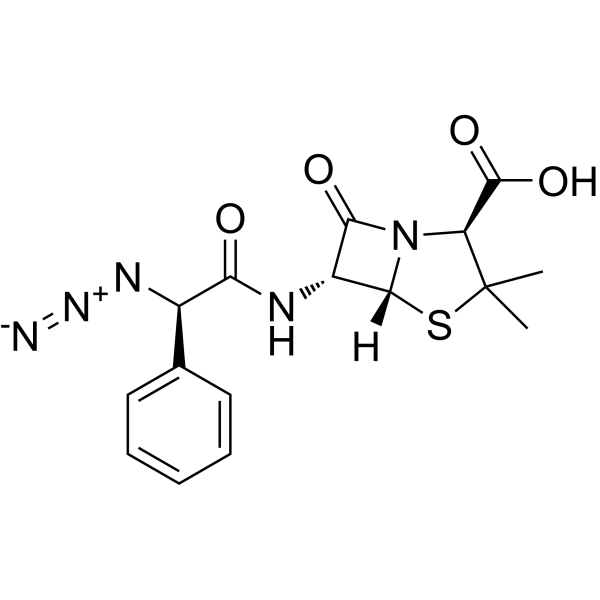
Azidocillin, a semi-synthetic Penicillin, is an orally active β-lactam antibiotic. Azidocillin bears an azide functionality and retains on-target activity within bacteria. Azidocillin can be used to research osteitis caused by dental surgery, otitis media, enterococcal septicemia and other bacterial infectious diseases . Azidocillin is a click chemistry reagent, it contains an Azide group and can undergo copper-catalyzed azide-alkyne cycloaddition reaction (CuAAc) with molecules containing Alkyne groups. It can also undergo strain-promoted alkyne-azide cycloaddition (SPAAC) reactions with molecules containing DBCO or BCN groups.
loading...
    loading...
Cat. No.: HY-174443
PROTAC sEH degrader-2 is a soluble epoxide hydrolase (sEH) PROTAC degrader, with pIC50 values of 8.37 and 7.12 against hsEH-H and msEH-H, respectively. PROTAC sEH degrader-2 induces targeted degradation of sEH via the ubiquitin-proteasome system, thereby completely blocking its dual functions as an epoxide hydrolase and a lipid phosphatase by bridging the short-branch exit of sEH with the CRBN E3 ubiquitin ligase. PROTAC sEH degrader-2 can be used in the research of neuroinflammation and Alzheimer's disease .
loading...
    loading...
Cat. No.: HY-121413
CAS No.: 3207-50-9
Target:  

Endogenous Metabolite

Research Areas:  

Others

Clinolamide is an N-cyclohexyl linoleamide. In a rat cholesterol metabolism study, feeding it at a dose of 0.3% for 21 days had no significant effect on serum, liver or kidney cholesterol levels, but had different effects on cholesterol synthesis in liver slices under different substrates and concentrations.
loading...
    loading...
Cat. No.: HY-D3087
CAS No.: 1966158-27-9
Target:  

Fluorescent Dye

Research Areas:  

Cancer

Lyso-OC is a two-photon fluorescent probe that enables real-time monitoring of autophagy through ultrasensitive detection of lysosomal polarity changes. Lyso-OC possesses a coumarin (HY-N0709) solvatochromic group and a morpholine lysosome-targeting group, allowing selective lysosomal localization in living cells. Lyso-OC emits strong fluorescence in low-polarity lysosomes, whereas in high-polarity autolysosomes formed during autophagy, its fluorescence intensity decreases and the emission peak shifts by approximately 30 nm. For two-photon detection, the excitation/emission wavelengths of Lyso-OC are 760/490-550 nm, and its one-photon excitation wavelength is 375 nm. Lyso-OC can be used in cancer-related research .
loading...
    loading...
Cat. No.: HY-N19001
CAS No.: 720-00-3
(rac)-5-Hydroxykynurenine is a urinary metabolite. (rac)-5-Hydroxykynurenine is generated via indole ring oxidative cleavage of 5-hydroxytryptophan (HY-N0122) catalyzed by indoleamine 2,3-dioxygenase .
loading...
    loading...
Cat. No.: HY-W051199
CAS No.: 4210-66-6
Synonyms: o-Phosphohomoserine
O-Phosphono-L-homoserine (o-Phosphohomoserine) is an intermediate in threonine synthesis in bacteria and plants, and can also be hijacked by MetM in some Streptomyces species to enter a novel methionine synthesis pathway. O-Phosphono-L-homoserine acts as a weak antagonist of the NMDA receptor. O-Phosphono-L-homoserine can be used as a substrate for studies on amino acid metabolism of the aspartate family, a control for mechanism studies of PLP enzymes, and a reference for structure-activity relationship studies of NMDA receptor ligands .
loading...
    loading...

