9 Results for "

target site resistance

" in MedChemExpress (MCE) Product Catalog:
Products (9)

9 Results for "target site resistance" in MCE Product Catalog:

1
1 Cited Publications
Cat. No.: HY-113138
CAS No.: 2140-69-4
Purity:  99.05%
Synonyms: N3-Methyluridine
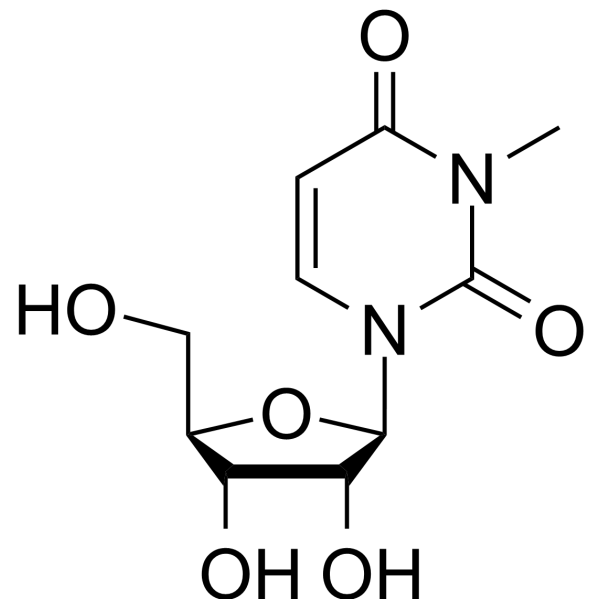
3-Methyluridine (m 3U; N3-Methyluridine) is a methylated nucleotide present in ribosomal RNA (rRNA), mainly targeting specific base sites of RNA molecules such as 23S rRNA. 3-Methyluridine can introduce a methyl group at the N3 position of uracil, affecting the secondary structure stability and base pairing ability of RNA, and regulating ribosome function. For example, it affects ribosomal subunit binding and tRNA interaction. 3-Methyluridine is often used as a key raw material for the synthesis of modified nucleotides, and is used to construct RNA oligonucleotides containing methylation modifications to study the effects of RNA methylation on gene expression and drug resistance .
loading...
    loading...
Cat. No.: HY-136426
CAS No.: 1258836-72-4
Purity:  98.76%
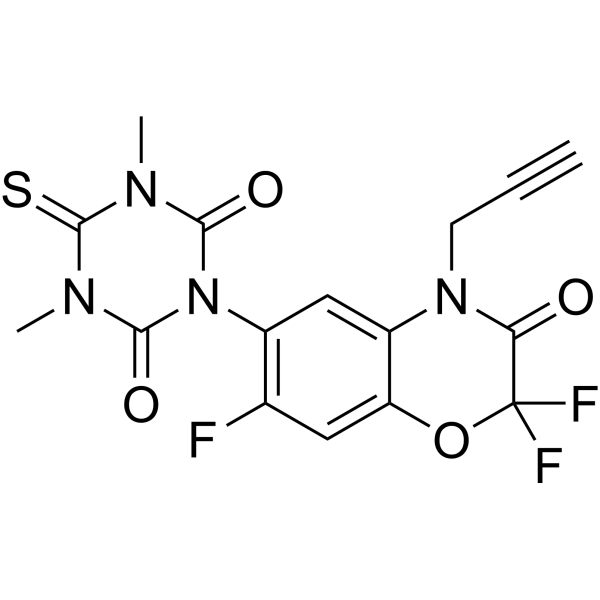
Trifludimoxazin is a click chemistry reagent, a protoporphyrinogen oxidase (PPO) inhibitor and herbicide. Trifludimoxazin inhibits PPO, accumulates reactive oxygen species, damages cell membranes, and thereby causes weed death. Trifludimoxazin exhibits high-efficiency activity in controlling broadleaf weeds and grassy weeds .
loading...
    loading...
Cat. No.: HY-148062
CAS No.: 2769753-48-0
Purity:  99.85%
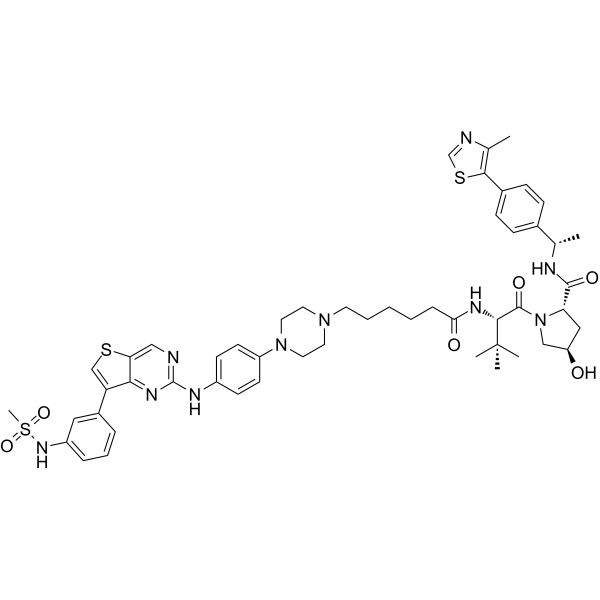
RSS0680 is a small noncoding RNA (sRNA) targeting the mRNA ribosome binding site (RBS) and a PROTAC. RSS0680 competitively binds to RBS through the conserved CCUCCUCCC anti-Shine-Dalgarno (aSD) sequence and inhibits the translation initiation of target genes. RSS0680 can interact with the DUF1127 protein CcaF1, regulate its own stability and participate in bacterial oxidative stress defense, enhancing the host's resistance to heat shock and oxidative damage by affecting pathways such as C1 metabolism and pyruvate dehydrogenase complex. RSS0680 degrades AAK1, CDK1, CDK16, CDK2, CDK4, CDK6, EIF2AK4, GAK, LATSl, LIMK2, MAPK6, MAPKAPK5, MARK2, MARK4, MKNK2, NEK9, RPS6KB1, SIK2, SNRK, STK17A, STK17B, STK35, and WEEl. RSS0680 can be used to study diseases or disorders mediated by aberrant kinase activity and regulatory mechanisms of noncoding RNAs in α-proteobacteria[1][2].
loading...
    loading...
Cat. No.: HY-121524
CAS No.: 1803242-21-8
Purity:  99.36%
Target:  

Microtubule/Tubulin

Research Areas:  

Cancer

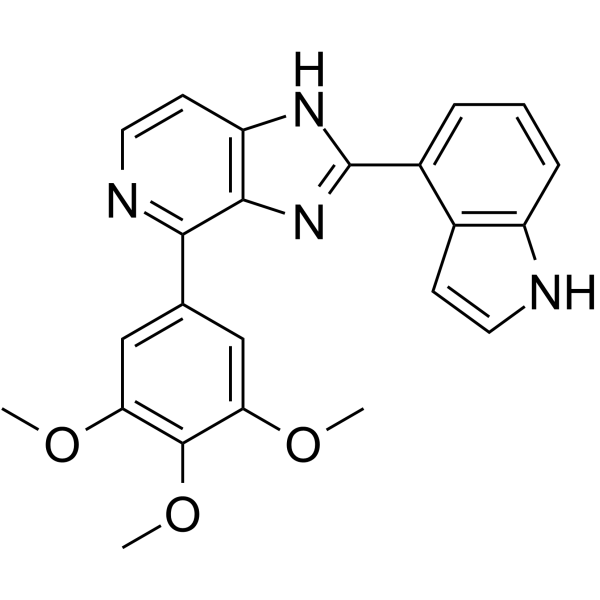
DJ101 is a potent and metabolically stable tubulin inhibitor. DJ101 targets the colchicine binding site and overcomes taxane resistance. DJ101 also inhibits melanoma tumor growth and lung metastasis. DJ101 can be used for prostate cancer research .
loading...
    loading...
Cat. No.: HY-115527
CAS No.: 902891-37-6
Target:  

SHP2

Research Areas:  

Cancer

SHP244 is a conformational inhibitor targeting the "latch allosteric site" (site 2) of the SHP2 protein with an IC50 value for SHP2 WT of 60 μM. SHP244 has no significant effect on the level of p-ERK alone. SHP244 combined with RMC-4550 (HY-116009) ("tunnel site" site 1 inhibitor) can reduce p-ERK and inhibit the rebound of p-ERK, thereby reducing drug resistance. SHP244 can be used to study drug resistance in FGFR-driven cancers .
loading...
    loading...
Cat. No.: HY-185314
CAS No.: 1848207-89-5
Research Areas:  

Others

Metproxybicyclone is a graminaceous herbicide. Metproxybicyclone also acts as an ACCase inhibitor, with an IC50 of 0.19 μM against Lolium multiflorum. Metproxybicyclone inhibits eukaryotic homomeric acetyl-CoA carboxylase, which catalyzes the first key step in fatty acid biosynthesis of graminaceous plants. Metproxybicyclone controls susceptible graminaceous weeds as well as graminaceous weed populations with target-site, non-target-site, and ACCase D2078G target-site resistance mechanisms. Metproxybicyclone is safe to dicotyledonous crops and is suitable for pre-plant burndown applications .
loading...
    loading...
Cat. No.: HY-L941
4,236 compounds

Orthosteric sites are highly conserved, leading to poor subtype selectivity, off-target toxicity and drug resistance in traditional drugs. By contrast, allosteric sites show low conservation, high hydrophobicity, weak polarity, confined geometry and dynamic cryptic properties, granting modulators high selectivity, functional tunability and safety. Thus, allosteric therapy has become a major focus in drug discovery.

MCE curated nearly 1,000 clinical-stage allosteric modulators, analyzed PDB complex structures to identify key pharmacophores and privileged scaffolds, then designed and filtered compounds using rational “scaffold derivation + physicochemical screening” with strict property criteria. The resulting compounds show high rigidity and shape complementarity to shallow, dynamic, hydrophobic allosteric pockets.

This library comprises 4,315 diverse, lead-like compounds ideal for allosteric drug discovery and target screening, covering kinases, GPCRs and more. All are analogs of clinical-stage molecules with similarity > 0.6, combining high druggability and allosteric binding potential to support efficient early-stage R&D.

Cat. No.: HY-LD004
14 million compounds

DEL technology enables the simultaneous screening of millions or billions of compounds in a single tube by covalently linking each small molecule with a unique DNA sequence. Traditional DEL screening primarily focuses on identifying non-covalent binding molecules, where interactions with the target are reversible. In contrast, DNA‑encoded covalent library is an ultra‑high‑throughput screening library developed on the basis of conventional DNA‑encoded library technology. It incorporates controllable electrophilic covalent warheads capable of forming irreversible covalent bonds with amino acid residues at the active sites of target proteins, including Cys, Lys, Ser, Tyr, and others. This covalent binding enhances binding affinity, prolongs residence time at the target site, and has the potential to overcome challenges associated with traditional non-covalent inhibitors, such as drug resistance or off-target effects.

Each compound in the library contains both a binding domain and an electrophilic warhead. It first recognizes and binds to the target through non covalent interactions, and then forms a stable covalent bond with key amino acid residues to achieve irreversible inhibition. This library is specifically designed for the discovery of potent, long lasting, and highly selective covalent inhibitors, particularly for undruggable targets such as kinases, GPCRs, proteases, and mutant oncoproteins. Each molecule is uniquely labeled with a DNA barcode for molecular identification and sequencing decoding.

This library is an advanced and highly diverse collection, consists of 35 independent sub-libraries with a total scaleof 14 million compounds, It incorporates over 14 experimentally validated covalent warheads capable of targeting cysteine, lysine, arginine, aspartic acid and glutamic acid. This library is constructed with diverse drug like core scaffolds and integrated controllable covalent warheads, it features structural diversity, reaction spec

Cat. No.: HY-113138R
CAS No.: 2140-69-4
Synonyms: N3-Methyluridine (Standard)
3-Methyluridine (Standard) is the analytical standard of 3-Methyluridine. This product is intended for research and analytical applications. 3-Methyluridine (m3U; N3-Methyluridine) is a methylated nucleotide present in ribosomal RNA (rRNA), mainly targeting specific base sites of RNA molecules such as 23S rRNA. 3-Methyluridine can introduce a methyl group at the N3 position of uracil, affecting the secondary structure stability and base pairing ability of RNA, and regulating ribosome function. For example, it affects ribosomal subunit binding and tRNA interaction. 3-Methyluridine is often used as a key raw material for the synthesis of modified nucleotides, and is used to construct RNA oligonucleotides containing methylation modifications to study the effects of RNA methylation on gene expression and drug resistance .
loading...
    loading...

