



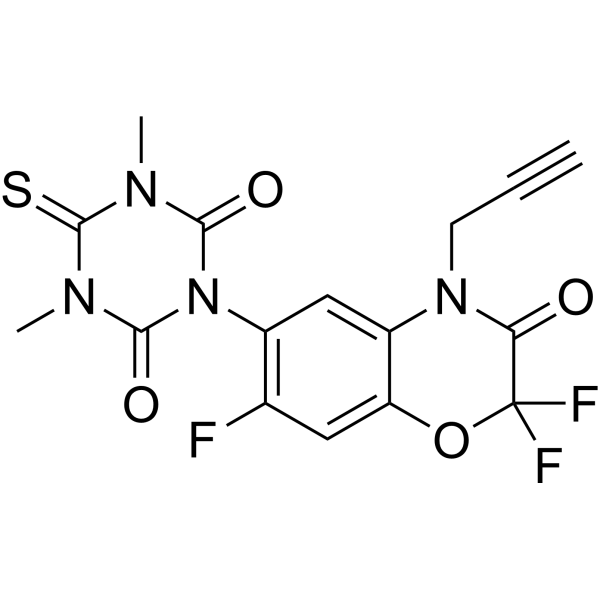
Trifludimoxazin

Based on 1 Customer Validation
Trifludimoxazin is a click chemistry reagent, a protoporphyrinogen oxidase (PPO) inhibitor and herbicide. Trifludimoxazin inhibits PPO, accumulates reactive oxygen species, damages cell membranes, and thereby causes weed death. Trifludimoxazin exhibits high-efficiency activity in controlling broadleaf weeds and grassy weeds.
For research use only. We do not sell to patients.
- Purity : 98.05%
- CAS No.: 1258836-72-4
- Formula: C16H11F3N4O4S
- Molecular Weight:412.34
-
Storage:Powder -20°C, 3 years ; In solvent -80°C, 6 months , -20°C, 1 month

To place orders, for customer services and technical support, please contact: MedChemExpress USA
Tel: 609-228-6898 E-mail: [email protected] [email protected]


-
 Biological Activity
-
Chemical Information
-
Solvent & Solubility
- Protocols
- Purity & Documentation
- References
-
 Help & FAQs




Biological Activity
Description
In Vitro
Trifludimoxazin potently inhibits wild-type and multiple mutant variants of purified A. tuberculatus PPO2 in vitro, with IC50 values as low as 2.45 × 10⁻¹⁰ M for wild-type enzyme, and retains inhibitory activity against most R128(X) ΔG210 double-mutant enzymes[1].
Trifludimoxazin (3.35-12.5 g a.i. ha-1; 7 days post-treatment) reduces growth of transgenic A. thaliana lines ectopically expressing R128(X) ΔG210 double-mutant A. tuberculatus PPO2 at field-relevant doses, with greater efficacy than saflufenacil for most tested mutant variants[1].
Trifludimoxazin maintains binding affinity to ΔG210, R128G, and G399A mutant A. tuberculatus PPO2 proteins via unique interactions with the enzyme's beta-sheet backbone, which are less affected by common target site mutations than interactions of other PPO inhibitors[1].
Trifludimoxazin (2-16 g ai ha-1; 7-20 d postapplication) effectively controls a range of annual broadleaf and grass weed species (including resistant Lolium perenne ssp. multiflorum) in greenhouse postemergence trials when assessed 7 and 20 d postapplication[2].
Trifludimoxazin (2.7 g ai ha-1; 24-72 h after application) shows moderate foliar uptake (20-29% for barnyardgrass, 41-90% for Italian ryegrass) with excellent metabolic stability in barnyardgrass and lower stability in Italian ryegrass, and does not translocate to roots in either grass species when assessed 24 and 72 h postapplication[2].
MedChemExpress (MCE) has not independently confirmed the accuracy of these methods. They are for reference only. Further protocols information, click here.
-
Cell Line:E. coli hemG mutants complemented with wild-type or mutant A. tuberculatus PPO2 proteins
-
Concentration:10-5 M (serial 1:5 dilutions in 60% dimethyl sulfoxide)
-
Incubation Time:24 h
-
Result:Inhibited growth of E.
coli hemG mutants expressing wild-type A.
tuberculatus PPO2 with an IC50 of 9.27 × 10⁻¹⁰ M.
Inhibited growth of mutants expressing ΔG210 single-mutant PPO2 with an IC50 of 1.18 × 10⁻⁹ M.
Inhibited growth of mutants expressing various R128(X) ΔG210 double-mutant PPO2 enzymes with IC50 values ranging from 9.86 × 10⁻⁹ M to 9.00 × 10⁻⁸ M.


Chemical Information
-
CAS No. 1258836-72-4
-
Appearance Solid
-
Molecular Weight 412.34
-
Formula C16H11F3N4O4S
-
Color Light yellow to khaki
-
SMILES
O=C(N(C1=C(F)C=C(OC(F)(F)C(N2CC#C)=O)C2=C1)C(N3C)=O)N(C)C3=S
-
Shipping
Room temperature in continental US; may vary elsewhere.
-
Storage
Powder -20°C 3 years In solvent -80°C 6 months -20°C 1 month


Solvent & Solubility
In Vitro:
DMSO : 100 mg/mL (242.52 mM; Need ultrasonic; Hygroscopic DMSO has a significant impact on the solubility of product, please use newly opened DMSO)
Please refer to the solubility information to select the appropriate solvent. Once prepared, please aliquot and store the solution to prevent product inactivation from repeated freeze-thaw cycles.
Storage method and period of stock solution: -80°C, 6 months; -20°C, 1 month. When stored at -80°C, please use it within 6 months. When stored at -20°C, please use it within 1 month.
Please refer to the solubility information to select the appropriate solvent. Once prepared, please aliquot and store the solution to prevent product inactivation from repeated freeze-thaw cycles.
Storage method and period of stock solution: -80°C, 6 months; -20°C, 1 month. When stored at -80°C, please use it within 6 months. When stored at -20°C, please use it within 1 month.
Concentration (start) × Volume (start) = Concentration (final) × Volume (final)

Protocols
-
EdU Incorporation Assay (Click Chemistry-Based DNA Synthesis Measurement)
The EdU incorporation assay measures DNA synthesis by adding the thymidine analog 5-ethynyl-2′-deoxyuridine to cells or tissues, where it is incorporated into newly synthesized DNA during S phase. Incorporated EdU is detected by copper-catalyzed azide-alkyne cycloaddition, in which a fluorescent azide covalently reacts with the ethynyl group on EdU, allowing S-phase cells to be detected by fluorescence microscopy, flow cytometry, or high-content imaging. EdU detection does not require DNA denaturation or anti-BrdU antibody access, which preserves sample structure and improves compatibility with immunostaining and multiparameter cytometry compared with BrdU-based detection. EdU can be cytotoxic in a cell-type- and exposure-dependent manner, so pulse duration, concentration, and continuous-labeling designs should be validated for each cell type.
-
ROS/oxidative-stress fluorescent staining
ROS/oxidative-stress fluorescent staining uses cell-permeant fluorogenic probes that become fluorescent after oxidation inside cells or tissues; commonly used examples include DCFH-DA/DCFDA for broad cellular oxidant detection, DHE for superoxide-related signal detection, MitoSOX for mitochondrial superoxide-related signal detection, and CellROX probes for oxidative-stress-associated fluorescence readouts. The assay detects probe oxidation rather than a single ROS species unless the probe and analysis method have been chemically validated for that species. DCFH-DA enters cells, is deacetylated by intracellular esterases to DCFH, and produces fluorescent DCF after oxidation, so the readout is used as an operational measure of total cellular oxidative stress rather than a species-specific ROS measurement. DHE and MitoSOX can report superoxide-related oxidation, but red fluorescence alone can include non-specific ethidium-like oxidation products; HPLC or optimized spectral approaches are


Purity & Documentation
-
Data Sheet (278 KB)
-
SDS (252 KB)
- English - EN (252 KB)
- Français - FR (252 KB)
- Deutsch - DE (252 KB)
- Norwegian - NO (252 KB)
- Español - ES (252 KB)
- Swedish - SV (252 KB)
- Italian - IT (252 KB)
- Korean - KR (252 KB)
- Portuguese - PT (252 KB)
-
Handling Instructions (2659 KB)
References


Complete Stock Solution Preparation Table
Please refer to the solubility information to select the appropriate solvent. Once prepared, please aliquot and store the solution to prevent product inactivation from repeated freeze-thaw cycles.
Storage method and period of stock solution: -80°C, 6 months; -20°C, 1 month. When stored at -80°C, please use it within 6 months. When stored at -20°C, please use it within 1 month.
| Optional Solvent | Concentration Solvent Mass | 1 mg | 5 mg | 10 mg | 25 mg |
|---|---|---|---|---|---|
| DMSO | 1 mM | 2.4252 mL | 12.1259 mL | 24.2518 mL | 60.6296 mL |
| 5 mM | 0.4850 mL | 2.4252 mL | 4.8504 mL | 12.1259 mL | |
| 10 mM | 0.2425 mL | 1.2126 mL | 2.4252 mL | 6.0630 mL | |
| 15 mM | 0.1617 mL | 0.8084 mL | 1.6168 mL | 4.0420 mL | |
| 20 mM | 0.1213 mL | 0.6063 mL | 1.2126 mL | 3.0315 mL | |
| 25 mM | 0.0970 mL | 0.4850 mL | 0.9701 mL | 2.4252 mL | |
| 30 mM | 0.0808 mL | 0.4042 mL | 0.8084 mL | 2.0210 mL | |
| 40 mM | 0.0606 mL | 0.3031 mL | 0.6063 mL | 1.5157 mL | |
| 50 mM | 0.0485 mL | 0.2425 mL | 0.4850 mL | 1.2126 mL | |
| 60 mM | 0.0404 mL | 0.2021 mL | 0.4042 mL | 1.0105 mL | |
| 80 mM | 0.0303 mL | 0.1516 mL | 0.3031 mL | 0.7579 mL | |
| 100 mM | 0.0243 mL | 0.1213 mL | 0.2425 mL | 0.6063 mL |


Trifludimoxazin Related Classifications
HY-136426 Related Classifications
 Powered by Bioz