6 Results for "

thylakoid membranes

" in MedChemExpress (MCE) Product Catalog:
Products (6)

6 Results for "thylakoid membranes" in MCE Product Catalog:

Cat. No.: HY-N9625
CAS No.: 126-29-4
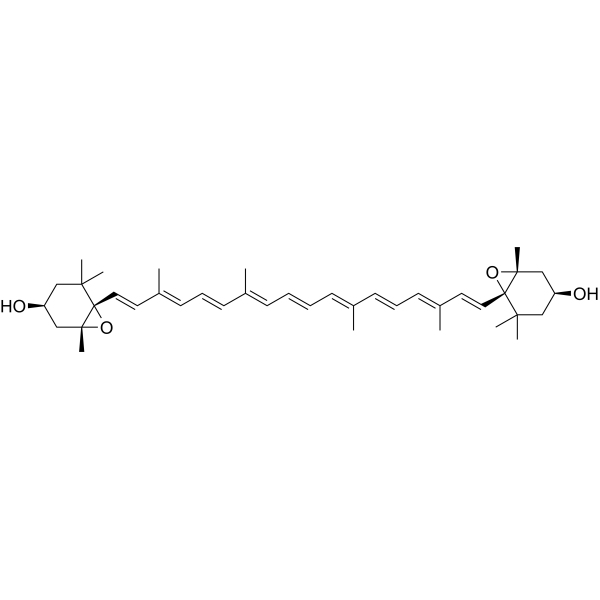
Violaxanthin is a naturally derived diepoxy xanthophyll carotenoid and light-harvesting accessory pigment with biological activities such as antioxidation and anti-inflammation. Violaxanthin transfers excitation energy to chlorophyll a under low-light conditions. Violaxanthin participates in the xanthophyll cycle and dissipates excess light energy in the form of heat, thereby protecting thylakoid membrane lipids from photo-oxidative damage. Violaxanthin exhibits activities including inhibition of lipid peroxidation, quenching of singlet oxygen, scavenging of DPPH free radicals, and scavenging of ABTS + free radicals. Violaxanthin can be used in antioxidant-related research .
loading...
    loading...
Cat. No.: HY-157618
CAS No.: 322647-48-3
Purity:  ≥99.0%
Target:  

Bacterial

Research Areas:  

Others

18:0-18:1 PG sodium is a hydrogenated phospholipid that contributes to the stability of photosystem I and II protein complexes and plays a role in bacterial defense mechanisms, featuring two extra methylene groups in its saturated sn-1 chain, and is present in the thylakoid membranes of higher plants and cyanobacteria.
loading...
    loading...
Cat. No.: HY-N11882
CAS No.: 4299-57-4
Synonyms: PQ-9
Plastoquinone (PQ-9) is a photosynthetic electron carrier as well as a redox sensor capable of regulating state transitions and gene expression. Plastoquinone transfers electrons to the cytochrome b6/f complex via the Q cycle, and participates in the establishment of the thylakoid transmembrane pH gradient. Plastoquinone can react with ROS. Plastoquinone is used in plant photosynthesis research .
loading...
    loading...
Cat. No.: HY-N9625A
CAS No.: 126-29-4
Violaxanthin (HPLC≥90%) is a naturally derived diepoxy xanthophyll carotenoid and light-harvesting accessory pigment with biological activities such as antioxidation and anti-inflammation. Violaxanthin (HPLC≥90%) transfers excitation energy to chlorophyll a under low-light conditions. Violaxanthin (HPLC≥90%) participates in the xanthophyll cycle and dissipates excess light energy in the form of heat, thereby protecting thylakoid membrane lipids from photo-oxidative damage. Violaxanthin (HPLC≥90%) exhibits activities including inhibition of lipid peroxidation, quenching of singlet oxygen, scavenging of DPPH free radicals, and scavenging of ABTS + free radicals. Violaxanthin (HPLC≥90%) can be used in antioxidant-related research .
loading...
    loading...
Hydrogenated DGDG
0 Images
β-D-Galactopyranoside, (2S)-2,3-bis[(1-oxooctadecyl)oxy]propyl 6-O-β-D-galactopyranosyl-
Cat. No.: HY-N16344
CAS No.: 960204-99-3
Hydrogenated DGDG is a lipid derived from plants. Digalactosyldiacylglycerol (DGDG) is a galactosylglycerolipid, which is a major lipid component in the thylakoid membrane of leaf chloroplasts. DGDG is vital for photosynthesis.
loading...
    loading...
Cat. No.: HY-N16337
CAS No.: 51424-47-6
Target:  

Others

Research Areas:  

Others

Hydrogenated MGDG is a type of glycolipid. Monogalactosyldiacylglycerol (MGDG), a galactosylglycerolipid, is a major lipid in the thylakoid membrane of the chloroplast of leaves. It is also localized in the roots, fruits and grains. MGDG is synthesized from Monogalactosyldiacylglycerol synthase 1 (MGD1). It is a precursor for digalactosyldiacylglycerol (DGDG).
loading...
    loading...

