13 Results for "

wildtype p53 tumors

" in MedChemExpress (MCE) Product Catalog:
Products (13)

13 Results for "wildtype p53 tumors" in MCE Product Catalog:

13
13 Publications Verification
Cat. No.: HY-19980
CAS No.: 5291-32-7
Synonyms: APR-246; PRIMA-1Met
Research Areas:  

Cancer

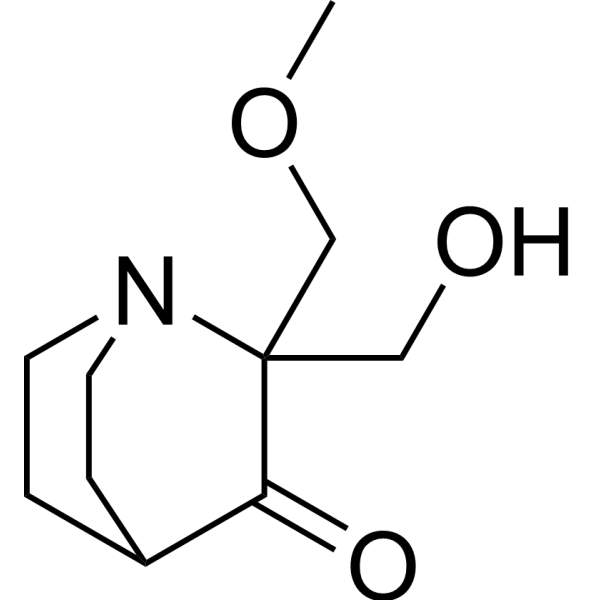
Eprenetapopt (APR-246) is a first-in-class, small molecule that restores wild-type p53 functions in TP53-mutant cells. Eprenetapopt triggers apoptosis in tumor cells. Eprenetapopt also targets the selenoprotein thioredoxin reductase 1 (TrxR1), a key regulator of cellular redox balance .
loading...
    loading...
4
4 Cited Publications
Cat. No.: HY-19896
CAS No.: 1039455-84-9
Target:  

MDM-2/p53 Apoptosis

Research Areas:  

Cancer

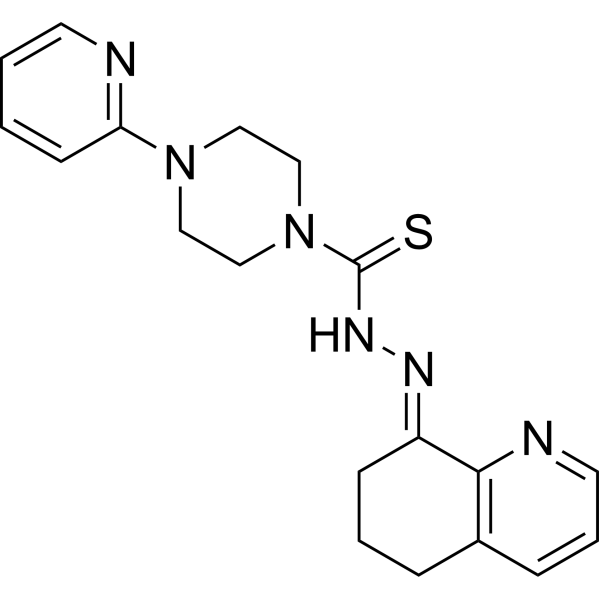
COTI-2, an anti-cancer agent with low toxicity, is an orally available third generation activator of p53 mutant forms. COTI-2 acts both by reactivating mutant p53 and inhibiting the PI3K/AKT/mTOR pathway. COTI-2 induces apoptosis in multiple human tumor cell lines. COTI-2 exhibits antitumor activity in HNSCC through p53-dependent and -independent mechanisms. COTI-2 converts mutant p53 to wild-type conformation .
loading...
    loading...
3
3 Cited Publications
Cat. No.: HY-12025
CAS No.: 881202-45-5
Purity:  99.56%
Synonyms: JNJ-26854165
Research Areas:  

Cancer

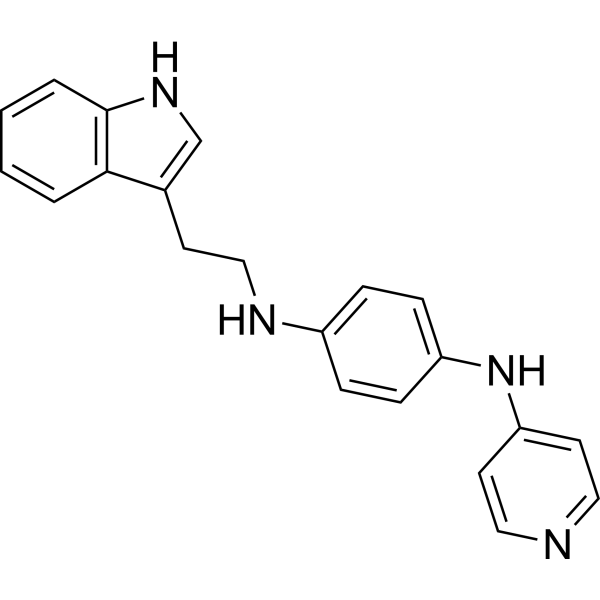
Serdemetan (JNJ-26854165) is a potent anticancer agent with radiosensitizing activity. Serdemetan exhibits antiproliferative activity in various p53 wild-type tumor cells. Serdemetan also antagonizes the Mdm2-HIF1α axis leading to decreased levels of glycolytic enzymes .
loading...
    loading...
3
3 Cited Publications
Cat. No.: HY-114305
CAS No.: 2064292-12-0
Purity:  99.70%
Research Areas:  

Cancer

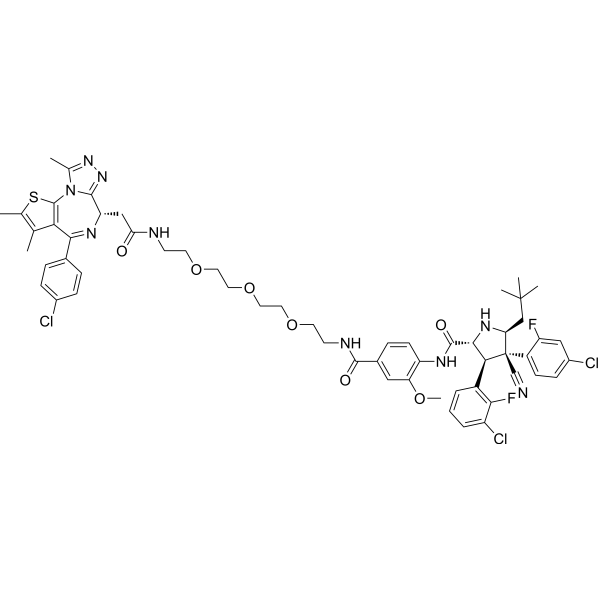
A1874 is an orally active BRD4 PROTAC degrader with a DC50 of 32 nM. A1874 degrades BRD4 via the ubiquitin-proteasome system by recruiting the MDM2 E3 ligase, while disrupting the MDM2-p53 interaction to stabilize p53 and upregulate p21, thereby inducing cell cycle arrest and apoptosis. A1874 exhibits selectivity for wild-type p53 cells and MDM2-amplified tumors, and it can be used in research on breast cancer, colorectal cancer, melanoma, lung cancer, lymphoma, myeloid leukemia, osteosarcoma, and glioblastoma .
loading...
    loading...
1
1 Cited Publications
Cat. No.: HY-170451
CAS No.: 2713618-08-5
Synonyms: KT-253
Research Areas:  

Cancer

Seldegamadlin (KT-253) is a cereblon-recruiting PROTAC degrader of MDM2, with a DC50 of 0.4 nM. Seldegamadlin catalyzes the ubiquitination and proteasomal degradation of MDM2, disrupts the MDM2/p53 autoregulatory feedback loop, induces apoptosis, caspase activation and p53 target gene expression, and inhibits the growth of wild-type p53 hematologic tumor cells and solid tumor cells. Seldegamadlin is applicable for the research of acute myeloid leukemia, acute lymphoblastic leukemia, diffuse large B-cell lymphoma and wild-type p53 solid tumors .
loading...
    loading...
Cat. No.: HY-145939
CAS No.: 2468783-75-5
Purity:  98.27%
Synonyms: BRD5846
Target:  

Casein Kinase

Research Areas:  

Cancer

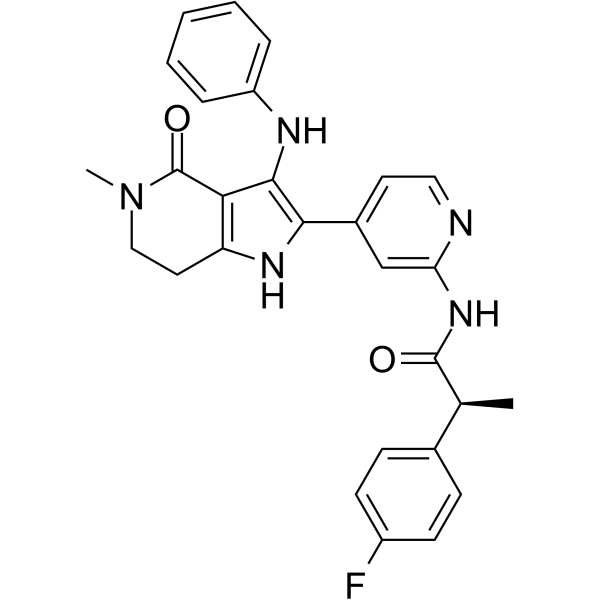
BAY-888 is a selective CK1α/CSNK1A1 (casein kinase 1α) ATP-competitive inhibitor (IC50: 4 nM@10 μM ATP; 63 nM@1 mM ATP). BAY-888 blocks the negative regulation of p53 and other signaling pathways by CK1α, induces apoptosis and inhibits proliferation of tumor cells. BAY-888 has shown inhibitory efficacy against cancers such as acute myeloid leukemia (AML) in PRISM barcoded cell line screening and can mimic the effects of shRNA-mediated CK1α knockdown. BAY-888 is primarily used for the development of anticancer drugs for p53 wild-type tumors and for the study of the mechanisms of CK1α-related signaling pathways .
loading...
    loading...
Cat. No.: HY-16999
CAS No.: 1309684-94-3
Research Areas:  

Cancer

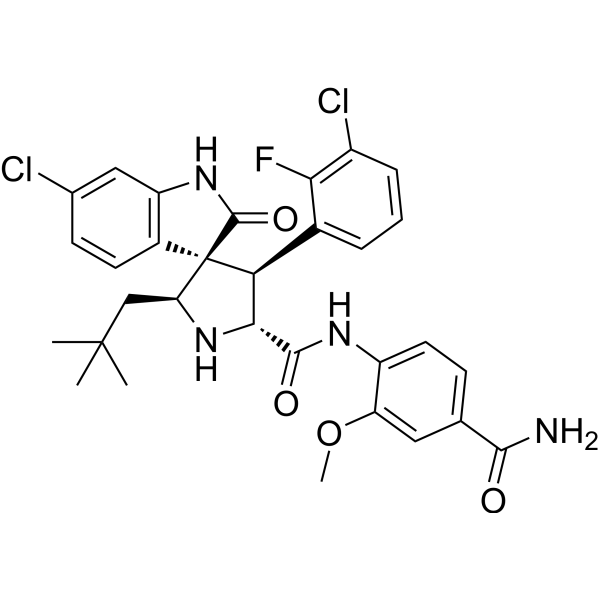
RO8994 (Compound 4) is an orally active, highly potent and selective spiroindolinone p53-MDM2 inhibitor with an IC50 value of 5 nM (HTRF binding assays) and 20 nM (MTT proliferation assays). RO8994 induces up-regulation of p53 expression and Apoptosis in wild-type p53 cancer cells. RO8994 also inhibits tumor growth in the tumor xenograft model .
loading...
    loading...
Cat. No.: HY-136910
CAS No.: 2413944-70-2
Purity:  99.09%
Synonyms: USP7-IN-7
Research Areas:  

Cancer

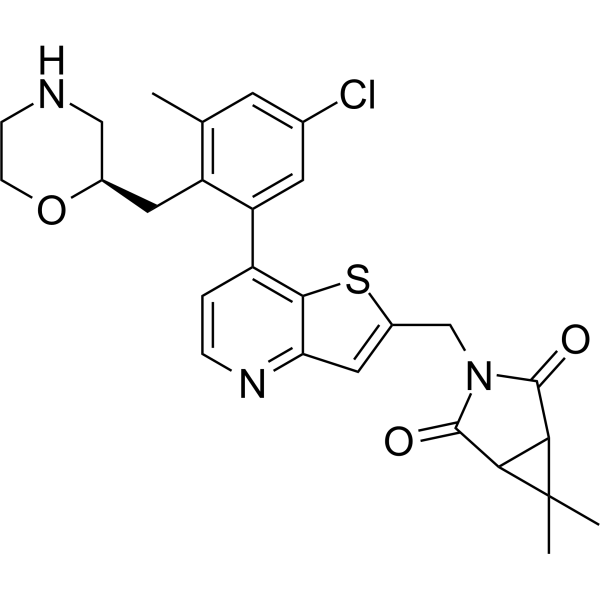
USP7-797 (USP7-IN-7) is an orally available, selective USP7 inhibitor (IC50=0.5 nmol/L) with antitumor activity. USP7-797 reduces the level of MDM2, thereby increasing the stability and activity of p53, leading to cell cycle arrest and apoptosis. USP7-797 has low nanomolar cytotoxicity against p53 mutant cancer cell lines, p53 wild-type hematological tumors, and neuroblastoma cell lines .
loading...
    loading...
Cat. No.: HY-174458
Target:  

PROTACs MDM-2/p53

Research Areas:  

Cancer

MD-4251 is an orally active MDM2 PROTAC degrader with a DC50 of 0.2 nM in RS4;11 cells. MD-4251 induces cereblon-dependent depletion and degradation of MDM2 protein, elevates p53 protein levels and activates p53. MD-4251 inhibits the proliferation of wild-type p53 acute leukemia cells, induces complete and durable tumor regression in xenograft models, and upregulates the protein levels of DSC1, NBEA and CASP14. MD-4251 can be used in studies related to acute leukemia .
loading...
    loading...
Cat. No.: HY-18343
CAS No.: 259199-65-0
Target:  

MDM-2/p53 Apoptosis

Research Areas:  

Cancer

CP-31398 can stabilize the active conformation of p53 and promote p53 activity in cancer cells with either mutant or wild-type p53. In addition, CP-31398 can upregulate p53 target genes, such as p21WAF1/Cip1 and KILLER/DR5. CP-31398 exerts an inhibitory effect on tumor growth .
loading...
    loading...
Cat. No.: HY-19980G
CAS No.: 5291-32-7
Synonyms: APR-246 (GMP); PRIMA-1Met (GMP)
Eprenetapopt (GMP) (APR-246(GMP)) is Eprenetapopt (HY-19980) in GMP grade. GMP small molecules works appropriately as an auxiliary reagent for cell therapy manufacture. Eprenetapopt (APR-246) is a first-in-class, small molecule that restores wild-type p53 functions in TP53-mutant cells. Eprenetapopt triggers apoptosis in tumor cells. Eprenetapopt also targets the selenoprotein thioredoxin reductase 1 (TrxR1), a key regulator of cellular redox balance .
loading...
    loading...
Cat. No.: HY-122038
CAS No.: 849723-20-2
Target:  

MDM-2/p53

Research Areas:  

Cancer

NU-8165 is an inhibitor of the MDM2-p53 protein-protein interaction with anti-tumor activity. Optimization of NU-8165 was guided by MDM2 NMR titrations, which indicated key binding interaction regions. NU-8165 activated MDM2 and p21 transcription in cell-based assays and showed modest selectivity for wild-type p53 cell lines .
loading...
    loading...
Cat. No.: HY-186151
CAS No.: 1372406-51-3
Target:  

MDM-2/p53 Apoptosis

Research Areas:  

Cancer

UCI-LC0019 is a mutant p53 reactivator. UCI-LC0019 binds to mutant p53, induces wild-type-like conformational change, restores sequence-specific DNA binding activity, activates p53-dependent transcription programs, and does not act via thiol reactivity or glutathione depletion. UCI-LC0019 inhibits proliferation and induces apoptosis in cancer cells harboring mutant p53, with no significant effect on p53 null or wild-type p53 tumors cells. UCI-LC0019 exhibits anti-tumor activity in xenograft mouse models carrying p53R175H mutant tumors. UCI-LC0019 can be used for the research of cancer, such as ovarian cancer .
loading...
    loading...
  • 1

