



Nuclease, Serratia marcescens

Based on 1 Customer Validation
Serratia marcescens nuclease (EC 3.1.30.2) is a nonspecific nuclease. Serratia marcescens nuclease has broad utility due to its potent digestive activity toward both DNA and RNA.
For research use only. We do not sell to patients.
- Purity: 95%
- CAS No.: 9025-65-4
-
Storage:
Please store the product under the recommended conditions in the Certificate of Analysis.

To place orders, for customer services and technical support, please contact: MedChemExpress USA
Tel: 609-228-6898 E-mail: [email protected] [email protected]


-
 Biological Activity
-
Chemical Information
- Purity & Documentation
- References
-
 Help & FAQs


-
HY-108882A
Recombinant DNase I (RNase-free) -
HY-B0496
PMSF -
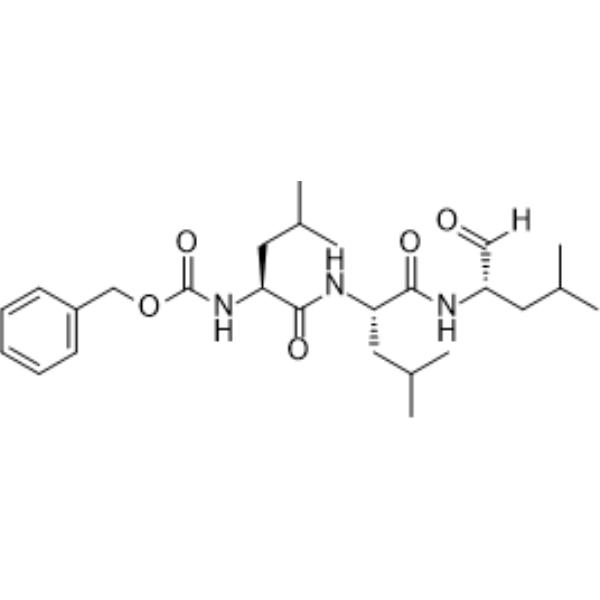
HY-13259
MG-132 -
HY-129046
RNase A, Bovine pancreas -

HY-129046I
RNase A, Recombinant (animal free) -

HY-129046D
RNase A, Recombinant -

HY-129046B
RNase A, Bovine Pancreas DNase & Protease Free -
HY-108882
DNase I, Bovine pancreas -

HY-129046E
RNase A DNase & Protease Free, Recombinant -

HY-129046H
RNase A, Recombinant Protease & DNase free, animal free -

HY-108882C
DNase I (filtered) -

HY-108882B
DNase I RNase & Protease free


Biological Activity
Description
In Vitro
Product Information
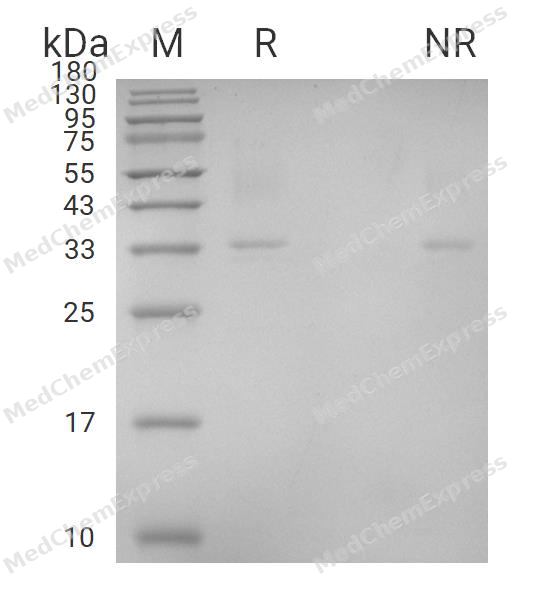
An endonuclease from Serratia marcescens that can completely digest all forms of DNA and RNA (including single-stranded, double-stranded, linear and circular) into 5'monophosphate oligonucleotides of 3-5 bases in length. It has no protein activity and is highly specific. It is expressed in a yeast system and is suitable for the removal of nucleic acids in various proteins and biological products. The reaction conditions are mild, the reaction time is short, and the nucleic acid removal efficiency is high.
The storage solution is: 20 mM Tris-HCl pH 8.0, 2 mM MgCl2, 20 mM NaCl, 50% glycerol
Instructions
1. Sample preparation
1) Adherent cells: remove the culture medium, wash the cells with PBS, and remove the supernatant.
2) Suspended cells: collect the cells by centrifugation, wash the cells with PBS, centrifuge at 6,000 rpm for 10 min, and collect the precipitate.
3) Escherichia coli: collect the bacteria by centrifugation, wash once with PBS, centrifuge at 8,000 rpm for 5 min, and collect the precipitate.
2. Sample processing
The collected cell pellets are lysed at a ratio of mass (g) to volume (mL) of 1:10~20. Cells can also be lysed mechanically or chemically on ice or at room temperature (1 g of cells is approximately 109).
3. Enzyme addition
1) Add an appropriate amount of MgCl2 to adjust the Mg2+ concentration in the reaction system to within the range of 1-5 mM, and adjust the pH to 8-9.
2) Add enzymes at a ratio of 250 U to digest 1 g of cell pellets, and incubate at 37°C for more than 30 minutes. You can also select the addition scheme according to the recommended usage in the table above, increase the enzyme amount within a certain range, and the digestion time will be reduced accordingly.
Note: Enzyme activity is affected by factors such as ion concentration, reaction temperature and pH. It is recommended to explore the optimal concentration for the first use.
4. Supernatant acquisition
Centrifuge at 12,000 rpm for 30 minutes to obtain the cell lysate supernatant, and then conduct subsequent related experiments.
Note: If the solution is a high-salt solution, slightly acidic or alkaline, and contains a higher concentration of detergent or denaturant, the amount of enzyme should be appropriately increased or the incubation time should be extended.
MedChemExpress (MCE) has not independently confirmed the accuracy of these methods. They are for reference only.
EC Number
3.1.30.2
Enzyme Activity
≥250 U/μL
Unit Definition
One unit is defined as the amount of enzyme that can digest sonicated salmon sperm DNA to an acid-soluble oligonucleotide(2.625 mL of reaction volume) equivalent to 1.0 ΔA260 within 30 min at pH 8.0, 37°C


Chemical Information
-
CAS No. 9025-65-4
-
Appearance Liquid
-
Color Colorless to light yellow
-
SMILES
[Nuclease, Serratia marcescens]
-
Synonyms
Serratia marcescens nuclease
-
Shipping
Room temperature in continental US; may vary elsewhere.
-
Storage
Please store the product under the recommended conditions in the Certificate of Analysis.


Purity & Documentation
-
Data Sheet (268 KB)
-
SDS (251 KB)
- English - EN (251 KB)
- Français - FR (251 KB)
- Deutsch - DE (251 KB)
- Norwegian - NO (251 KB)
- Español - ES (251 KB)
- Swedish - SV (251 KB)
- Italian - IT (251 KB)
- Korean - KR (251 KB)
- Portuguese - PT (251 KB)
-
Handling Instructions (2659 KB)
References
[1]. "Vafina G, et al. Endonuclease from Gram-Negative Bacteria Serratia marcescens Is as Effective as Pulmozyme in the Hydrolysis of DNA in Sputum. Front Pharmacol. 2018;9:114. Published 2018 Feb 16. doi: " [Content Brief]
[2]. "Friedhoff P, et al. A procedure for renaturation and purification of the extracellular Serratia marcescens nuclease from genetically engineered Escherichia coli. Protein Expr Purif. 1994;5(1):37-43. " [Content Brief]

Calculators
Concentration (start) × Volume (start) = Concentration (final) × Volume (final)


Nuclease, Serratia marcescens Related Classifications
HY-131160 Related Classifications
 Powered by Bioz