



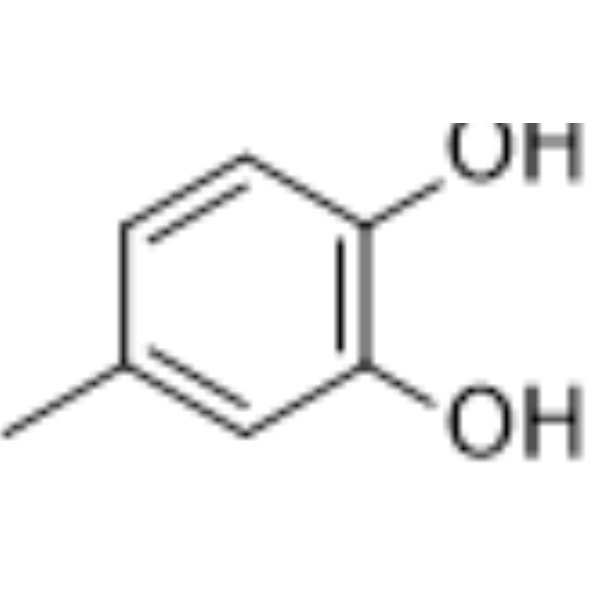
4-Methylcatechol

Based on 1 Customer Validation
4-Methylcatechol is an intermediate in the degradation of some alkylbenzenes and an orally active suicide inhibitor of catechol 2,3-dioxygenase (C23O). 4-Methylcatechol induces apoptosis in melanoma cells through oxidative stress, but some studies have also shown that 4-Methylcatechol is carcinogenic. In addition, 4-Methylcatechol has antiplatelet and blood pressure-lowering activities. 4-Methylcatechol can also inhibit protein oxidation in beef but does not disulfide formation.
For research use only. We do not sell to patients.
- Purity : 99.17%
- CAS No.: 452-86-8
- Formula: C7H8O2
- Molecular Weight:124.14
-
Storage:Powder -20°C, 3 years , 4°C, 2 years ; In solvent -80°C, 6 months , -20°C, 1 month

To place orders, for customer services and technical support, please contact: MedChemExpress USA
Tel: 609-228-6898 E-mail: [email protected] [email protected]


-
 Biological Activity
-
Chemical Information
-
Solvent & Solubility
- Purity & Documentation
- References
-
 Help & FAQs



All Endogenous Metabolite Isoforms
More

Biological Activity
Description
In Vitro
4-Methylcatechol (0-25 μg/mL; 8 h-14 days) can inhibit the proliferation of melanoma cells, induce cell cycle arrest and induce apoptosis through the generation of reactive oxygen species through mitochondrial pathway[1].
MedChemExpress (MCE) has not independently confirmed the accuracy of these methods. They are for reference only.
In Vivo
4-Methylcatechol (Intravenous injection; 0.2-25 mg/kg; single dose) has vasodilatory and blood pressure-lowering effects in spontaneously hypertensive rats[3].
MedChemExpress (MCE) has not independently confirmed the accuracy of these methods. They are for reference only.
-
Animal Model:Male and female F344 rats aged 5 weeks old[2]
-
Dosage:2%
-
Administration:Feed management; 104 weeks
-
Result:Slightly reduced the average body weight and food intake in rats.
Decreased survival from about the 70th week in male rats, the cause of death may have been perforation due to glandular stomach ulceration.
Caused multiple nodules or large masses in the forestomachs in rats.
Caused thickening or polypoid lesions in the pyloric region in the glandular stomach in rats.
Induced forestomach papillomas and squamous-cell carcinomas, as well as glandular stomach submucosal hyperplasias, adenomas, and adenocarcinomas, some of which were accompanied by ulceration or erosion.


Chemical Information
-
CAS No. 452-86-8
-
Appearance Solid
-
Molecular Weight 124.14
-
Formula C7H8O2
-
Color Off-white to light brown
-
SMILES
OC1=CC=C(C)C=C1O
-
Structure Classification
-
Initial Source
-
Shipping
Room temperature in continental US; may vary elsewhere.
-
Storage
Powder -20°C 3 years 4°C 2 years In solvent -80°C 6 months -20°C 1 month


Solvent & Solubility
In Vitro:
DMSO : 100 mg/mL (805.55 mM; Need ultrasonic; Hygroscopic DMSO has a significant impact on the solubility of product, please use newly opened DMSO)
H2O : ≥ 100 mg/mL (805.55 mM)
* "≥" means soluble, but saturation unknown.
Please refer to the solubility information to select the appropriate solvent. Once prepared, please aliquot and store the solution to prevent product inactivation from repeated freeze-thaw cycles.
Storage method and period of stock solution: -80°C, 6 months; -20°C, 1 month. When stored at -80°C, please use it within 6 months. When stored at -20°C, please use it within 1 month.
* Note: If you choose water as the stock solution, please dilute it to the working solution, then filter and sterilize it with a 0.22 μm filter before use.
Please refer to the solubility information to select the appropriate solvent. Once prepared, please aliquot and store the solution to prevent product inactivation from repeated freeze-thaw cycles.
Storage method and period of stock solution: -80°C, 6 months; -20°C, 1 month. When stored at -80°C, please use it within 6 months. When stored at -20°C, please use it within 1 month.
* Note: If you choose water as the stock solution, please dilute it to the working solution, then filter and sterilize it with a 0.22 μm filter before use.
Concentration (start) × Volume (start) = Concentration (final) × Volume (final)
In Vivo:
Select the appropriate dissolution method based on your experimental animal and administration route.
- For the following dissolution methods, please ensure to first prepare a clear stock solution using an In Vitro approach and then sequentially add co-solvents:
- To ensure reliable experimental results, the clarified stock solution can be appropriately stored based on storage conditions. As for the working solution for In Vivo experiments, it is recommended to prepare freshly and use it on the same day.
- The percentages shown for the solvents indicate their volumetric ratio in the final prepared solution. If precipitation or phase separation occurs during preparation, heat and/or sonication can be used to aid dissolution.
Add each solvent one by one: 10% DMSO 40% PEG300 5% Tween-80 45% Saline
Solubility: ≥ 2.5 mg/mL (20.14 mM); Clear solution
This protocol yields a clear solution of ≥ 2.5 mg/mL (saturation unknown).
Taking 1 mL working solution as an example, add 100 μL DMSO stock solution (25.0 mg/mL) to 400 μL PEG300, and mix evenly; then add 50 μL Tween-80 and mix evenly; then add 450 μL Saline to adjust the volume to 1 mL.
Preparation of Saline: Dissolve 0.9 g sodium chloride in ddH₂O and dilute to 100 mL to obtain a clear Saline solution.
Add each solvent one by one: 10% DMSO 90% (20% SBE-β-CD in Saline)
Solubility: ≥ 2.5 mg/mL (20.14 mM); Clear solution
This protocol yields a clear solution of ≥ 2.5 mg/mL (saturation unknown).
Taking 1 mL working solution as an example, add 100 μL DMSO stock solution (25.0 mg/mL) to 900 μL 20% SBE-β-CD in Saline, and mix evenly.
Preparation of 20% SBE-β-CD in Saline (4°C, storage for one week): 2 g SBE-β-CD powder is dissolved in 10 mL Saline, completely dissolve until clear.
In Vivo Dissolution Calculator
Please enter the basic information of animal experiments:
-
-
-
-
Recommended: Prepare an additional quantity of animals to account for potential losses during experiments.
Working solution concentration: 0.22 mg/mL
This product has good water solubility, please refer to the measured solubility data in water/PBS/Saline for details.


Purity & Documentation
-
Data Sheet (276 KB)
-
SDS (393 KB)
- English - EN (393 KB)
- Français - FR (393 KB)
- Deutsch - DE (393 KB)
- Norwegian - NO (393 KB)
- Español - ES (393 KB)
- Swedish - SV (393 KB)
- Italian - IT (393 KB)
- Korean - KR (393 KB)
- Portuguese - PT (393 KB)
-
Handling Instructions (2659 KB)
References
[1]. Payton F, et al. 4-Methylcatechol-induced oxidative stress induces intrinsic apoptotic pathway in metastatic melanoma cells. Biochem Pharmacol. 2011 May 15;81(10):1211-8. [Content Brief]
[2]. Asakawa E, et al. Carcinogenicity of 4-methoxyphenol and 4-methylcatechol in F344 rats. Int J Cancer. 1994 Jan 2;56(1):146-52. [Content Brief]
[3]. Pourová J, et al. Two flavonoid metabolites, 3,4-dihydroxyphenylacetic acid and 4-methylcatechol, relax arteries ex vivo and decrease blood pressure in vivo. Vascul Pharmacol. 2018 Dec;111:36-43. [Content Brief]
[4]. Okuta A, et al. Construction of chimeric catechol 2,3-dioxygenase exhibiting improved activity against the suicide inhibitor 4-methylcatechol. Appl Environ Microbiol. 2004 Mar;70(3):1804-10. [Content Brief]
[5]. Jongberg S, et al. 4-methylcatechol inhibits protein oxidation in meat but not disulfide formation. J Agric Food Chem. 2011 Sep 28;59(18):10329-35. [Content Brief]
[6]. Applová L, et al. 4-Methylcatechol, a Flavonoid Metabolite with Potent Antiplatelet Effects. Mol Nutr Food Res. 2019 Aug 7;63(20):e1900261. [Content Brief]


Complete Stock Solution Preparation Table
Please refer to the solubility information to select the appropriate solvent. Once prepared, please aliquot and store the solution to prevent product inactivation from repeated freeze-thaw cycles.
Storage method and period of stock solution: -80°C, 6 months; -20°C, 1 month. When stored at -80°C, please use it within 6 months. When stored at -20°C, please use it within 1 month.
| Optional Solvent | Concentration Solvent Mass | 1 mg | 5 mg | 10 mg | 25 mg |
|---|---|---|---|---|---|
| DMSO / H2O | 1 mM | 8.0555 mL | 40.2774 mL | 80.5549 mL | 201.3872 mL |
| 5 mM | 1.6111 mL | 8.0555 mL | 16.1110 mL | 40.2774 mL | |
| 10 mM | 0.8055 mL | 4.0277 mL | 8.0555 mL | 20.1387 mL | |
| 15 mM | 0.5370 mL | 2.6852 mL | 5.3703 mL | 13.4258 mL | |
| 20 mM | 0.4028 mL | 2.0139 mL | 4.0277 mL | 10.0694 mL | |
| 25 mM | 0.3222 mL | 1.6111 mL | 3.2222 mL | 8.0555 mL | |
| 30 mM | 0.2685 mL | 1.3426 mL | 2.6852 mL | 6.7129 mL | |
| 40 mM | 0.2014 mL | 1.0069 mL | 2.0139 mL | 5.0347 mL | |
| 50 mM | 0.1611 mL | 0.8055 mL | 1.6111 mL | 4.0277 mL | |
| 60 mM | 0.1343 mL | 0.6713 mL | 1.3426 mL | 3.3565 mL | |
| 80 mM | 0.1007 mL | 0.5035 mL | 1.0069 mL | 2.5173 mL | |
| 100 mM | 0.0806 mL | 0.4028 mL | 0.8055 mL | 2.0139 mL |
* Note: If you choose water as the stock solution, please dilute it to the working solution, then filter and sterilize it with a 0.22 μm filter before use.


4-Methylcatechol Related Classifications
HY-W012814 Related Classifications
 Powered by Bioz