



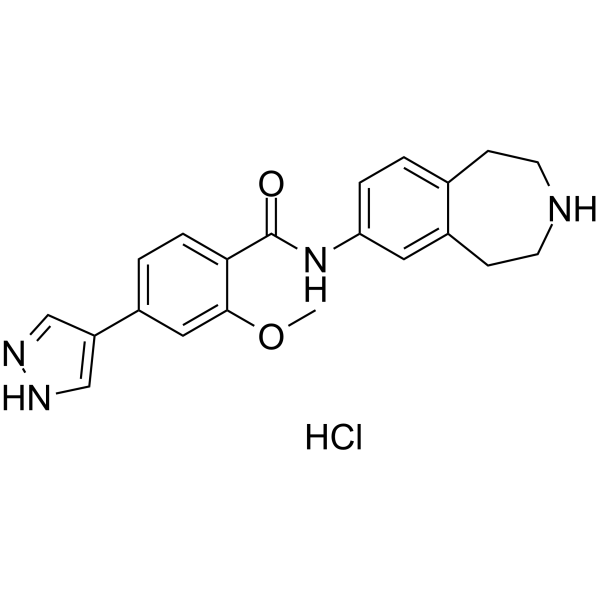
JNJ-47117096 hydrochloride

Based on 1 Customer Validation
JNJ-47117096 hydrochloride is potent and selective MELK inhibitor, with an IC50 of 23 nM, also effectively inhibits Flt3, with an IC50 of 18 nM.
For research use only. We do not sell to patients.
- Purity : 99.67%
- CAS No.: 1610536-69-0
- Formula: C21H23ClN4O2
- Molecular Weight:398.89
-
Storage:
4°C, sealed storage, away from moisture
* In solvent : -80°C, 6 months; -20°C, 1 month (sealed storage, away from moisture)

To place orders, for customer services and technical support, please contact: MedChemExpress USA
Tel: 609-228-6898 E-mail: [email protected] [email protected]


-
 Biological Activity
-
Chemical Information
-
Solvent & Solubility
- Protocol
- Purity & Documentation
- References
-
 Help & FAQs






Biological Activity
Description
IC50 & Target
IC50: 23 nM (MELK), 18 nM (Flt3)[1]
In Vitro
JNJ-47117096 hydrochloride is potent and selective MELK inhibitor, with an IC50 of 23 nM, also effectively inhibits Flt3, with an IC50 of 18 nM, and slighitly blocks CAMKIIδ, Mnk2, CAMKIIγ, and MLCK (IC50, 810 nM, 760 nM, 1000 nM, 1000 nM). JNJ-47117096 (MELK-T1) suppresses the proliferation of Flt3-driven Ba/F3 cell lines, with an IC50 of 1.5 μM in the absence of IL-3, while no inhibitory activity is observed in the presence of IL-3. JNJ-47117096 does not inhibit the proliferation of Ba/F3 cell lines transfected with either FGFR1, FGFR3, or KDR, either in the presence or absence of IL-3[1]. JNJ-47117096 (MELK-T1, 10 μM) delays the progression of MCF-7 cells through S-phase. JNJ-47117096 inhibits MELK, and then exerts stalled replication forks and DNA double-strand breaks (DSBs). JNJ-47117096 activates the ATM-mediated DNA-damage response (DDR). JNJ-47117096 (3, 10 μM) results in a growth arrest and a senescent phenotype. Moreover, JNJ-47117096 induces a strong phosphorylation of p53, a prolonged up-regulation of p21 and a down-regulation of FOXM1 target genes[2].
MedChemExpress (MCE) has not independently confirmed the accuracy of these methods. They are for reference only.


Chemical Information
-
CAS No. 1610536-69-0
-
Appearance Solid
-
Molecular Weight 398.89
-
Formula C21H23ClN4O2
-
Color White to off-white
-
SMILES
O=C(NC1=CC=C2CCNCCC2=C1)C3=CC=C(C4=CNN=C4)C=C3OC.Cl
-
Synonyms
MELK-T1 hydrochloride
-
Shipping
Room temperature in continental US; may vary elsewhere.
-
Storage
4°C, sealed storage, away from moisture
* In solvent : -80°C, 6 months; -20°C, 1 month (sealed storage, away from moisture)


Solvent & Solubility
In Vitro:
DMSO : ≥ 250 mg/mL (626.74 mM; Hygroscopic DMSO has a significant impact on the solubility of product, please use newly opened DMSO)
H2O : 3.33 mg/mL (8.35 mM; ultrasonic and warming and heat to 60°C)
* "≥" means soluble, but saturation unknown.
Please refer to the solubility information to select the appropriate solvent. Once prepared, please aliquot and store the solution to prevent product inactivation from repeated freeze-thaw cycles.
Storage method and period of stock solution: -80°C, 6 months; -20°C, 1 month (sealed storage, away from moisture). When stored at -80°C, please use it within 6 months. When stored at -20°C, please use it within 1 month.
* Note: If you choose water as the stock solution, please dilute it to the working solution, then filter and sterilize it with a 0.22 μm filter before use.
Please refer to the solubility information to select the appropriate solvent. Once prepared, please aliquot and store the solution to prevent product inactivation from repeated freeze-thaw cycles.
Storage method and period of stock solution: -80°C, 6 months; -20°C, 1 month (sealed storage, away from moisture). When stored at -80°C, please use it within 6 months. When stored at -20°C, please use it within 1 month.
* Note: If you choose water as the stock solution, please dilute it to the working solution, then filter and sterilize it with a 0.22 μm filter before use.
Concentration (start) × Volume (start) = Concentration (final) × Volume (final)

Protocol
Kinase Assay[1]
Inhibition of MELK kinase activity is measured using a radioactive filter binding assay. Briefly, each assay well contains 1.25 nM MELK (human, residues 1-340) 10 μM ATP, 6.7 uCi/mL γ33P-ATP, 3 μM biotinylated ZIP-tide peptide (Biotin-KKLNRTLSFAEPG) in 30 μL reaction buffer (25 mM Tris pH 7.5, 10 mM MgCl2, 1 mM DTT, 1 mM EGTA, 0.1% Triton X100). Kinase reactions are performed for 25 minutes at room temperature before stopping with 40 μL 2% orthophosphoric acid. Unbound radioactivity is removed by filtering the reaction through a MAPH filter plate. The trapped 33P labelled peptide is then washed twice with 200 μL 0.5% orthophosphoric acid, 20 μL Microscint-20 added per well and the amount of radioactivity determined by scintillation counting using a Topcount. To calculate compound IC50, semi-log serial dilutions are used to produce 8-point dose-response curves in duplicate. IC50 values are then derived using the four parameter logistic fit method in GraphPad Prism 5.0[1].
MedChemExpress (MCE) has not independently confirmed the accuracy of these methods. They are for reference only.
Cell Assay[1]
Compounds (JNJ-47117096) dissolved in DMSO are sprayed into 384-well plates (100 nL/well). A suspension of Ba/F3-Flt3 cells is added (20,000 cell/well), followed by the addition of 10 ng/mL IL3. The cells are incubated for 24 h at 37°C and 5% CO2. Alamar Blue solution is added, and after 4 h incubation at 37°C, the fluorescent intensity is measured on a Fluorescence plate reader (540 nm excitation and 590 nm emission). The control experiment in the absence of IL3 is performed in the same way. To calculate compound IC50, semi-log serial dilutions are used to produce 8- point dose-response curves in duplicate. A best-fit curve is fitted by a minimum sum of squares method to the plot of %Control vs. compound concentration. From this an IC50 value is calculated[1].
MedChemExpress (MCE) has not independently confirmed the accuracy of these methods. They are for reference only.


Purity & Documentation
-
Data Sheet (275 KB)
-
SDS (252 KB)
- English - EN (252 KB)
- Français - FR (252 KB)
- Deutsch - DE (252 KB)
- Norwegian - NO (252 KB)
- Español - ES (252 KB)
- Swedish - SV (252 KB)
- Italian - IT (252 KB)
- Korean - KR (252 KB)
- Portuguese - PT (252 KB)
-
Handling Instructions (2659 KB)
References
[1]. Johnson CN, et al. Fragment-based discovery of type I inhibitors of maternal embryonic leucine zipper kinase. ACS Med Chem Lett. 2014 May 23;6(1):25-30. [Content Brief]
[2]. Beke L, et al. MELK-T1, a small-molecule inhibitor of protein kinase MELK, decreases DNA-damage tolerance in proliferating cancer cells. Biosci Rep. 2015 Oct 2;35(6). pii: e00267. [Content Brief]


Complete Stock Solution Preparation Table
Please refer to the solubility information to select the appropriate solvent. Once prepared, please aliquot and store the solution to prevent product inactivation from repeated freeze-thaw cycles.
Storage method and period of stock solution: -80°C, 6 months; -20°C, 1 month (sealed storage, away from moisture). When stored at -80°C, please use it within 6 months. When stored at -20°C, please use it within 1 month.
| Optional Solvent | Concentration Solvent Mass | 1 mg | 5 mg | 10 mg | 25 mg |
|---|---|---|---|---|---|
| H2O / DMSO | 1 mM | 2.5070 mL | 12.5348 mL | 25.0696 mL | 62.6739 mL |
| 5 mM | 0.5014 mL | 2.5070 mL | 5.0139 mL | 12.5348 mL | |
| DMSO | 10 mM | 0.2507 mL | 1.2535 mL | 2.5070 mL | 6.2674 mL |
| 15 mM | 0.1671 mL | 0.8357 mL | 1.6713 mL | 4.1783 mL | |
| 20 mM | 0.1253 mL | 0.6267 mL | 1.2535 mL | 3.1337 mL | |
| 25 mM | 0.1003 mL | 0.5014 mL | 1.0028 mL | 2.5070 mL | |
| 30 mM | 0.0836 mL | 0.4178 mL | 0.8357 mL | 2.0891 mL | |
| 40 mM | 0.0627 mL | 0.3134 mL | 0.6267 mL | 1.5668 mL | |
| 50 mM | 0.0501 mL | 0.2507 mL | 0.5014 mL | 1.2535 mL | |
| 60 mM | 0.0418 mL | 0.2089 mL | 0.4178 mL | 1.0446 mL | |
| 80 mM | 0.0313 mL | 0.1567 mL | 0.3134 mL | 0.7834 mL | |
| 100 mM | 0.0251 mL | 0.1253 mL | 0.2507 mL | 0.6267 mL |
* Note: If you choose water as the stock solution, please dilute it to the working solution, then filter and sterilize it with a 0.22 μm filter before use.


JNJ-47117096 hydrochloride Related Classifications
HY-12420 Related Classifications
 Powered by Bioz