



EGFR
Epidermal growth factor receptor; ErbB-1; HER1
The EGFR family of receptor tyrosine kinases (RTK) comprises four distinct receptors: the EGFR (also known as ErbB-1/HER1), ErbB-2 (neu, HER2), ErbB-3 (HER3) and ErbB-4 (HER4). All EGFR family members are characterized by a modular structure consisting of an extracellular ligand-binding domain, a single hydrophobic transmembrane region, and the intracellular part harbouring the highly conserved tyrosine kinase domain. The ErbB family of receptor tyrosine kinases (RTKs) couples binding of extracellular growth factor ligands to intracellular signaling pathways regulating diverse biologic responses, including proliferation, differentiation, cell motility, and survival. Ten growth factors and their ErbB specificities are: EGF, amphiregulin (AR), and TGF bind ErbB-1; betacellulin, and epiregulin bind both ErbB-1 and ErbB-4; the neuregulins (also called heregulins and Neu differentiation factors) NRG-1 and NRG-2 bind ErbB-3 and ErbB-4; and NRG-3 and NRG-4 bind ErbB-4. No known ligand binds ErbB-2. The three best characterized signaling pathways induced through ErbBs are Ras-mitogen-activated protein kinase (Ras-MAPK), phosphatidylinositol 3 kinase-protein kinase B (PI3K-PKB/Akt), and phospholipase C-protein kinase C (PLC-PKC) pathways.
EGFR Isoform Specific Products
All Product Categories
-
EGFR Inhibitors
(1035)
View all products
-
EGFR Agonists
(4)
View all products
-
EGFR Antagonists
(5)
View all products
-
EGFR Activators
(8)
View all products
-
EGFR Modulators
(7)
View all products
-
EGFR Chemicals
(3)
View all products
-
EGFR Inducers
(4)
View all products
-
EGFR Degraders
(45)
View all products
-
EGFR Controls
(6)
View all products
-
EGFR Substrate
(1)
View all products
-
EGFR Ligands
(19)
View all products
-
ErbB2/HER2 Proteins
(39)
View all products
-
ErbB3/HER3 Proteins
(15)
View all products
-
EGFR Proteins
(46)
View all products
-
ErbB4/HER4 Proteins
(10)
View all products
-
EGFR Related Products (1259)
Related Products (1259)

-
Recombinant Proteins (110)
-
Antibodies (19)
-
EGFR Isoform Comparison

-
BMS-599626 dihydrochloride
 0 ImagesCat. No.: HY-110333CAS No.: 1781932-33-9BMS-599626 dihydrochloride is a small molecule pan-HER (human epidermal growth factor receptor) kinase inhibitor. BMS-599626 dihydrochloride primarily targets HER1 (IC50=20 nmol/L) and HER2 (IC50=30 nmol/L) kinase activity in the HER family. BMS-599626 inhibits the kinase activity of HER1 and HER2 by competing with their ATP-binding sites, and can inhibit the downstream signaling pathway by blocking the heterodimer formation of HER1 and HER2. BMS-599626 dihydrochloride can be used to study the antitumor effects of multiple HER1 or HER2 overexpressed tumor models.
-
Anti-Mouse E-Cadherin/CD324 Antibody (DECMA-1)
 0 ImagesCat. No.: HY-P990248Anti-Mouse E-Cadherin/CD324 Antibody (DECMA-1) is an anti-mouse E-Cadherin/CD324 IgG1 monoclonal antibody. Anti-Mouse E-Cadherin/CD324 Antibody (DECMA-1) can downregulate the HER signaling axis and PI3K/Akt/mTOR signaling pathway. Anti-Mouse E-Cadherin/CD324 Antibody (DECMA-1) can inhibit the proliferation of tumor cells and induce their apoptosis. Anti-Mouse E-Cadherin/CD324 Antibody (DECMA-1) can be used for researches on cancer and inflammation conditions such as breast cancer, chronic compression injury (CCI) and asthma.
-
EGFR-IN-139
 0 ImagesCat. No.: HY-170438CAS No.: 1574321-31-5EGFR-IN-139 (compound PD 18) is an epidermal growth factor receptor (EGFR) inhibitor, with IC50s of 12.88 (wild type), 10.84 (L858R/T790M), 42.68 (L858R/T790M/C797S) nM, respectively. EGFR-IN-139 displays strong anticancer activity against A549 and H1975 cancer cell lines, which are highly expressed EGFR. EGFR-IN-139 has a strong selectivity to cancer cells. EGFR-IN-139 can be used for nonsmall cell lung cancer (NSCLC) research[1].
-
EGFR/CDK2-IN-2
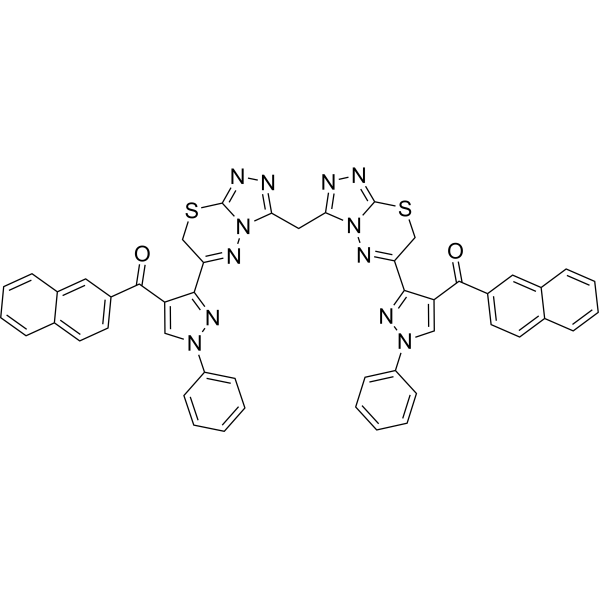 0 ImagesCat. No.: HY-156114EGFR/CDK2-IN-2 (compound 6a) is a dual inhibitor of EGFR and CDK-2 with IC50s of 19.6 and 87.9 nM, respectively. EGFR/CDK2-IN-2 induces apoptosis in MCF-7 cells and arrests the cell cycle in the S phase. EGFR/CDK2-IN-2 has significant anti-cancer cell toxicity and inhibits MCF-7 with an IC50 of 0.39 μM.
-
Erbb4 Rat Pre-designed siRNA Set A
 0 ImagesCat. No.: HY-RS04474
Erbb4 Rat Pre-designed siRNA Set A contains three designed siRNAs for Erbb4 gene (Rat), as well as a negative control, a positive control, and a FAM-labeled negative control.
-
EGFR-IN-119
 0 ImagesCat. No.: HY-163880EGFR-IN-119 (Compound 5l) is an inhibitor for EGFR with an IC50 of 84.3 nM. EGFR-IN-119 inhibits the cytotoxicity in lung cancer cell A549 with an IC50 of 1.34 μM. EGFR-IN-119 downregulates the expressions of EGFR, KRAS, and MAP2K genes, exhibits antioxidant activity through reduction of reactive oxygen species (ROS), and hyperpolarizes the mitochondrial membrane potential.
-
EGFR/PI3Kα-IN-1
 0 ImagesCat. No.: HY-161968EGFR/PI3Kα-IN-1 (compound 30k) is a dual EGFR/PI3Kα inhibitor with IC50 values of 3.6 nM (EGFRL858R/T790M) and 30 nM (PI3Kα), respectively. EGFR/PI3Kα-IN-1 can inhibit tumor cell proliferation and has anticancer activity.
-
EGFR-IN-192
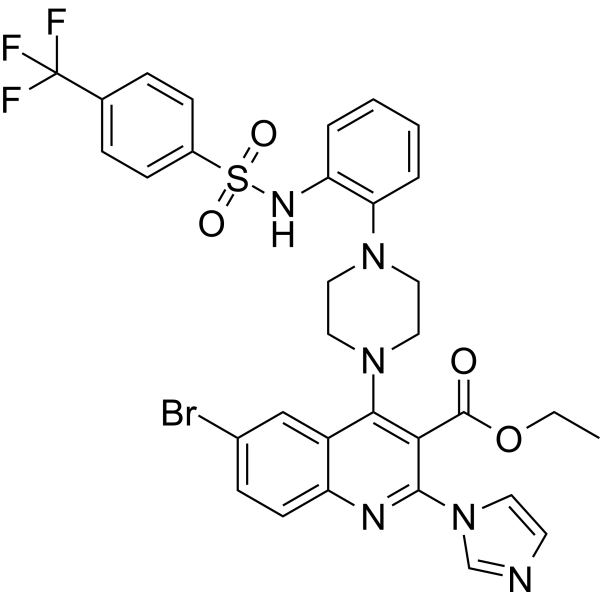
 0 ImagesCat. No.: HY-181097EGFR-IN-192 is an anticancer agent. EGFR-IN-192 inhibits EGFR (IC50: 0.12 μM), downregulates the HIF-VEGF and PI3K/AKT/mTOR pathways, upregulates the tumor suppressor gene PTEN, and induces cell cycle arrest and apoptosis in tumor cells. EGFR-IN-192 exhibits antitumor activity and can be used in tumor research.
-
(+)-Theta-cypermethrin
 0 ImagesCat. No.: HY-W714853CAS No.: 65732-07-2(+)-Theta-cypermethrin is a stereoisomer of Cypermethrin (HY-B0829) that possesses blood-brain barrier penetration ability and binds to AKT1, SRC, STAT3 and EGFR with high affinity. (+)-Theta-cypermethrin reduces the amplitude of delayed rectifier potassium channel currents, shifts the steady-state activation curve to negative potentials, and shifts the steady-state inactivation curve to negative potentials at higher concentrations. (+)-Theta-cypermethrin induces abnormal electrical activity in rat hippocampal neurons. (+)-Theta-cypermethrin causes chronic respiratory system damage and exhibits neurotoxicity.
-
EGFR/HER2-IN-5
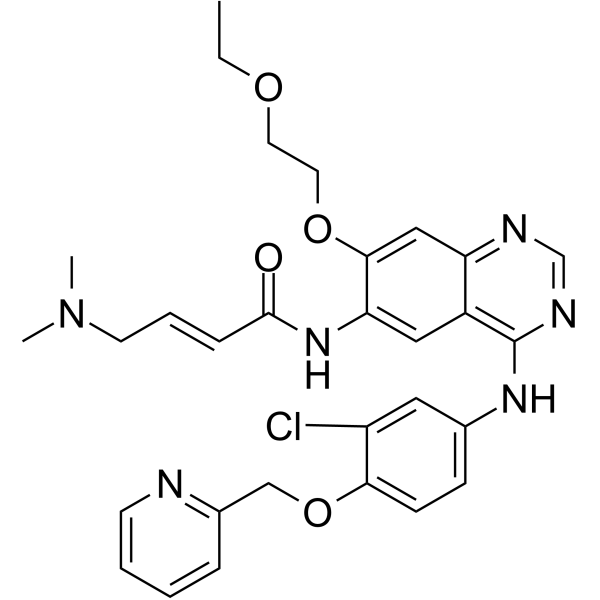 0 ImagesCat. No.: HY-147994CAS No.: 1879071-97-2EGFR/HER2-IN-5 (compound 6h) is an orally active irreversible dual inhibitor. EGFR/HER2-IN-5 inhibits EGFR with an IC50 value of 1.01 nM and demonstrates potent EGFR kinase inhibitory activities on L858R and T790M mutations. EGFR/HER2-IN-5 has potent antitumor efficacy in vivo and can be used for lung cancer research.
-
Degalactotigonin
 0 ImagesCat. No.: HY-N9684CAS No.: 39941-51-0Degalactotigonin is a saponin-selective inhibitor targeting the EGFR, GSK3β and Hedgehog/Gli1 pathways and can be isolated from Solanum nigrum (Solanum nigrum). Degalactotigonin inhibits EGFR phosphorylation and the downstream Akt/ERK signaling pathway, and at the same time inhibits the Hedgehog/Gli1 pathway through GSK3β inactivation, thereby inducing cancer cell apoptosis, arresting the cell cycle, and inhibiting migration and invasion. Degalactotigonin can be used in targeted research on malignant tumors such as pancreatic cancer and osteosarcoma.
-
Trastuzumab-DM21
 0 ImagesCat. No.: HY-185780Synonyms: T-DM21Trastuzumab-DM12 (T-DM21) is an antibody-drug conjugate (ADC). Trastuzumab-DM12 binds to HER2, inhibits HER2 shedding, and mediates antibody-dependent cellular cytotoxicity. Trastuzumab-DM12 is formed by conjugating the antibody Trastuzumab (HY-P9907) with DM-21 (HY-139441). Trastuzumab-DM12 can be used for cancer research.

-
PROTAC EGFR degrader 13
 0 ImagesCat. No.: HY-158313CAS No.: 2861227-35-0PROTAC EGFR degrader 13 (compound 106) is an EGFR PROTAC degrader with a DC50 of <0.1 μM. PROTAC EGFR degrader 13 has proliferation inhibitory activity on cell Ba/F3-TEL-EGFR-T790M-L858R-C797S with an IC50 of 15.6 nM. PROTAC EGFR degrader 13 can be used for the study of EGFR-related diseases such as cancer.
-
EGFR-IN-185
 0 ImagesCat. No.: HY-179143EGFR-IN-185 is a EGFR inhibitor. EGFR-IN-185 exhibits potent activity against non-small cell lung cancer (NSCLC) cells harboring EGFR mutations. EGFR-IN-185 inhibits colony formation and migration, induces G0/G1 arrest, and promots apoptosis, which are associated with the suppression of EGFR and AKT phosphorylation. EGFR-IN-185 can be used for the research of NSCLC.
-
Sutetinib maleate
 0 ImagesCat. No.: HY-164387ACAS No.: 1701408-75-4Sutetinib maleate is the maleate form of Sutetinib (HY-164387). Sutetinib maleate is an orally active inhibitor for tyrosine kinase, that is associated with tumor growth and angiogenesis, such as VEGFR (Ki= 0.009 µM for VEGFR-1/2/3), PDGFR (Ki= 0.008 µM for PDGFR-α/β) and proto-oncogene cKIT. Sutetinib maleate inhibits the proliferation, migration, and tubular structure formation of endothelial cells and fibroblasts, and exhibits board-spectrum antitumor efficacy in vitro and in vivo.
-
HER2-IN-12
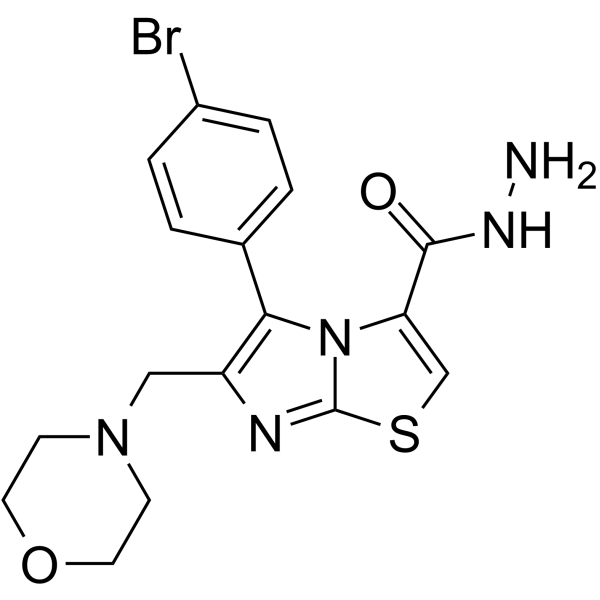 0 ImagesCat. No.: HY-151162CAS No.: 2820126-51-8HER2-IN-12 is a HER2 inhibitor (IC50: 121 nM). HER2-IN-12 can be used in the research of cancers, such as breast cancer.
-
EGFR-IN-121
 0 ImagesCat. No.: HY-162788CAS No.: 418799-16-3EGFR-IN-121 (compound 15) is a EGFR and VEGFR-2 dual inhibitor with IC50s of 84 and 3.5 nM, respectively.




