



PD-1/PD-L1
PD-1/Programmed death-ligand 1
Programmed death-1 (PD-1) is a cell surface receptor that functions as a T cell checkpoint and plays a central role in regulating T cell exhaustion. PD-1 is activated by the engagement of its ligands PDL-1 or PDL-2. PD-1 receptor delivers inhibitory checkpoint signals to activated T cells upon binding to its ligands PD-L1 and PD-L2 expressed on antigen-presenting cells and cancer cells, resulting in suppression of T-cell effector function and tumor immune evasion. Inhibiting the programmed cell death-1 (PD-1)/programmed cell death-ligand 1 (PD-L1) pathway is an attractive strategy for tumor immunotherapy.
PD-1 is expressed on activated T cells, B cells, monocytes, dendritic cells (DCs), regulatory T cells (Tregs), and natural killer T cells (NKT). It is a member of a family of immunoglobulin domain (Ig) co-receptors that modify the outcome of activation of the T cell receptor by an antigen-presenting cell (APC) or infected target cell. PD-L1 is widely and constitutively expressed on both hematopoietic and nonhematopoietic cells; e.g., naive T and B cells, vascular endothelial cells, and pancreatic islet cells, whereas PD-L2 is exclusively and inducibly expressed on professional APCs.
All Product Categories
-
PD-1/PD-L1 Inhibitors
(341)
View all products
-
PD-1/PD-L1 Agonists
(5)
View all products
-
PD-1/PD-L1 Antagonists
(11)
View all products
-
PD-1/PD-L1 Activators
(16)
View all products
-
PD-1/PD-L1 Modulators
(7)
View all products
-
PD-1/PD-L1 Inducers
(3)
View all products
-
PD-1/PD-L1 Degraders
(13)
View all products
-
PD-1/PD-L1 Control
(1)
View all products
-
PD-1/PD-L1 Substrates
(2)
View all products
-
PD-1/PD-L1 Ligands
(7)
View all products
-
PD-1/PD-L1 Related Products (451)
Related Products (451)

-
Antibodies (8)
-
PD-L1-IN-8
 0 ImagesCat. No.: HY-179447CAS No.: 3104751-99-4
-
PD-1/PD-L1-IN-25
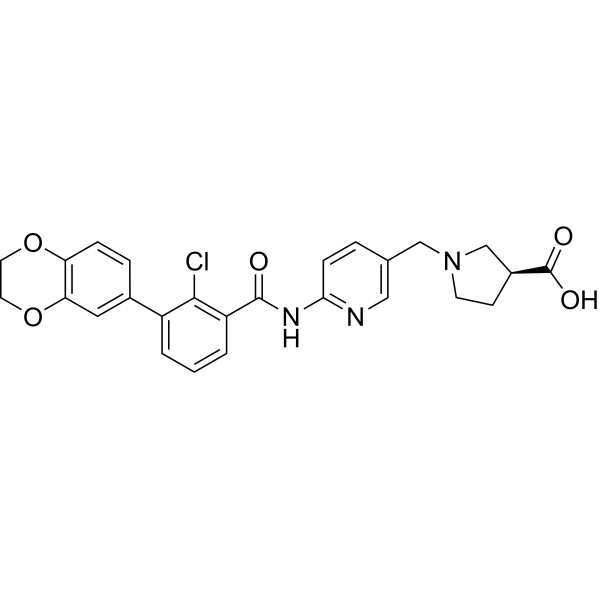 0 ImagesCat. No.: HY-143305CAS No.: 2768759-52-8PD-1/PD-L1-IN-25 (compound D2) is an inhibitor of PD-1/PD-L1 interaction with an IC50 value of 16.17 nM. PD-1/PD-L1-IN-25 activates the antitumor immunity of T cells efficiently in PBMCs. PD-1/PD-L1-IN-25 can be used for the research of cancer.
-
N-(8-Carboxyoctanoyl)-deacetyl BMS-202
 0 ImagesCat. No.: HY-182980N-(8-Carboxyoctanoyl)-deacetyl BMS-202 is a target protein ligand-linker conjugate. N-(8-Carboxyoctanoyl)-deacetyl BMS-202 contains the target protein PD-1/PD-L1 ligand and a PROTAC linker. N-(8-Carboxyoctanoyl)-deacetyl BMS-202 can be used for the synthesis of PROTAC PD-L1 Degrader-3 (HY-182959).
-
PD-L1/CD-73-IN-1
 0 ImagesCat. No.: HY-161677CAS No.: 3048634-84-7
-
OSE-279
 0 ImagesCat. No.: HY-P992434OSE-279 is a high-affinity humanized monoclonal bivalent antibody targeting PD-1, the recommended isotype control is HY-P99003. OSE-279 blocks PD-1 ligand binding, inhibits PDL1-induced SHP1 phosphorylation, restores T cell activation, and promotes reactivation of primary T cell effector functions. OSE-279 binds hFcRn receptor, predicts long half-life, induces CD4 and CD8 T cell proliferation, and promotes interleukin 2 and interferon gamma secretion. OSE-279 can be used for the research of advanced malignancies, colon cancer, hepatocarcinoma, mesothelioma.
-
dPDL1-4
 0 ImagesCat. No.: HY-174468dPDL1-4 is a potent and selective eHSPTAC eHSP90 PD-L1 degrader with DC50s of 7.77 μM and 6.52 μM in HeLa and B16F10 cells. dPDL1-4 bridges eHSP90 with the target protein, inducing lysosomal degradation. dPDL1-4 can degrade PD-L1 significantly and inhibits tumor growth. dPDL1-4 can be used for the study of cervical cancer and melanoma. ((Pink: eHSP90 ligand (HY-174476); Blue: PD-L1 ligand (HY-116274); Black: Linker (HY-W021787); HSP ligand + linker: HY-174799)).
-
PCC16 chloride
 0 ImagesCat. No.: HY-169232PCC16 chloride is a dual PROTAC degrader targeting DHHC3 and PD-L1, with a DC50 of 0.103 μM for PD-L1 degradation. PCC16 chloride induces DHHC3 degradation via the ubiquitin-proteasome pathway by recruiting the CRBN E3 ubiquitin ligase (E3 ubiquitin ligase). By targeting DHHC3-which is essential for PD-L1 palmitoylation and membrane stability-PCC16 chloride reduces PD-L1 levels, decreases PD-L1 membrane retention time, and impairs its immunosuppressive function. PCC16 chloride enhances anti-tumor immunity by disrupting PD-L1-mediated immunosuppression. PCC16 chloride can be used in the research of immune checkpoint blockade-resistant cancers.
-
PD-1/PD-L1-IN-15
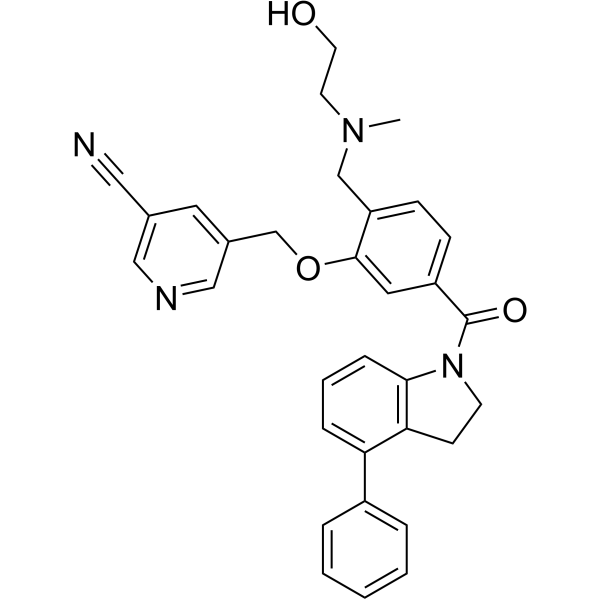 0 ImagesCat. No.: HY-144442CAS No.: 3033262-72-2
-
AMP-224
 0 ImagesCat. No.: HY-P991344
-
HDAC3-IN-7
 0 ImagesCat. No.: HY-172601CAS No.: 3104610-92-3HDAC3-IN-7 (Compound 8ae) is a selective HDAC3 inhibitor with an IC50 value of 311 nM. HDAC3-IN-7 degrades PD-L1 through the lysosome pathway mediated by Cathepsin B, exerting activities such as inhibiting tumor cell proliferation, migration, and invasion. HDAC3-IN-7 is promising for research of cancers.
-
BAT-1306
 0 ImagesCat. No.: HY-P991348BAT-1306 is a human monoclonal antibody (mAb) targeting PDCD1/PD-1/CD279. BAT-1306 can be used in Colorectal cancer and Solid tumours research.
-
Penpulimab (Anti-PD-1)
 0 ImagesCat. No.: HY-P99108ACAS No.: 2350298-92-7
-
PD-L1-IN-11
 0 ImagesCat. No.: HY-183887CAS No.: 324054-99-1PD-L1-IN-11 is a PD-L1 inhibitor with human PD-L1 IC50 and KD of 27.82 μM and 49.50 μM, respectively. PD-L1-IN-11 directly binds to PD-L1 via a dimer-locking mechanism, occluding the PD-1 interaction surface to disrupt PD-1/PD-L1 interaction. PD-L1-IN-11 can be used for the research of melanoma, colon carcinoma.

-
BMS-202 hydrochloride
 0 ImagesBMS-202 hydrochloride is a potent and nonpeptidic PD-1/PD-L1 complex inhibitor with an IC50 of 18 nM and a KD of 8 μM. BMS-202 hydrochloride binds to PD-L1 and blocks human PD-1/PD-L1 interaction. BMS-202 hydrochloride has antitumor activity.
-
PD-L1/HDAC-IN-1
 0 ImagesCat. No.: HY-172167CAS No.: 2923313-69-1PD-L1/HDAC-IN-1 (Compound 14) is the inhibitor for PD-L1 and HDAC that inhibits PD-1/PD-L1 interaction, HDAC2 and HDAC3 with IC50 of 88.10, 27.98 and 14.47 nM, respectively. PD-L1/HDAC-IN-1 exhibits slight cytotoxicity in MCF-7 (IC50=19.34 μM). PD-L1/HDAC-IN-1 upregulates the expression of PD-L1 and CXCL10, promoting anti-tumour immune response by recruiting T-cell infiltration into TME.
-
Anti-Mouse IFN Beta Antibody (MIB-5E9.1)
 0 ImagesCat. No.: HY-P991801Anti-Mouse IFN Beta Antibody (MIB-5E9.1) is an antibody targeting mouse IFN-β. Anti-Mouse IFN Beta Antibody (MIB-5E9.1) blocks the IFN-β signaling pathway, abolishes LPS-induced upregulation of B7H1 and GITRL in dendritic cells, restores dendritic cell-dependent T cell proliferation impaired by LPS exposure, and reverses LPS-induced upregulation of PD-1 on splenic T cells. Anti-Mouse IFN Beta Antibody (MIB-5E9.1) reduces LPS-induced upregulation of GITR on splenic T cells and inhibits LPS-mediated Treg priming.
-
Sulindac (Standard)
 0 ImagesSynonyms: MK-231 (Standard)Sulindac (Standard) is the analytical standard of Sulindac. This product is intended for research and analytical applications. Sulindac (MK-231) is an orally active nonsteroidal anti-inflammatory agent. Sulindac also is an immunomodulatory agent. Sulindac can be used for the research of arthritis of the spine, gouty arthritis and kinds of cancer including colorectal cancer (CRC) and lung cancer.
-
Icariside I (Standard)
 0 ImagesSynonyms: Icarisid I (Standard)Icariside I (Standard) is the analytical standard of Icariside I (HY-N1939). This product is intended for research and analytical applications. Icariside I (GH01) is an orally active metabolite of icalin. Icariside I improves estrogen deficiency-induced osteoporosis by simultaneously regulating osteoblast and osteoclast differentiation. Icariside I promotes ATP (HY-B2176) or Nigericin (HY-127019)-induced mtROS production and NLRP3 inflammasome activation and causes idiosyncratic hepatotoxicity. Icariside I does not alter the activation of NLRC4 and AIM2 inflammasomes. Icariside I inhibits breast cancer proliferation, apoptosis, invasion, and metastasis by targeting the IL-6/STAT3 pathway. Icariside I is a kynurenine-AhR pathway inhibitor that alleviates cancer by blocking tumor immune escape.
-
PF-06465469 (Standard)
 0 ImagesCat. No.: HY-108691RCAS No.: 1407966-77-1PF-06465469 (Standard) is the analytical standard of PF-06465469 (HY-108691). This product is intended for research and analytical applications. PF-06465469 is a covalent inhibitor of ITK with an IC50 of 2 nM. PF-06465469 also inhibits BTK. PF-06465469 inhibits cell migration in response to CXCL12. PF-06465469 decreases PD-1 and LAG-3 expression. PF-06465469 can be used to study leukemia and T-cell lymphoma.




