



PD-1/PD-L1-IN-25
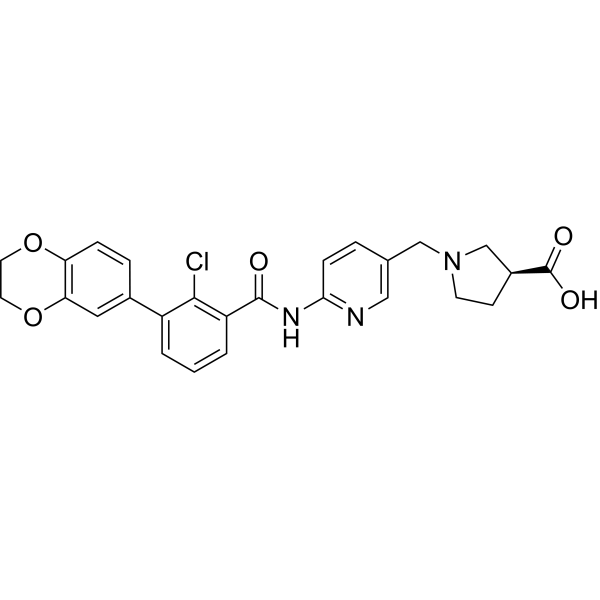
PD-1/PD-L1-IN-25 (compound D2) is an inhibitor of PD-1/PD-L1 interaction with an IC50 value of 16.17 nM. PD-1/PD-L1-IN-25 activates the antitumor immunity of T cells efficiently in PBMCs. PD-1/PD-L1-IN-25 can be used for the research of cancer.
For research use only. We do not sell to patients.
- CAS No.: 2768759-52-8
- Formula: C26H24ClN3O5
- Molecular Weight:493.94
-
Storage:
Please store the product under the recommended conditions in the Certificate of Analysis.

To place orders, for customer services and technical support, please contact: MedChemExpress USA
Tel: 609-228-6898 E-mail: [email protected] [email protected]


-
 Biological Activity
-
Chemical Information
- Protocols
- Purity & Documentation
- References
-
 Help & FAQs




Biological Activity
Description
IC50 & Target
IC50: 16.17 nM (PD-1/PD-L1)[1].
In Vitro
PD-1/PD-L1-IN-25 (0-1 μM; 90 min) inhibits PD-1/PD-L1 interaction with an IC50 value of 16.17 nM[1]. PD-1/PD-L1-IN-25 (0-2 μM; 2 h) activates the antitumor immunity of T cells efficiently in PBMCs[1].
MedChemExpress (MCE) has not independently confirmed the accuracy of these methods. They are for reference only. Further protocols information, click here.
-
Cell Line:MDA-MB 231 cells by human PBMCs
-
Concentration:0-2 μM
-
Incubation Time:2 hours
-
Result:Showed no toxicity towards MDA-MB 231 cells, and activated the antitumor immunity of PBMCs to kill MDA-MB 231 cells efficiently at a concentration of 1.0 μM.


Chemical Information
-
CAS No. 2768759-52-8
-
Molecular Weight 493.94
-
Formula C26H24ClN3O5
-
SMILES
O=C(C1=C(C(C2=CC3=C(OCCO3)C=C2)=CC=C1)Cl)NC4=NC=C(C=C4)CN5CC[C@@H](C5)C(O)=O
-
Shipping
Room temperature in continental US; may vary elsewhere.
-
Storage
Please store the product under the recommended conditions in the Certificate of Analysis.

Protocols
-
Cell Cytotoxicity Assay
Cytotoxicity assays are usually based on the assessment of cell membrane damage, which can also be indirectly detected by measuring cell viability. Detection methods include MTT assay, CKK-8 assay, LDH assay and ATP assay, etc.
-
Research Protocol for Cancer Immunology
Cancer immunology studies how the immune system recognizes, suppresses, edits, or fails to eliminate malignant cells through tumor antigen release, antigen presentation, T-cell priming, immune trafficking, tumor-cell killing, and feedback inhibition in the tumor microenvironment. The cancer-immunity cycle links tumor antigenicity, dendritic-cell priming, CD8+ T-cell infiltration, cytotoxic function, and immune-checkpoint regulation to tumor rejection or immune escape. Immune-checkpoint pathways such as PD-1/PD-L1 and CTLA-4 suppress antitumor T-cell activity and can be therapeutically blocked, but many tumors remain resistant because of poor antigen presentation, weak T-cell infiltration, suppressive myeloid cells, regulatory T cells, and tumor-intrinsic immune-exclusion programs. Unresolved questions include which immune-cell states predict response, how tumor-intrinsic pathways exclude immune cells, how myeloid suppression limits checkpoint blockade, and which combination strategies


Purity & Documentation
References

Calculators
Concentration (start) × Volume (start) = Concentration (final) × Volume (final)


PD-1/PD-L1-IN-25 Related Classifications
HY-143305 Related Classifications
 Powered by Bioz