



PKM2 Inhibitor
-
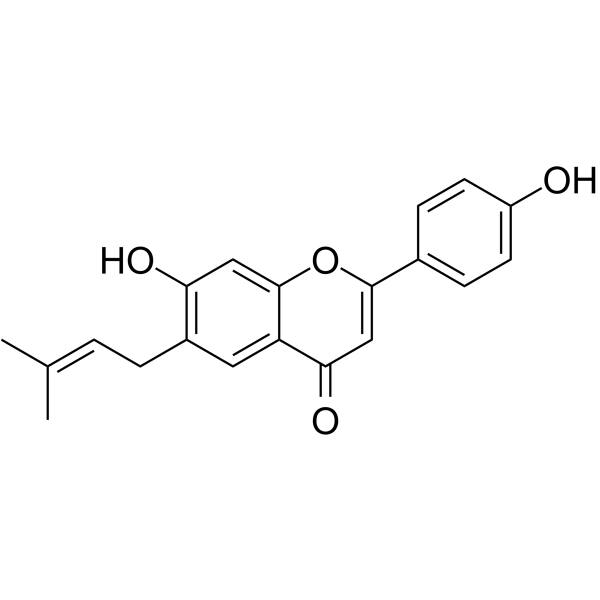
Licoflavone A
 0 Images
Licoflavone A is an orally active PTP1B/VEGFR-2 inhibitor, with an IC50 of 54.5 μM against PTP1B, an IC50 of 14.36 μM and a Kd of 142.38 nM against human VEGFR-2. Licoflavone A blocks the PI3K/AKT and MEK/ERK signaling pathways. Licoflavone A induces G1 phase cell cycle arrest, apoptosis via the intrinsic mitochondrial pathway (apoptosis), and inhibits migration, invasion and epithelial-mesenchymal transition (EMT) of gastric cancer cells. Licoflavone A inhibits the proliferation of gastric cancer cells in vitro and in xenograft models. Licoflavone A reduces the expression levels of HIF-1α, GLUT1, LDHA, PKM2 and HK2 in hypoxic gastric cancer cells, decreases glucose uptake and suppresses glycolysis. Licoflavone A can be used in research related to gastric cancer, type 2 diabetes and obesity.
-
LIQ1
 0 ImagesCat. No.: HY-179371CAS No.: 2606032-80-6
LIQ1, a flavonoid derivative, is a potent Pyruvate kinase M2 (PKM2) allosteric inhibitor (IC50 = 0.39 μM; Kd = 4.5 μM) targeting Arg43 within the polyarginine pocket. LIQ1 exhibits efficacy in a mouse model of LPS (HY-D1056)-induced endotoxemia, preventing the nuclear translocation of PKM2 and inhibiting its binding to HIF-1α, thereby suppressing IL-1β transcription. LIQ1 can be used for the research of endotoxemia[1].
-
PARP1/PKM2-IN-1
 0 ImagesCat. No.: HY-183765
PARP1/PKM2-IN-1 is a dual PARP1/PKM2 inhibitor, with an IC50 of 39.5 nM against PARP1, and IC50 values of 261 nM (recombinant PKM2) and 50 nM (dimeric PKM2) against PKM2. PARP1/PKM2-IN-1 reduces the dimerization of PKM2 and decreases its nuclear accumulation level. PARP1/PKM2-IN-1 also selectively downregulates PKM2 mRNA and impairs poly (ADP-ribose)-mediated nuclear retention of PKM2. PARP1/PKM2-IN-1 exhibits antiproliferative activity and inhibits the formation of 3D cancer spheroids. PARP1/PKM2-IN-1 can be used in research related to mammary adenocarcinoma, triple-negative breast cancer, BRCA1-mutant triple-negative breast cancer, and prostate adenocarcinoma.
-
PKM2-IN-10
 0 ImagesCat. No.: HY-172881
PKM2-IN-10 (Compound 16) is a PKM2 inhibitor. PKM2-IN-10 inhibits the proliferation of A549 and HCC1833 cell lines with IC50 of 3.36 μM and 9.20 μM, respectively. PKM2-IN-10 exhibits antitumor activity in human non-small cell lung cancer (NSCLC) and mouse lung adenocarcinoma models. PKM2-IN-10 can be used in lung cancer research.
-
PKM2-IN-13
 0 ImagesCat. No.: HY-180523
PKM2-IN-13 is a selective PKM2 inhibitor inhibiting PKM2 with an IC50 value of 55.13 μM. PKM2-IN-13 exhibits broad-spectrum anticancer activity with low toxicity to normal cells. PKM2-IN-13 induces apoptosis by elevated ROS levels and activation of caspases 3/7, and interacts with and inhibits the glycolytic activity of Pyruvate Kinase M2 in virto. PKM2-IN-13 demonstrates a favorable safety profile with no significant adverse effects in vivo. PKM2-IN-13 can be used for oral squamous cell carcinoma (OSCC), colon carcinoma, breast cancer and melanoma research.
-
Multi-target kinase-IN-9
 0 ImagesCat. No.: HY-182037
Multi-target kinase-IN-9 is a multi-target enzyme inhibitor with antiproliferative and antiangiogenic activities, and exhibits remarkable selectivity against hepatocellular carcinoma cells. By broadly binding to the active sites or ATP-binding regions of multiple key enzymes including DNA polymerase β, Pyruvate Kinase M2 (PKM2), Multi-target kinase-IN-9 comprehensively disrupts DNA repair and replication, glycolysis, chromatin dynamics and transcriptional programs, and blocks the self-renewal of cancer stem cells. Multi-target kinase-IN-9 induces genomic instability, lysosomal dysfunction and autophagic flux impairment, thereby triggering tumor cell death, effectively inhibiting tumor proliferation, invasion, metastasis and angiogenesis, and significantly reducing tumor volume in xenograft models. Multi-target kinase-IN-9 is applicable to hepatocellular carcinoma-related research.
-
PKM2-IN-12
 0 ImagesCat. No.: HY-178748
PKM2-IN-12 is an orally active PKM2 inhibitor with an IC50 of 10 nM. PKM2-IN-12 inhibits COLO-205 cell proliferation and migration, arrests the cell cycle, and induces apoptosis. PKM2-IN-12 significantly reduces cellular levels of lactate, pyruvate, and ROS. PKM2-IN-12 directly kills cancer cells and restores disrupted gut microbiota balance in mice model. PKM2-IN-12 can be used to study colorectal cancer.
-
PKM2-IN-11
 0 ImagesCat. No.: HY-178441
PKM2-IN-11 is a PKM2 inhibitor (IC50 = 0.363 μM). PKM2-IN-11 has dual mechanisms involving pyruvate kinase M2 (PKM2) inhibition and microtubule stabilization. PKM2-IN-11 can decrease PKM2 protein levels in MCF-7 cells. PKM2-IN-11 can slightly reduce reactive oxygen species (ROS) levels and significantly increase early apoptotic cells. PKM2-IN-11 induces G2/M phase arrest. PKM2-IN-11 can be used for the study of breast cancer.



