



Biochemical Assay Reagents
Biochemical agents refers to the life science research related to biological material or organic compounds. Due to a wide range of life sciences, rapid development, and therefore a wide variety of such agents, complex in nature. There are electrophoresis reagents, chromatography reagents, centrifuged reagents, immunological reagent, labeled reagent, staining agents, penetration agents and carcinogens variable, insecticides, culture, buffering agents, electron microscopy reagents, protein and nucleic acid precipitating agent, condensing agent ultrafiltration membrane, clinical diagnostic reagents, dyes, antioxidants, preservatives, detergents and surfactants, standard biochemical reagents, biochemical reagents quality control materials, separation material, etc..
All Product Categories
-
Biochemical Assay Reagents Inhibitors
(10)
View all products
-
Biochemical Assay Reagents Modulator
(1)
View all products
-
Biochemical Assay Reagents Chemicals
(7)
View all products
-
Biochemical Assay Reagents Inducer
(1)
View all products
-
Biochemical Assay Reagents Controls
(59)
View all products
-
Biochemical Assay Reagents Substrates
(4)
View all products
-
Biochemical Assay Reagents Ligand
(1)
View all products
-
Biochemical Assay Reagents Related Products (15918)
Related Products (15918)

-
Antibodies (44)
-
Triampyzine
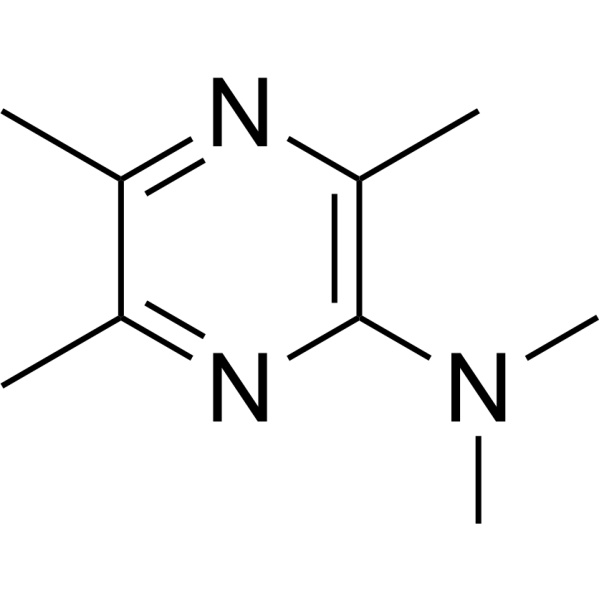 0 ImagesCat. No.: HY-W373206CAS No.: 6503-95-3Triampizine is a potent gastric antisecretory agent without the side effects of anticholinergic drugs. Triampizine may react with the excipient magnesium stearate and is used in studies of hyperacidity.
-
Glucose-PEG5000-OH
 0 ImagesCat. No.: HY-183164CGlucose-PEG5000-OH is a conjugate composed of glucose, PEG chains, and hydroxyl groups (-OH). Glucose-PEG5000-OH combines the targeted recognition capability of glucose with the modification flexibility of hydroxyl groups, enabling applications such as targeted drug delivery systems and nanoparticle modification.
-
C16-PEG2000-NHS
 0 ImagesCat. No.: HY-183134C16-PEG2000-NHS is a conjugate composed of hexadecyl (C16, i.e., palmitoyl), a PEG chain, and an active ester (NHS). C16-PEG2000-NHS combines the membrane compatibility of lipids with glucose as an active site for sugar recognition or subsequent conjugation reactions, making it suitable for research in biomaterial construction and drug delivery.
-
PLLA5000-PEG3000-SPDP
 0 ImagesCat. No.: HY-167319PLLA5000-PEG3000-SPDP is a polylactic acid derivative that can form micelles in water and the SPDP moiety can react with thiols. PLLA5000-PEG3000-SPDP can be used in drug delivery research.
-
PLLA1000-PEG2000-ALK
 0 ImagesCat. No.: HY-167406PLLA1000-PEG2000-ALK is a polylactic acid derivative that can form micelles in water. PLLA1000-PEG2000-ALK can be used in drug delivery research.
-
Mannose-PEG3400-NH2
 0 ImagesCat. No.: HY-183015BMannose-PEG3400-NH2 is composed of mannose, PEG chains, and terminal amino groups (–NH2). Mannose-PEG-NH2 combines the targeting recognition ability of mannose with the chemical modifiability of amino groups, making it suitable for applications such as targeted drug delivery systems and nanoparticle modification.
-
Methyl yellow
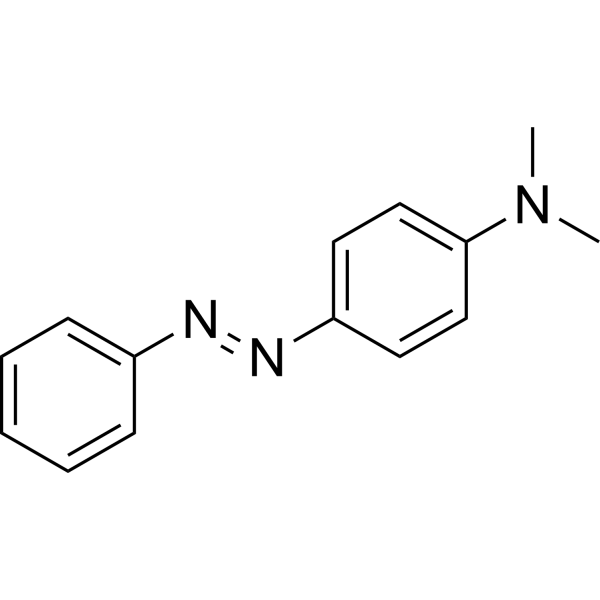 0 ImagesCat. No.: HY-W025785CAS No.: 60-11-7Synonyms: Solvent Yellow 2; Dimethyl yellowMethyl yellow (Solvent Yellow 2) is a pH indicator. Methyl yellow appears red at low pH, and becomes yellow above pH 4.0.
![1-Pyrroline-2-carboxylate reductase [NAD(P)H]](https://file.medchemexpress.com/product_pic/hy-e71399.gif "Click to View 1-Pyrroline-2-carboxylate reductase [NAD(P)H] Product Detail")
-
Trimethylsilyl-D-(+)-trehalose
 0 ImagesCat. No.: HY-W739308CAS No.: 42390-78-3Trimethylsilyl-D-(+)-trehalose is a biochemical assay reagent.
-
trans-2-Dodecenedioyl-CoA
 0 ImagesCat. No.: HY-CE01975CAS No.: 138149-22-1Synonyms: trans-2-Dodecenedioyl-coenzyme Atrans-2-Dodecenedioyl-CoA (trans-2-Dodecenedioyl-coenzyme A) is a coenzyme A derivative.
-
Catalase, Murine
 0 ImagesCat. No.: HY-135849HCatalase, Murine (EC 1.11.1.6) activates the decomposition of hydrogen peroxide, a reactive oxygen species, into water and oxygen. Catalase functions as a natural antioxidant, protecting cells against oxidative damage to proteins, lipids and nucleic acids.
-
Alloc-Aeg(Fmoc)-OH
 0 ImagesCat. No.: HY-P11694CAS No.: 570383-98-1Alloc-Aeg (Fmoc)-OH is a protected serine triphosphate building block and an Nα-Fmoc protected amino acid. Alloc-Aeg (Fmoc)-OH contains serine protected by α-N-allyloxycarbonyl (Alloc) and bis (allyl) phosphate groups, and it can be used in the synthesis of peptide nucleic acids (PNAs). Alloc-Aeg (Fmoc)-OH is applicable to research related to Alzheimer's disease.
-
2,4-Dimethylhexanedioyl-CoA
 0 ImagesCat. No.: HY-CE00683Synonyms: 2,4-Dimethylhexanedioyl-coenzyme A2,4-Dimethylhexanedioyl-CoA (2,4-Dimethylhexanedioyl-coenzyme A) is a coenzyme A derivative.
-
3,12-Dihydroxytetradecanoyl-CoA
 0 ImagesCat. No.: HY-CE00646Synonyms: 3,12-Dihydroxytetradecanoyl-coenzyme A3,12-Dihydroxytetradecanoyl-CoA (3,12-Dihydroxytetradecanoyl-coenzyme A) is a coenzyme A derivative.
-
trans-2,cis-6-Nonadienal-d5
 0 ImagesCat. No.: HY-W769547trans-2,cis-6-Nonadienal-d5 is the deuterium labeled Trans-2,cis-6-Nonadienal (HY-W127515). Trans-2, cis-6-NonadienalIt is an organic compound belonging to aldehydes. It has a strong, pungent smell and is commonly found in a variety of foods, including fruits and vegetables. Trans-2, cis-6-NonadienalIt has a variety of applications in the flavor and fragrance industry, especially as a fragrance agent in products such as perfume, cologne and air fresheners. In addition, it can also be used as an intermediate in the synthesis of various chemicals and drugs.
-
L-KYFIL
 0 ImagesCat. No.: HY-P10661L-KYFIL is a pentapeptide that is amorphous on its own. When mixed with D-KYFIL, it transforms from fibrous hydrogels into plate-like networks, resulting in changes in mechanical properties and forming a crystalline state. The mixture can protect L-KYFIL from proteolytic degradation. L-KYFIL can be used to study stereocomplexation behavior of peptide sequences and in the development of biomaterials.
-
7-Oxononanoyl-CoA
 0 ImagesCat. No.: HY-CE01343Synonyms: 7-Oxononanoyl-coenzyme A7-Oxononanoyl-CoA (7-Oxononanoyl-coenzyme A) is a coenzyme A derivative.
-
Chloramphenicol 3-O-β-D-glucuronide
 0 ImagesCat. No.: HY-W587441CAS No.: 39751-33-2Chloramphenicol 3-O-β-D-glucuronide is a class of biochemical reagents used in glycobiology research. Glycobiology studies the structure, synthesis, biology, and evolution of sugars. It involves carbohydrate chemistry, enzymology of glycan formation and degradation, protein-glycan recognition, and the role of glycans in biological systems. This field is closely related to basic research, biomedicine, and biotechnology.

-
4-Chloro-2-cyclopentylphenyl β-D-galactopyranoside
 0 ImagesCat. No.: HY-W739420CAS No.: 24718-43-24-Chloro-2-cyclopentylphenyl β-D-galactopyranoside is a class of biochemical reagents used in glycobiology research. Glycobiology studies the structure, synthesis, biology, and evolution of sugars. It involves carbohydrate chemistry, enzymology of glycan formation and degradation, protein-glycan recognition, and the role of glycans in biological systems. This field is closely related to basic research, biomedicine, and biotechnology.




