



Drug Intermediate
Drug Iintermediate
Drug intermediates are used as raw materials for the production of bulk drugs, or they can refer to a material produced during synthesis of an API that must undergo further molecular change or processing before it becomes an API. Drug intermediates are hygienically formulated using high grade raw materials and they are used in the pharmaceutical and cosmetic industry[1][2].
References:
- [1]. Ma HC, et al. Homochiral Covalent Organic Framework for Catalytic Asymmetric Synthesis of a Drug Intermediate. J Am Chem Soc. 2020 Jul 22;142(29):12574-12578. [Content Brief]
- [2]. Ramachary D B, et al. Development of pharmaceutical drugs, drug intermediates and ingredients by using direct organo‐click reactions[J]. 2008.
All Product Categories
-
Drug Intermediate Related Products (4723)
Related Products (4723)

-
Tranexamic acid impurity 1
 0 ImagesCat. No.: HY-W063191CAS No.: 1197-17-7
-
6,7-Dihydropyrazino[2,3-d]pyridazine-5,8-dione
![6,7-Dihydropyrazino[2,3-d]pyridazine-5,8-dione](https://file.medchemexpress.com/product_pic/hy-z4491.gif "Click to View 6,7-Dihydropyrazino[2,3-d]pyridazine-5,8-dione Product Detail") 0 ImagesCat. No.: HY-Z4491CAS No.: 13480-40-56,7-Dihydropyrazino[2,3-d]pyridazine-5,8-dione impurity is a drug impurity.
0 ImagesCat. No.: HY-Z4491CAS No.: 13480-40-56,7-Dihydropyrazino[2,3-d]pyridazine-5,8-dione impurity is a drug impurity.
-
(R)-1,4-Dibenzyl-2-(chloromethyl)piperazine
 0 Images(R)-1,4-Dibenzyl-2-(chloromethyl)piperazine is a drug intermediate for synthesis of various active compounds.
-
5-Methoxyquinolin-8-amine
 0 Images5-Methoxyquinolin-8-amine is an intermediate. 5-Methoxyquinolin-8-amine can be used to synthesize SND1 inhibitors. 5-Methoxyquinolin-8-amine is applicable to breast cancer-related research.
-
tert-Butyl (trans-3-(pyridin-4-yloxy)cyclobutyl)carbamate
 0 Imagestert-Butyl (trans-3-(pyridin-4-yloxy)cyclobutyl)carbamate is a drug intermediate for synthesis of various active compounds.
-
Butenafine impurity 2
 0 ImagesCat. No.: HY-W095754CAS No.: 120118-14-1
-
Thiophene-2-amidoxime
 0 ImagesThiophene-2-amidoxime is a synthetic intermediate useful for pharmaceutical synthesis.
-
5-Hydroxypyrazine-2-Carboxylic Acid
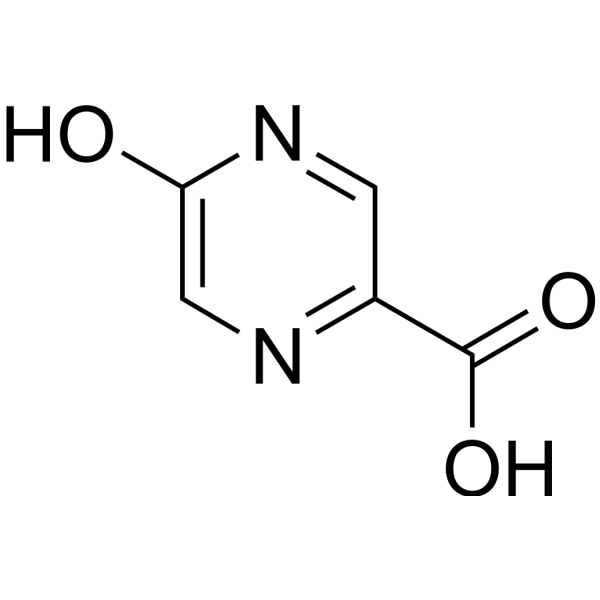 0 Images5-Hydroxypyrazine-2-Carboxylic Acid is a dibasic acid and also a urinary metabolite of coffee-derived 2-methylpyrazine (HY-W067358). 5-Hydroxypyrazine-2-Carboxylic Acid serves as an intermediate in the production of anti-tuberculosis reagents. It can be used in research related to tuberculosis[1][2].
-
Atenolol impurity 5
 0 ImagesCat. No.: HY-W015598CAS No.: 17194-82-0Synonyms: p-Hydroxy pheny lacetamideAtenolol impurity 5 (p-Hydroxy pheny lacetamide) is an impurity of Atenolol.
-
L-Orinithine lactam hydrochloride
 0 ImagesCat. No.: HY-W003592ACAS No.: 42538-31-8L-Orinithine lactam hydrochloride is a synthetic intermediate. L-Orinithine lactam (hydrochloride) can be used in the synthesis of dipeptidyl peptidase 4 (DPP-4) inhibitors, as well as signaling peptides.
-
Menthyl isovalerate
 0 ImagesMenthyl isovalerate is an ester formed by menthol and isovaleric acid. Menthyl isovalerate can be used as a food additive for flavor and fragrance.
-
2-Acetoxyacetic acid
 0 ImagesCat. No.: HY-W102363CAS No.: 13831-30-62-Acetoxyacetic acid is a drug intermediate that can be used for the synthesis of truncated sidroxil derivatives.

-
8-Chloroisoquinolin-3(2H)-one
 0 ImagesCat. No.: HY-23636CAS No.: 51463-18-48-Chloroisoquinolin-3(2H)-one is a drug intermediate for synthesis of various active compounds.
-
tert-Butyl (R)-2-(3-(3-(3,4-dimethoxyphenyl)-1-hydroxypropyl)phenoxy)acetate
 0 ImagesCat. No.: HY-24170CAS No.: 178445-89-1tert-Butyl (R)-2-(3-(3-(3,4-dimethoxyphenyl)-1-hydroxypropyl)phenoxy)acetate is a drug intermediate for synthesis of various active compounds.
-
2-Fluorofluoren-9-one
 0 Images2-Fluorofluoren-9-one is a drug intermediate for synthesis of various active compounds.
-
Pyrimidin-4-yl-methanol
 0 ImagesCat. No.: HY-W017825CAS No.: 33581-98-5Pyrimidin-4-yl-methanol is a synthetic intermediate useful for pharmaceutical synthesis.
-
tert-Butyl 1-(hydroxymethyl)hexahydropyrrolo[3,4-c]pyrrole-2(1H)-carboxylate hydrochloride
![tert-Butyl 1-(hydroxymethyl)hexahydropyrrolo[3,4-c]pyrrole-2(1H)-carboxylate hydrochloride](https://file.medchemexpress.com/product_pic/hy-waa0022.gif "Click to View tert-Butyl 1-(hydroxymethyl)hexahydropyrrolo[3,4-c]pyrrole-2(1H)-carboxylate hydrochloride Product Detail") 0 ImagesCat. No.: HY-WAA0022CAS No.: 2448475-38-3tert-Butyl 1-(hydroxymethyl)hexahydropyrrolo[3,4-c]pyrrole-2(1H)-carboxylate hydrochloride is a drug intermediate for synthesis of various active compounds.
0 ImagesCat. No.: HY-WAA0022CAS No.: 2448475-38-3tert-Butyl 1-(hydroxymethyl)hexahydropyrrolo[3,4-c]pyrrole-2(1H)-carboxylate hydrochloride is a drug intermediate for synthesis of various active compounds.
-
L-Isoleucic acid
 0 ImagesCat. No.: HY-35034CAS No.: 51576-04-6Synonyms: (2S,3S)-2-Hydroxy-3-methylpentanoic acidL-Isoleucic acid ((2S,3S)-2-Hydroxy-3-methylpentanoic acid) ((S)-isoleucic acid) is a non-proteinogenic amino acid derivative. L-Isoleucic acid can be used as a key synthetic building block to construct JBIR-39.



