



Fluorescent Dye
Fluorescence is a phenomenon of photoluminescence in luminescence. When an atom is irradiated by light, some electrons around the nucleus jump from their original orbitals to higher energy orbitals under the influence of light energy, i.e., from the ground state to the first or second excited single-line state, etc. Due to the instability of the first or second excited singlet state, the electron returns from the excited singlet state to the ground state accompanied by released energy, resulting in fluorescence.
Fluorescent dyes can be covalently bound or physically adsorbed in the structure of the substance. The fluorescence properties allow for the characterization, localization and quantitative analysis of the labeled object. Fluorescent dyes have shown great potential for the detection of proteins, nucleic acids, cells, and immunoassays, attributed to the advantages in non-radioactive contamination, simple experimental operation and easy observation.
Fluorescent dyes have penetrated many fields such as pharmacology, physiology, environmental science, and information science, as well as functional studies of proteins and drug screening.
All Product Categories
-
Fluorescent Dye Related Products (4889)
Related Products (4889)

-
Antibodies (4)
-
FITC-Alginate
 0 ImagesCat. No.: HY-D3033FITC-Alginate is a FITC (HY-66019)-labeled sodium alginate. FITC-Alginate acts as a fluorescent dye and probe, which enables the visualization of sodium alginate microspheres, microreservoirs, and sodium alginate-iron complexes via confocal microscopy, providing support for structural characterization, distribution analysis, and cell localization studies. The excitation/emission wavelengths of FITC-Alginate are 488 nm/~550 nm.
-
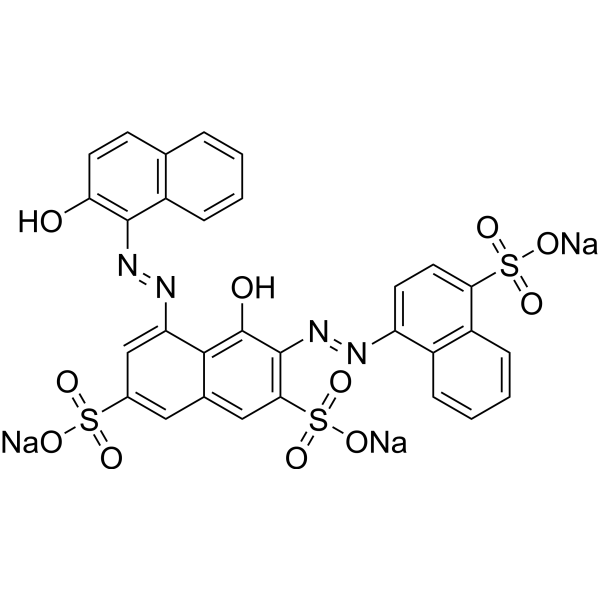
(E,E)-3,5-Bis(phenylethenyl)-BODIPY lipid stain
 0 ImagesCat. No.: HY-D3499CAS No.: 148185-53-9(E,E)-3,5-Bis(phenylethenyl)-BODIPY lipid stain is a fluorescent dye for intracellular lipid droplets. It is primarily used for specific fluorescent labeling and dynamic tracking of lipid droplets in living or fixed cells (Ex/Em = 627 nm/640 nm).

-
Ricinus Communis Agglutinin I (Rhodamine)
 0 ImagesCat. No.: HY-NP0157Synonyms: RCA I (Rhodamine)Ricinus Communis Agglutinin I (RCA I) Rhodamine is a plant lectin that can be used as a probe to specifically bind biomolecules (such as polysaccharides, peptides, etc.).Ricinus Communis Agglutinin I (RCA I) Rhodamine is a biological material or organic compound that can be used in life science research.
-
RB-PEG3400-Biotin
 0 ImagesCat. No.: HY-D2889DSynonyms: Rhodamine B-PEG3400-BiotinRB-PEG3400-Biotin (Rhodamine B-PEG3400-Biotin) is a fluorescent dye composed of Rhodamine B (HY-Y0016), PEG and a Biotin. Biotin can bind with high affinity to streptavidin or avidin. RB-PEG3400-Biotin plays an important role in the specific capture and detection of biomolecules (Ex/Em=546/610 nm).
-
CTAP-1
 0 ImagesCat. No.: HY-D3255CAS No.: 866534-64-7CTAP-1 is a monovalent copper ion probe. CTAP-1 binds to monovalent copper Cu (I) to inhibit photoinduced electron transfer, thereby enhancing fluorescence emission. CTAP-1 produces copper-dependent perinuclear staining that colocalizes with mitochondria and the Golgi apparatus. CTAP-1 can be used for imaging Cu (I) pools, excitation/emission Wavelength: 365/480 nm.
-
AF633 C5 Maleimide
 0 ImagesCat. No.: HY-D3582AF633 C5 Maleimide is a fluorescent dye used for surface protein labeling of extracellular vesicles and peptide labeling. AF633 C5 Maleimide covalently binds to protein thiol residues under neutral pH conditions (6.5-7.5), enabling visualization and quantitative analysis of extracellular vesicle uptake by target cells. AF633 C5 Maleimide undergoes maleimide-cysteine conjugation with cysteine residues on peptides in acetonitrile-water buffer solution, supporting detection of peptide-functionalized gold nanorods via confocal laser scanning microscopy, as well as tracking their cellular uptake and localization.
-
Cyanine 3 DBCO chloride
 0 ImagesCat. No.: HY-N16310CAS No.: 3091879-37-4
-
FAM labled IONIS-FGFR4Rx sodium
 0 ImagesCat. No.: HY-159691CFAM labled IONIS-FGFR4Rx sodiumis a FAM labled IONIS-FGFR4Rx sodium.
-
TAMRA-PEG2-NH2
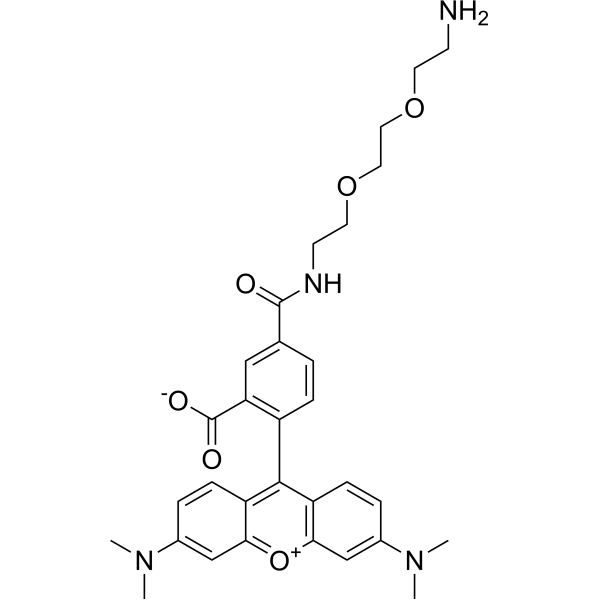 0 ImagesCat. No.: HY-D2098CAS No.: 1425379-69-6TAMRA-PEG2-NH2 is a dye derivative of TAMRA (HY-135640) containing 4 PEG units. TAMRA-PEG2-NH2 exhibits an excitation wavelength of around 550 nm and an emission wavelength of roughly 580 nm.
-
FURA-PE3/AM
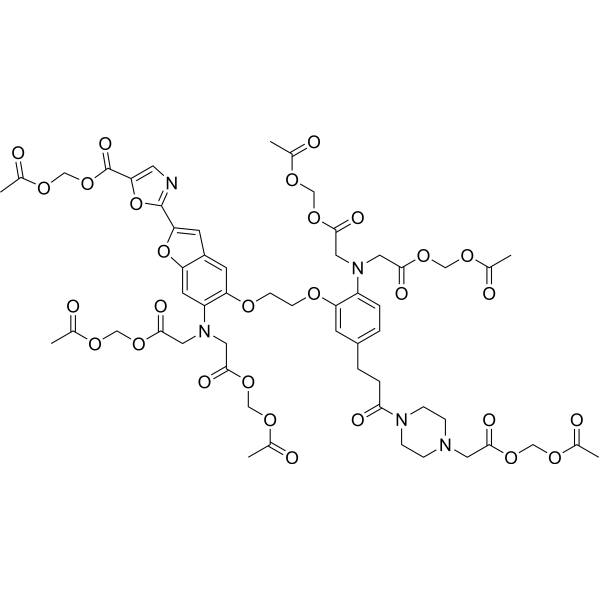 0 ImagesCat. No.: HY-D1502CAS No.: 172890-84-5FURA-PE3/AM is a leak-resistant fluorescent calcium indicator dye.
-
Rhodamine-PEG10000
 0 ImagesCat. No.: HY-D2892HRhodamine-PEG10000 a fluorescent PEG derivative composed of Rhodamine B (HY-Y0016) and PEG. Rhodamine-PEG10000 can be used for fluorescent labeling and imaging (Ex/Em=546/610 nm).
-
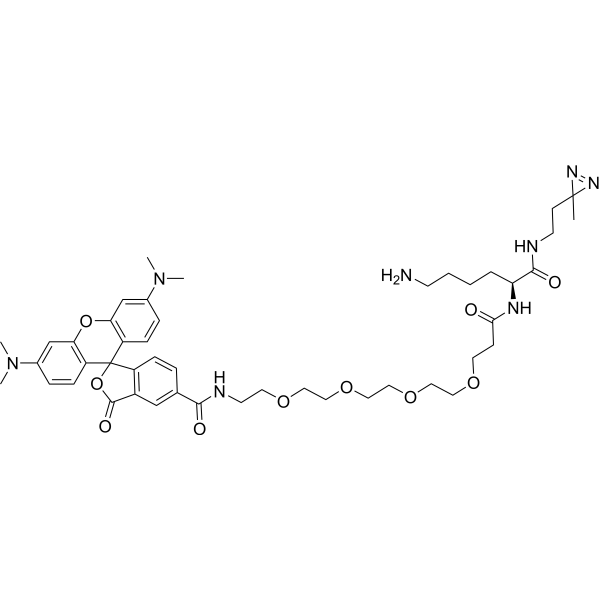
Cy3 labled Vutrisiran sodium
 0 ImagesCat. No.: HY-132589ECy3 labled Vutrisiran sodium is a Cy3 labled Vutrisiran sodium.
-
AMCA-PEG4-propargyl
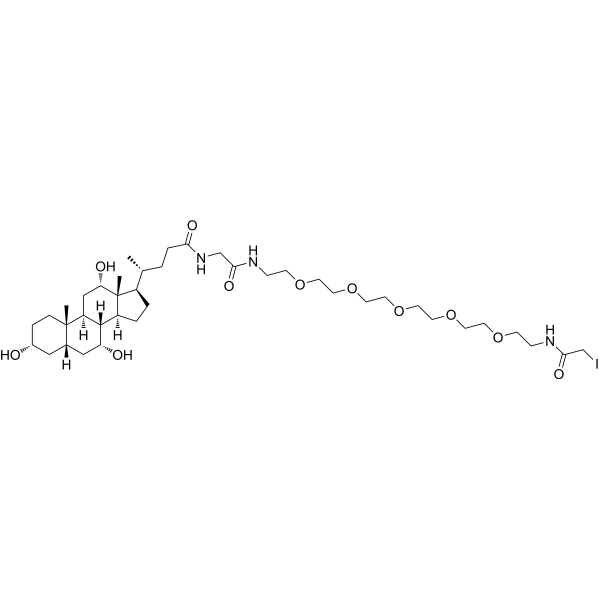
 0 ImagesCat. No.: HY-D3344AMCA-PEG4-propargyl is a derivative of AMCA featuring a propargyl group for CuAAC click chemistry reactions. It incorporates a PEG4 linker to enhance solubility and reduce steric hindrance. AMCA-PEG4-propargyl is primarily used for click chemistry-based bioconjugation (Ex/Em = 347/444 nm).

-
Mito-RhFe
 0 ImagesCat. No.: HY-D3128CAS No.: 2348351-60-8Mito-RhFe is a Fluorescent probe for mitochondrial labile Fe³⁺ monitoring via imaging and flow cytometry. This probe is a rhodamine-based construct with a spirolactam fluorescence signaling group and an N2-hydroxyethyldiethylenetriamine chelator; its delocalized positive charge enables mitochondria-targeting ability in live cells, and it exhibits fine cell membrane permeability. In its native state, it exists in the non-fluorescent spirolactam form, but upon binding to Fe³⁺, it undergoes a ring-opening conversion to the fluorescent rhodamine form, triggering a turn-on fluorescent response; this process is reversible, as the addition of the metal chelator TPEN removes Fe³⁺ and converts the probe back to its non-fluorescent spirolactam form, and re-addition of Fe³⁺ restores fluorescence. The probe shows high selectivity for Fe³⁺ over most other metal cations present in living systems, with a ~90-fold fluorescence enhancement upon binding to 20 equiv of Fe³⁺. Mito-RhFe has excitation/emission wavelengths of Ex/Em = 540/578 nm, with an ~8 nm bathochromic shift in emission upon Fe³⁺ binding, and it can also be excited at 543 nm for confocal imaging with emission detected at 570-620 nm[1].
-
Cy3 labled Vesleteplirsen sodium
 0 ImagesCat. No.: HY-132585ECy3 labled Vesleteplirsen sodium is a Cy3 labled Vesleteplirsen sodium.




