



Fluorescent Dye
Fluorescence is a phenomenon of photoluminescence in luminescence. When an atom is irradiated by light, some electrons around the nucleus jump from their original orbitals to higher energy orbitals under the influence of light energy, i.e., from the ground state to the first or second excited single-line state, etc. Due to the instability of the first or second excited singlet state, the electron returns from the excited singlet state to the ground state accompanied by released energy, resulting in fluorescence.
Fluorescent dyes can be covalently bound or physically adsorbed in the structure of the substance. The fluorescence properties allow for the characterization, localization and quantitative analysis of the labeled object. Fluorescent dyes have shown great potential for the detection of proteins, nucleic acids, cells, and immunoassays, attributed to the advantages in non-radioactive contamination, simple experimental operation and easy observation.
Fluorescent dyes have penetrated many fields such as pharmacology, physiology, environmental science, and information science, as well as functional studies of proteins and drug screening.
All Product Categories
-
Fluorescent Dye Related Products (4888)
Related Products (4888)

-
Antibodies (4)
-
Citrazinic acid
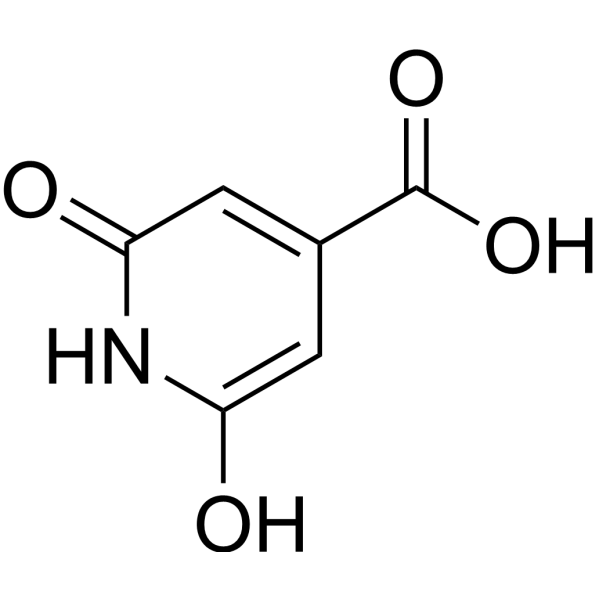 0 ImagesCat. No.: HY-W025817CAS No.: 99-11-6Citrazinic acid is a weakly fluorescent compound whose optical properties are dependent on aggregation states and chemical environment. Citrazinic acid strongly tends to form dimers at high concentrations.
-
5-TAMRA-DBCO
 0 ImagesCat. No.: HY-D2891CAS No.: 2071694-39-65-TAMRA-DBCO is a fluorescent dye that combines 5-TAMRA (HY-15942) with a dibenzocyclooctyne (DBCO) moiety. 5-TAMRA-DBCO is able to copper-free click chemistry reactions with azide-functionalized molecules. 5-TAMRA-DBCO can be used for labeling proteins, peptides, nucleic acids (Ex/Em = 541/567 nm).
-
ATTO 565 maleimide
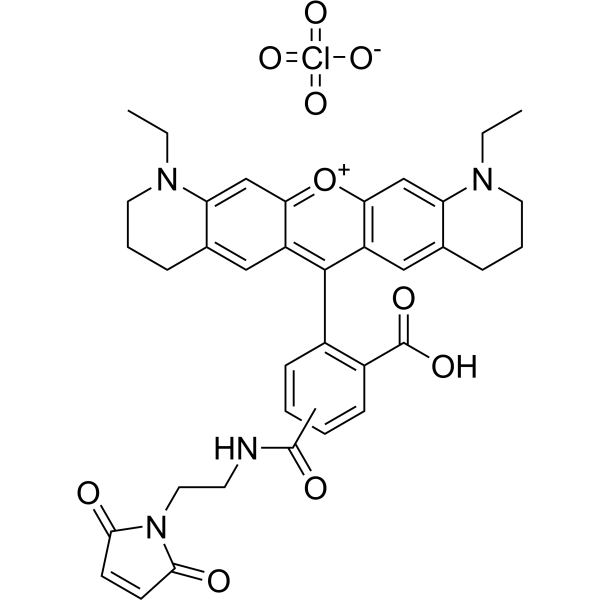 0 ImagesCat. No.: HY-D1961ATTO 565 maleimide is a new fluorescent marker based on the Rhodamine structure. It has strong absorption, high fluorescence quantum yield, high thermal stability and photochemical stability, and is suitable for single molecule detection and high-resolution microscopy. ATTO 565 maleimide is a maleimide derivative of ATTO 565, which can be used to label proteins or antibodies.
-
Mem-C1C18
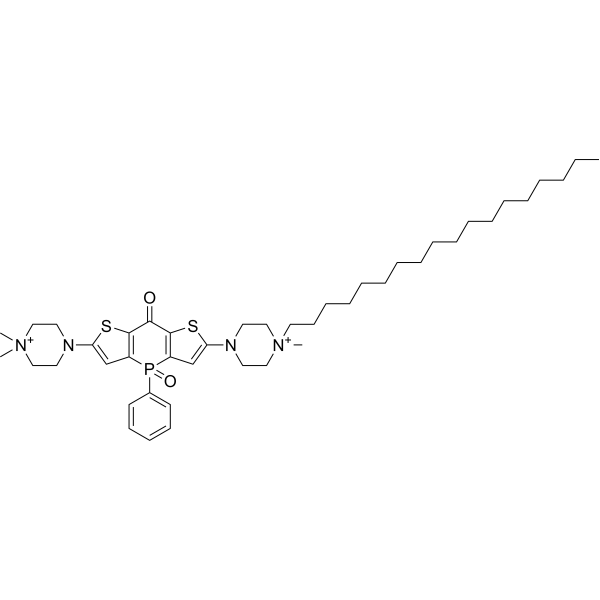 0 ImagesCat. No.: HY-149028Mem-C1C18 is a polarity-sensitive fluorescent probe with excellent plasma membrane anchoring, high brightness and a sensitive response to environmental polarity by altering the fluorescence lifetime. Mem-C1C18 can be used to quantify changes in the polarity of the plasma membrane during iron death.
-
4,5-Diamino-N,N,N',N'-tetraethyl-rhodamin
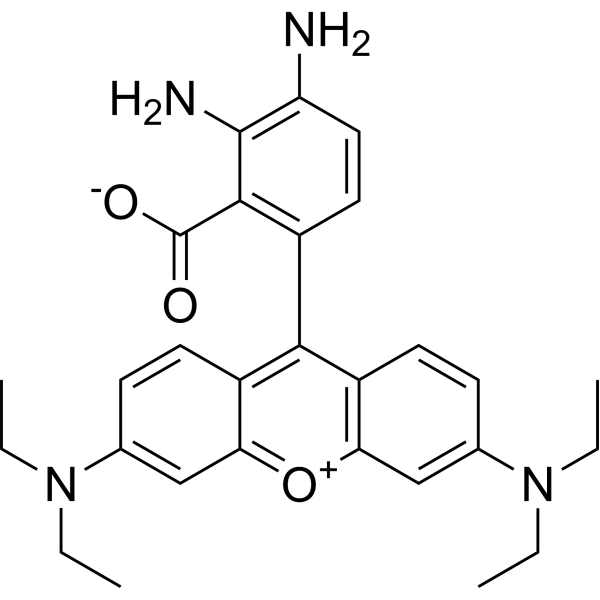 0 ImagesCat. No.: HY-D0081CAS No.: 261351-43-34,5-Diamino-N,N,N',N'-tetraethyl-rhodamin is a multifunctional dye. Dyes are important tools in biological experiments. They can help researchers observe and analyze cell structures, track biomolecules, evaluate cell functions, distinguish cell types, detect biomolecules, study tissue pathology and monitor microorganisms. Their applications range from basic scientific research to clinical A wide range of diagnostics. Dyes are also widely used in traditional fields such as textile dyeing, as well as in emerging fields such as functional textile processing, food pigments and dye-sensitized solar cells.
-
R-PE Streptavidin
 0 ImagesCat. No.: HY-D3558R-PE Streptavidin is a streptavidin labeled with R-Phycoerythrin (R-PE) at a concentration of 0.5 mg/mL. R-Phycoerythrin is an orange-red fluorescent probe. Streptavidin specifically binds to biotin, forming a reversible non-covalent interaction. R-PE Streptavidin is commonly used in experiments such as immunofluorescence (IF), enzyme-linked immunosorbent assay (ELISA), immunohistochemical staining (IFH), and in situ hybridization (Ex/Em=785/813 nm).
-
Cy3-PEG3400-NH2
 0 ImagesCat. No.: HY-D2506Cy3-PEG3400-NH2 is a polyethylene glycol derivative containing Cy3 (HY-D0822) fluorescent dye and polyethylene glycol (PEG) and an amino group. The Cy3 fluorophore is commonly used in applications such as immunolabeling, nucleic acid labeling, fluorescence microscopy, and flow cytometry. Cy3 has an emission maximum around 562-570 nm. Cy3-PEG3400-NH2 can be used for fluorescence imaging, fluorescence tracing and fluorescence labeling.
-
ROX NHS ester, 6-isomer
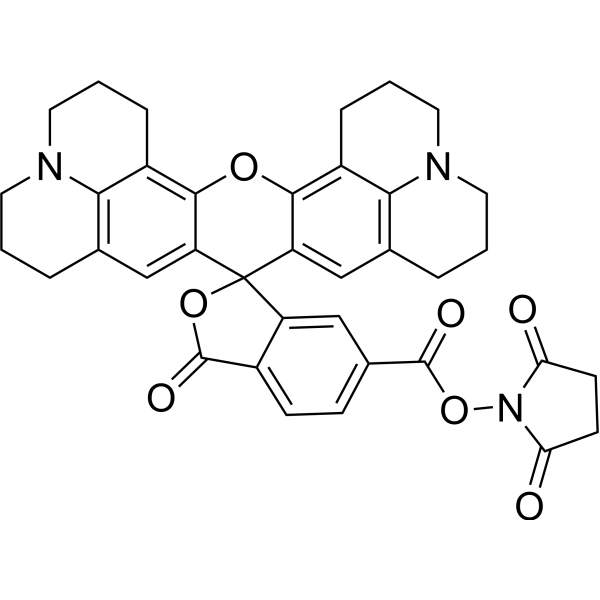 0 ImagesCat. No.: HY-D1756CAS No.: 117491-83-5ROX NHS ester, 6-isomer is a highly fluorescent, and photostable rhodamine dye for various applications. ROX labeled oligonucleotide probes are often used in qPCR, and qPCR instruments have ROX channel. This is reactive dye for the labeling of amino-groups in peptides, proteins, and amino-oligonucleotides. Pure single isomer.
-
NRERcl
 0 ImagesCat. No.: HY-D3093CAS No.: 2757682-02-1NRERcl is a Golgi-targeting lipid order probe. NRERcl can be used for imaging the lipid order and polarity of the endoplasmic reticulum. NRERcl carries a propyl chloride targeting group that directs it to the endoplasmic reticulum, and it functions via excited-state charge transfer, emitting colors according to local polarity changes associated with lipid order. NRERcl partitions into lipid membranes, with a higher fluorescence quantum yield in membrane environments than in aqueous buffers; its excitation wavelength is 520 nm, and the emission maximum varies with the environment (Ex/Em = 520/584-653 nm).
-
1,2-Dimethylpyridinium iodide-Bodipy
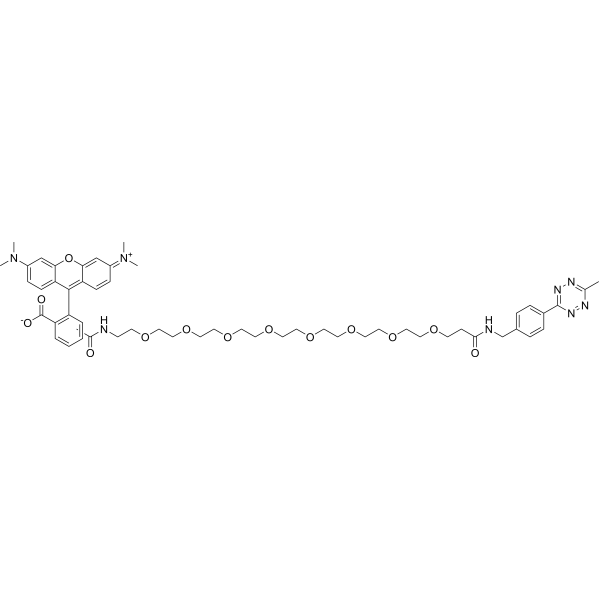
 0 ImagesCat. No.: HY-D2997CAS No.: 2705175-73-91,2-Dimethylpyridinium iodide-Bodipy (Probe 1) is an H2S fluorescent probe. Self-assembled 1,2-Dimethylpyridinium iodide-Bodipy exhibits highly efficient responsiveness to H2S. The assembled form of 1,2-Dimethylpyridinium iodide-Bodipy emits near-infrared fluorescence at 718 nm upon H2S activation.


-
FITC-CM-Polysucrose 400
 0 ImagesCat. No.: HY-179068AFITC-CM-Polysucrose 400 is FITC-labeled CM-Polysucrose 400. Polysucrose 70 is a high molecular weight branched polysaccharide polymer. FITC-CM-Polysucrose 400 is mainly used for permeability and microcirculation studies (Ex/Em = 488/525 nm).
-
RAPID DiO
 0 ImagesCat. No.: HY-D3372Synonyms: Dilinoleyl DiORAPID DiO (Dilinoleyl DiO) is a cyanine dye with green fluorescence (EX≈490 nm; Em≈505 nm). RAPID DiO is a lipophilic dye that labels cell membranes by inserting its two long hydrocarbon (C18 carbon) chains into the lipid bilayer. RAPID DiO is weakly fluorescent until incorporated into membranes. RAPID DiO diffuses laterally to stain the entire cell, allowing it to be used as an anterograde and retrograde tracer of neurons.
-
Concanavalin A-AF568
 0 ImagesCat. No.: HY-NP164KSynonyms: Con A-AF568Concanavalin A-AF568 (Con A-AF546) is an AF568-labled Concanavalin A (HY-P2149). Concanavalin A is a Ca2+/Mn2+-dependent and mannose/glucose-binding plant lectin. Concanavalin A binds the N- and O-glycosylated proteins of head and neck carcinoma cells glycoproteins.
-
PMQA
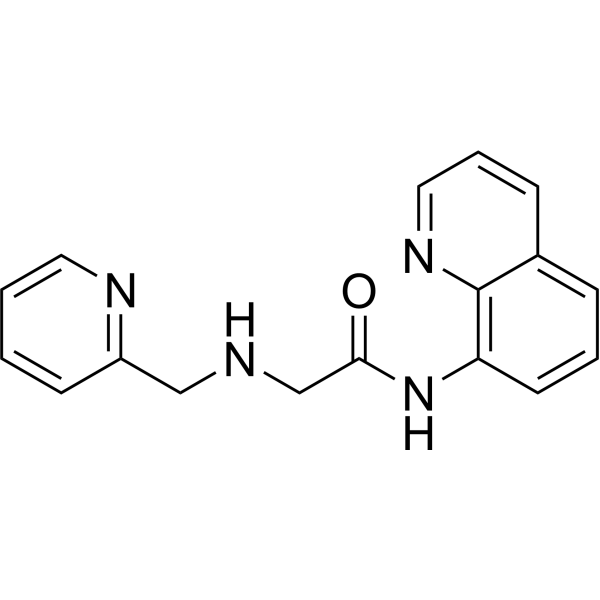 0 ImagesCat. No.: HY-D1264CAS No.: 1263820-18-3Synonyms: Zn-greenPMQA (Zn-green), an 8-aminoquinoline-based ratiometric fluorescent sensor, demonstrates the Zn2+-induced redshift of emission (85 nm). PMQA (Zn-green) is a cell membrane-permeable probe and suitable for imaging Zn2+ in living cells.
-
5(6)-Carboxyfluorescein diisobutyrate
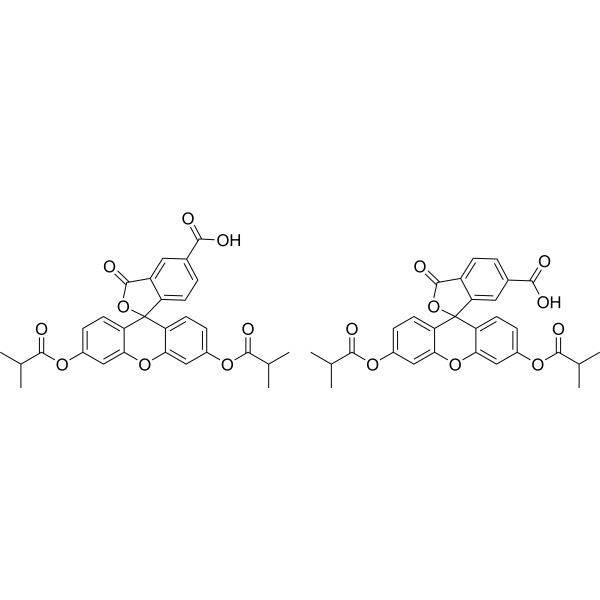 0 ImagesCat. No.: HY-D1477CAS No.: 287111-44-85(6)-Carboxyfluorescein diisobutyrate is a protected 5(6)-carboxyfluorescein. 5(6)-carboxyfluorescein is a fluorescence pH indicator.
-
Concanavalin A-AF680
 0 ImagesCat. No.: HY-NP164MSynonyms: Con A-AF680Concanavalin A-AF680 (Con A-AF680) is an AF680-labled Concanavalin A (HY-P2149). Concanavalin A is a Ca2+/Mn2+-dependent and mannose/glucose-binding plant lectin. Concanavalin A binds the N- and O-glycosylated proteins of head and neck carcinoma cells glycoproteins.
-
ATTO 725
 0 ImagesCat. No.: HY-D1971ATTO 725 is a new type of fluorescent dye with high fluorescence yield, which can be used for most labeling applications, maximum excitation/emission wavelength: 728/751 nm.




