



Fluorescent Dye
Fluorescence is a phenomenon of photoluminescence in luminescence. When an atom is irradiated by light, some electrons around the nucleus jump from their original orbitals to higher energy orbitals under the influence of light energy, i.e., from the ground state to the first or second excited single-line state, etc. Due to the instability of the first or second excited singlet state, the electron returns from the excited singlet state to the ground state accompanied by released energy, resulting in fluorescence.
Fluorescent dyes can be covalently bound or physically adsorbed in the structure of the substance. The fluorescence properties allow for the characterization, localization and quantitative analysis of the labeled object. Fluorescent dyes have shown great potential for the detection of proteins, nucleic acids, cells, and immunoassays, attributed to the advantages in non-radioactive contamination, simple experimental operation and easy observation.
Fluorescent dyes have penetrated many fields such as pharmacology, physiology, environmental science, and information science, as well as functional studies of proteins and drug screening.
All Product Categories
-
Fluorescent Dye Related Products (4891)
Related Products (4891)

-
Antibodies (4)
-
Ac-Arg-Gly-Lys-AMC
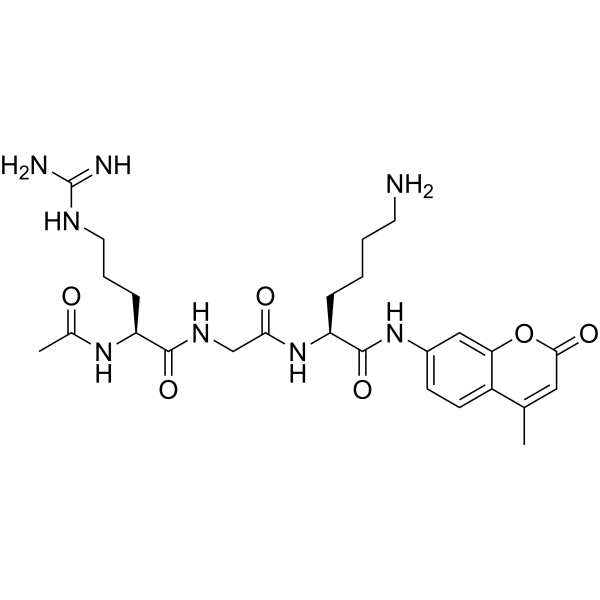 0 ImagesCat. No.: HY-P4408CAS No.: 660846-99-1Ac-Arg-Gly-Lys-AMC is a fluorogenic substrate for the determination of protease activity. Ac-Arg-Gly-Lys-AMC undergoes hydrolysis and releases the fluorescent product 7-amino-4-methylcoumarin (AMC). AMC is fluorescent under UV light and can emit a fluorescent signal.
-
FITC-PEG10000-FA
 0 ImagesCat. No.: HY-D2844EFITC-PEG10000-FA is a fluorescent dye composed of Folic acid (HY-16637) (FA), polyethylene glycol (PEG) and FITC (HY-66019). Fluorescent dye is linked to PEG and Folic acid through a specific chemical reaction to form a molecule with special properties. FITC-PEG10000-FA can be used for fluorescent labeling and imaging.


-
ONOO-/O2- tracker probe
 0 ImagesCat. No.: HY-D3002CAS No.: 2981401-58-3ONOO-/O2- tracker probe is a dual-responsive near-infrared fluorescent probe. ONOO-/O2- tracker probe will only emit a strong fluorescence signal when both peroxynitrite (ONOO⁻) and superoxide anion (O₂•⁻), the two key reactive oxygen/nitrogen species, are present simultaneously. ONOO-/O2- tracker probe can be used as a biomarker detection tool for drug-induced liver injury (DILI).
-
Photoactive esterase probe
 0 ImagesCat. No.: HY-D3157CAS No.: 2133002-04-5Photoactive esterase probe is a photoactivatable fluorescent probe for esterase. Photoactive esterase probe is used for the detection and imaging of esterase activity in living cells.

-
FAM labled Aganirsen sodium
 0 ImagesCat. No.: HY-153479DFAM labled Aganirsen sodiumis a FAM labled Aganirsen sodium.
-
6-HEX dipivaloate
 0 ImagesCat. No.: HY-130510CAS No.: 1166837-63-36-HEX dipivaloate is an amino-bindable fluorescent probe that can be used to label peptides and oligonucleotides. 6-HEX dipivaloate is widely used in nucleic acid sequencing and related research.
-
CuFS
 0 ImagesCat. No.: HY-D3206CAS No.: 1860808-05-4CuFS is a reaction-based fluorescent sensor for detecting Cu2+ with zero background fluorescence. CuFS acts as a fluorescence quencher in the absence of Cu2+ and as a fluorescence enhancer in the presence of Cu2+. CuFS can be fabricated into test strips and applied to the detection of Cu2+ in human cancer cells.
-
FAM labled Rosomidnar sodium
 0 ImagesCat. No.: HY-153494DFAM labled Rosomidnar sodiumis a FAM labled Rosomidnar sodium.
-
Cy3 labled Tadnersen sodium
 0 ImagesCat. No.: HY-132581ICy3 labled Tadnersen sodium is a Cy3 labled Tadnersen sodium.
-
Chrome Pure Blue BX
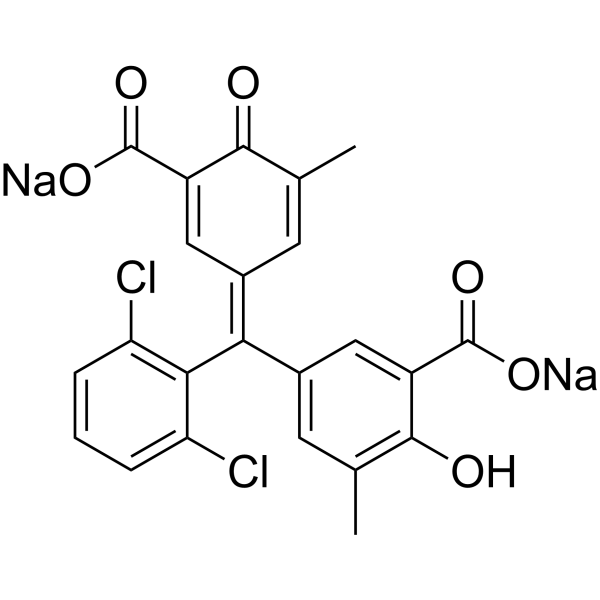 0 ImagesChrome Pure Blue BX (Sunchromine Pure Blue BX) is a multifunctional dye. Dyes are important tools in biological experiments. They can help researchers observe and analyze cell structures, track biomolecules, evaluate cell functions, distinguish cell types, detect biomolecules, study tissue pathology and monitor microorganisms. Their applications range from basic scientific research to clinical A wide range of diagnostics. Dyes are also widely used in traditional fields such as textile dyeing, as well as in emerging fields such as functional textile processing, food pigments and dye-sensitized solar cells.
-
Cy3 labled Aprinocarsen sodium
 0 ImagesCat. No.: HY-148413CCy3 labled Aprinocarsen sodium is a Cy3 labled Aprinocarsen sodium.

-
H7
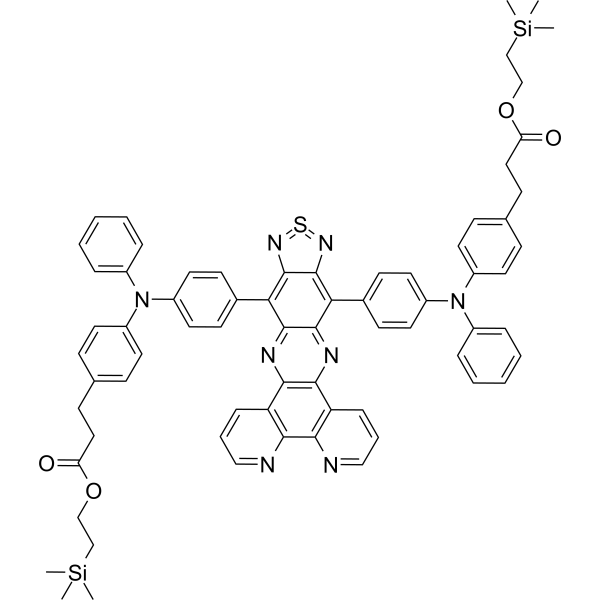 0 ImagesCat. No.: HY-142523CAS No.: 2803681-14-1H7 is a second near-infrared (NIR-II) fluorophore.
-
PE-Cy5.5
 0 ImagesCat. No.: HY-D3275PE-Cy5.5 is a far-red emitting tandem dye designed based on the principle of fluorescence resonance energy transfer (FRET), and is widely used in multicolor flow cytometry. PE-Cy5.5 consists of phycoerythrin (PE) as the energy donor and the cyanine dye Cy5.5 as the energy acceptor. Upon excitation by blue or green laser light, PE absorbs energy and transfers it to Cy5.5 via FRET, ultimately resulting in Cy5.5 emitting characteristic far-red fluorescence (Ex/Em = 450-500 nm/698 nm).
-
4,6-Dimethyl-7-ethylaminocoumarin
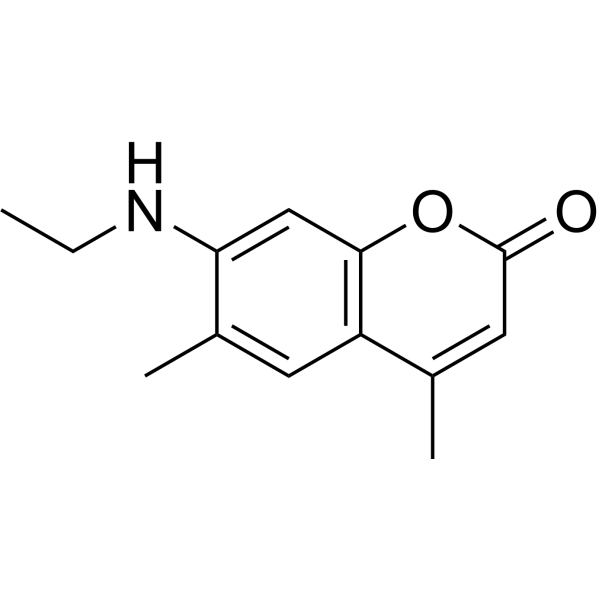 0 ImagesCat. No.: HY-W267393CAS No.: 26078-25-14,6-Dimethyl-7-ethylaminocoumarin is a laser dye for pulse and continuous operation.
-
TODi-1
 0 ImagesCat. No.: HY-165400CAS No.: 143413-84-7TODi-1 (TOTO) is a double-stranded DNA binder and Fluorescence enhancer (with a lambda max of 513 nm for dsDNA-TOTO). TODi-1 forms stable bis-intercalation complexes with double-stranded DNA. TODi-1 shows almost no fluorescence in free solution, but its fluorescence intensity increases significantly upon binding to double-stranded DNA.
-
18:1 Bromo-squareFluor(632/649) PE ammonium
 0 ImagesCat. No.: HY-N15847CAS No.: 3077426-97-918:1 Bromo-squarefluor (632/649) PE ammonium is a fluorescent lipid that can be used to visualize cell membranes (Ex/Em = 632/649 nm).




