



Fluorescent Dye
Fluorescence is a phenomenon of photoluminescence in luminescence. When an atom is irradiated by light, some electrons around the nucleus jump from their original orbitals to higher energy orbitals under the influence of light energy, i.e., from the ground state to the first or second excited single-line state, etc. Due to the instability of the first or second excited singlet state, the electron returns from the excited singlet state to the ground state accompanied by released energy, resulting in fluorescence.
Fluorescent dyes can be covalently bound or physically adsorbed in the structure of the substance. The fluorescence properties allow for the characterization, localization and quantitative analysis of the labeled object. Fluorescent dyes have shown great potential for the detection of proteins, nucleic acids, cells, and immunoassays, attributed to the advantages in non-radioactive contamination, simple experimental operation and easy observation.
Fluorescent dyes have penetrated many fields such as pharmacology, physiology, environmental science, and information science, as well as functional studies of proteins and drug screening.
All Product Categories
-
Fluorescent Dye Related Products (4894)
Related Products (4894)

-
Antibodies (4)
-
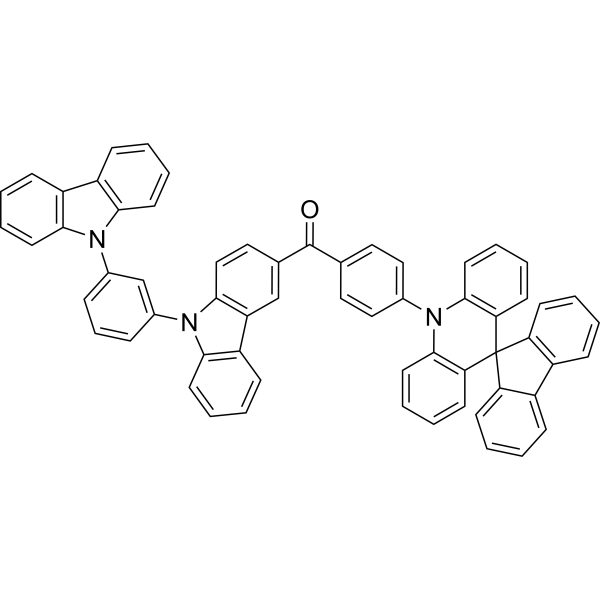
FAM labled Nivudirsen sodium
 0 ImagesCat. No.: HY-177649CFAM labled Nivudirsen sodiumis a FAM labled Nivudirsen sodium.


-
Fluo-3 pentaammonium
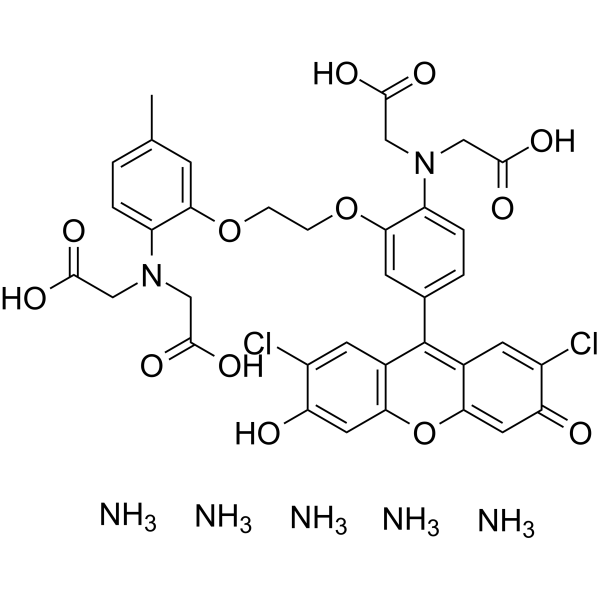 0 ImagesCat. No.: HY-126821ACAS No.: 339221-91-9Fluo-3 pentaammonium is a cell-impermeable calcium ion (Ca2+) indicator. Fluo-3 pentaammonium itself is not fluorescent, but it becomes fluorescent after binding to calcium ions (Ex/Em = 488/525 nm).
-
FITC-PEG3400-FA
 0 ImagesCat. No.: HY-D2844CFITC-PEG3400-FA is a fluorescent dye composed of Folic acid (HY-16637) (FA), polyethylene glycol (PEG) and FITC (HY-66019). Fluorescent dye is linked to PEG and Folic acid through a specific chemical reaction to form a molecule with special properties. FITC-PEG3400-FA can be used for fluorescent labeling and imaging.
-
Alexa Fluor 680 NHS ester
 0 ImagesCat. No.: HY-D2328CAS No.: 407628-15-3Synonyms: Alexa Fluor 680 succinimidyl esterAlexa Fluor 680 NHS ester (Alexa Fluor 680 succinimidyl ester) is a near-infrared (NIR) fluorescent dye. NHS esters can be used to label to the primary amines (R-NH2) of proteins, amine-modified oligonucleotides, and other amine-containing molecules (Ex/Em = 679/702 nm).

-
sBADA TFA
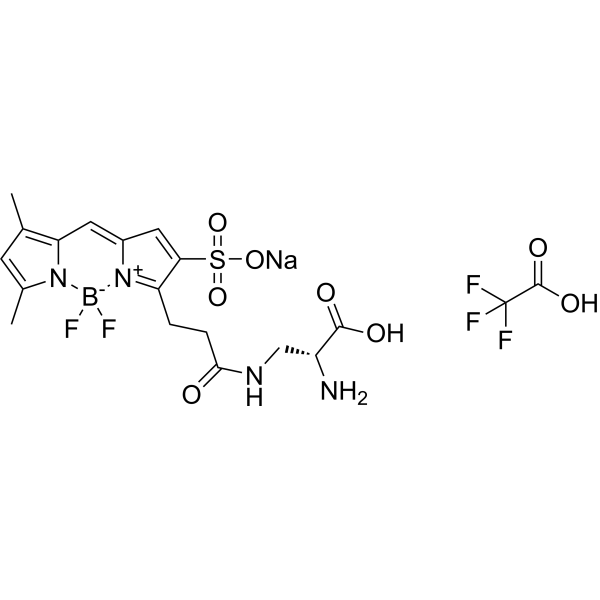 0 ImagesCat. No.: HY-D1690sBADA TFA is a potent green fluorescent dye that targets and labels peptidoglycan in the cell walls of live bacteria(Ex/Em = 490/510 nm).
-
Azide MegaStokes dye 673
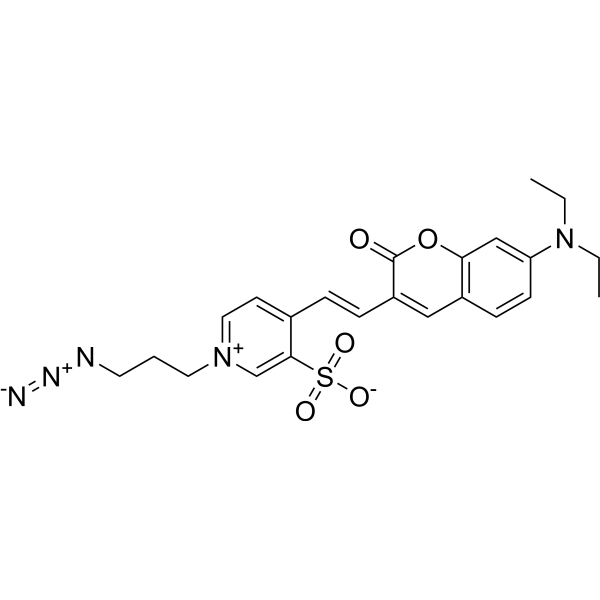 0 ImagesCat. No.: HY-D1354CAS No.: 1246853-81-5Azide MegaStokes dye 673 is a multifunctional dye. Dyes are important tools in biological experiments. They can help researchers observe and analyze cell structures, track biomolecules, evaluate cell functions, distinguish cell types, detect biomolecules, study tissue pathology and monitor microorganisms. Their applications range from basic scientific research to clinical A wide range of diagnostics. Dyes are also widely used in traditional fields such as textile dyeing, as well as in emerging fields such as functional textile processing, food pigments and dye-sensitized solar cells.
-
6-Carboxyfluorescein dipivalate
 0 Images6-Carboxyfluorescein dipivalate is a non-fluorescent derivative of 6-Carboxyfluorescein (HY-66021). 6-Carboxyfluorescein dipivalate is hydrolyzed by intracellular esterases to its neovalerate group, thus converting it into fluorescent 6-Carboxyfluorescein, which can be used for cell viability detection and tracking studies.
-
diSulfo-Cy3 alkyne
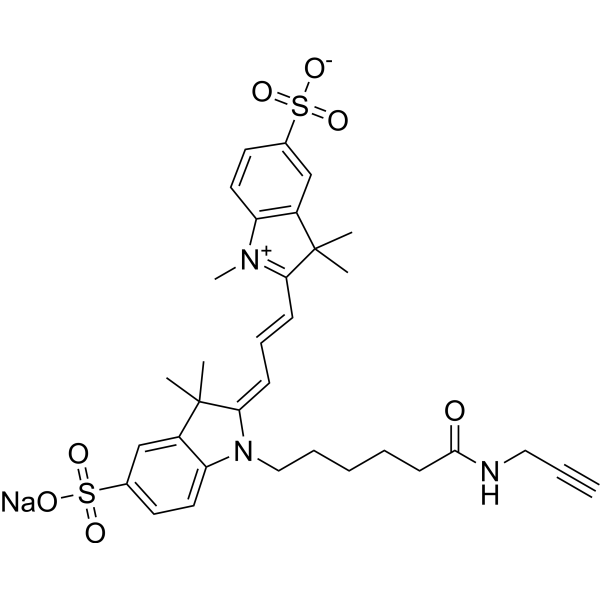 0 ImagesCat. No.: HY-151756CAS No.: 2055138-88-8diSulfo-Cy3 alkyne is a water-soluble dye and a Click Chemistry reagent containing an alkyne group. Absorbance and emission of the dye are identical to Cy3 fluorophore. diSulfo-Cy3 alkyne can be used for the labeling of proteins, and even intact biological objects in water phase.
-
(-)-15-Deoxyspergualin
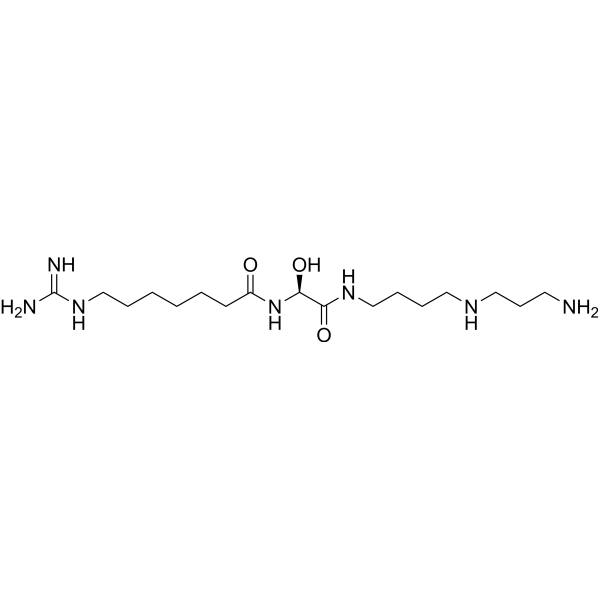 0 ImagesCat. No.: HY-10939CAS No.: 89149-10-0(-)-15-Deoxyspergualin is a potent antitumor agent. (-)-15-Deoxyspergualin shows strong inhibition against mouse leukemia L-1210.
-
FAM labled PS220 sodium
 0 ImagesCat. No.: HY-153324DFAM labled PS220 sodiumis a FAM labled PS220 sodium.
-
ATTO 550 alkyne
 0 ImagesCat. No.: HY-D2038ATTO 550 alkyne is a new fluorescent marker based on the Rhodamine structure. It has strong absorption, high fluorescence quantum yield, high thermal stability and photochemical stability, and is suitable for single molecule detection and high-resolution microscopy. ATTO 550 alkyne is an alkyne derivative of ATTO 550 and can be used to label proteins or antibodies.
-
Dabcyl acid sodium
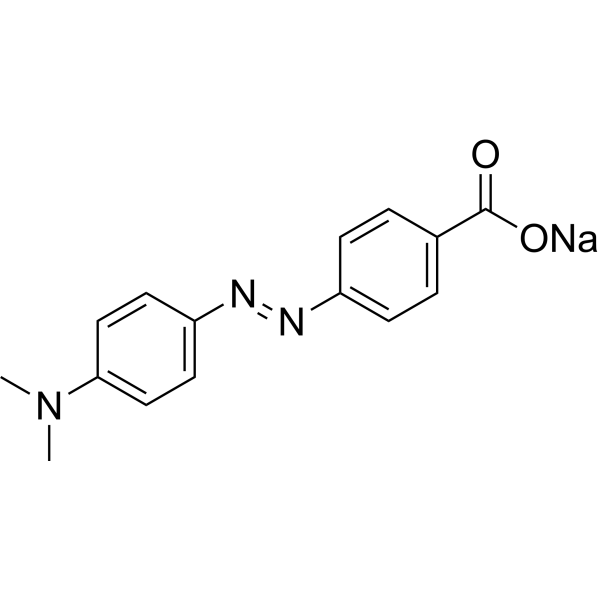 0 ImagesDabcyl acid sodium (DABCYL sodium) is a nonfluorescent chromophore and a quencher. Dabcyl acid sodium can be used as molecular beacon nucleic acid probes to recognize and report the presence of specific nucleic acids in homogeneous solutions.
-
Ready-to-Use Wright Staining Solution
 0 ImagesCat. No.: HY-DY2029Ready-to-Use Wright Staining Solution is a pre-mixed Romanowsky type absorbent composite staining agent, containing Eosin Y (HY-D0505) and methylene blue (HY-14536). Ready-to-Use Wright Staining Solution is suitable for staining of blood and cell smears, bacteria, protozoan parasites, etc., without the need for manual weighing of powder or complex preparation, thus saving time and ensuring the consistency of diagnostic results.
-
Cy5.5-PEG3400-DSPE
 0 ImagesCat. No.: HY-D2566Cy5.5-PEG3400-DSPE is a PEG phospholipid with Cy5.5 (HY-D0924) dye used in protein/nucelic acid labeling and fluorescence microscopy. Cy5.5-PEG3400-DSPE can self-assemble in aqueous solution to form micelles/lipid bilayer and used to prepare liposomes or nanoparticles for nutrients delivery such as mRNA or DNA vaccine.
-
Erythrina Cristagalli Lectin
 0 ImagesCat. No.: HY-NP066Synonyms: ECLErythrina Cristagalli Lectin (ECL) is a plant lectin that can be used as a probe to specifically bind biomolecules (such as polysaccharides, peptides, etc.).Erythrina Cristagalli Lectin (ECL) is a biological material or organic compound that can be used in life science research.
-
Dabcyl-RGVVNASSRLA-Edans TFA
 0 ImagesCat. No.: HY-P4777ASynonyms: Dabcyl-CMV-Edans TFADabcyl-RGVVNASSRLA-Edans (Dabcyl-CMV-Edans) is a fluorogenic substrate for human cytomegalovirus (HCMV) protease.




