



Fluorescent Dye
Fluorescence is a phenomenon of photoluminescence in luminescence. When an atom is irradiated by light, some electrons around the nucleus jump from their original orbitals to higher energy orbitals under the influence of light energy, i.e., from the ground state to the first or second excited single-line state, etc. Due to the instability of the first or second excited singlet state, the electron returns from the excited singlet state to the ground state accompanied by released energy, resulting in fluorescence.
Fluorescent dyes can be covalently bound or physically adsorbed in the structure of the substance. The fluorescence properties allow for the characterization, localization and quantitative analysis of the labeled object. Fluorescent dyes have shown great potential for the detection of proteins, nucleic acids, cells, and immunoassays, attributed to the advantages in non-radioactive contamination, simple experimental operation and easy observation.
Fluorescent dyes have penetrated many fields such as pharmacology, physiology, environmental science, and information science, as well as functional studies of proteins and drug screening.
All Product Categories
-
Fluorescent Dye Related Products (4914)
Related Products (4914)

-
Antibodies (4)
-
C.I. Solvent Blue 43
 0 ImagesCat. No.: HY-D0960CAS No.: 61813-75-0C.I. Solvent Blue 43 is the most important colorant used to add color or change the color of something and is chemically essentially unaffected by the carrier or medium into which it is incorporated. It can be widely used in textile, medicine, food, cosmetics, plastics, paint, ink, photography and paper industries.
-
Ulex Europaeus Agglutinin I-AF594
 0 ImagesCat. No.: HY-NP090HSynonyms: UEA I-AF594Ulex Europaeus Agglutinin I-AF594 (UEA I-AF594) is an AF594-labeled glehnia littoralis lectin I (UEA-I). Ulex Europaeus Agglutinin I exhibits specificity for cell surface glycoconjugates containing α-L-fucosylate. Ulex Europaeus Agglutinin I-AF594 can be used for vascular endothelial labeling, glycan imaging, and tissue staining studies (Ex/Em = 590/617 nm).
-
DCP-Rho1
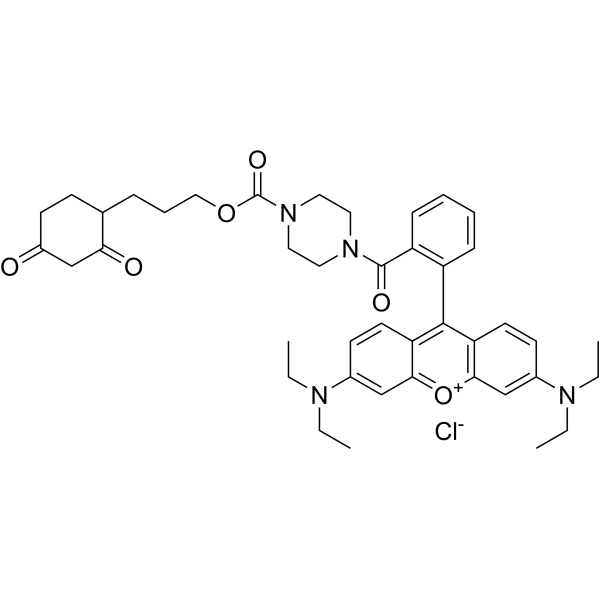 0 ImagesCat. No.: HY-138147CAS No.: 1001575-98-9DCP-Rho1 is a rhodamine-labeled probe. DCP-Rho1 can be used for the detection of sulfenic acid-containing proteins. DCP-Rho1 shows λex of 560 nM, λem, 581 nm.
-
Liptracker-Green
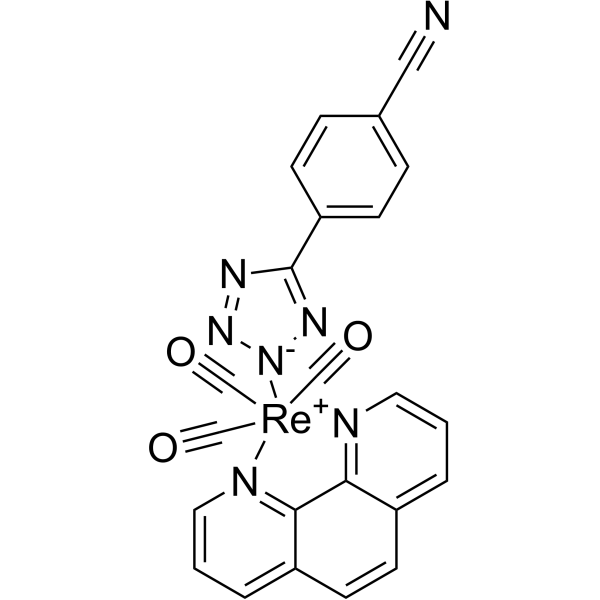 0 ImagesCat. No.: HY-D1745CAS No.: 1369583-75-4Synonyms: fac-[Re(CO)3(phen)L]Liptracker-green (fac-[Re(CO)3(phen)L]) is a cell-permeable fluorogenic probe that localizes to polar lipids, and can be used to label lipid droplets and other high lipid-content compartments in live and fixed cells using fluorescent microscopy.
-
Cy3 labled Fomivirsen sodium
 0 ImagesCat. No.: HY-109528CCy3 labled Fomivirsen sodium is a Cy3 labled Fomivirsen sodium.
-
Maackia Amurensis Lectin I
 0 ImagesCat. No.: HY-NP072Synonyms: MAL IMaackia Amurensis Lectin I (MAL I) is a plant lectin that can be used as a probe to specifically bind biomolecules (such as polysaccharides, peptides, etc.).Maackia Amurensis Lectin I (MAL I) is a biological material or organic compound that can be used in life science research.
-
RB-PEG5000-NH2
 0 ImagesCat. No.: HY-D2895ESynonyms: Rhodamine B-PEG5000-NH2RB-PEG5000-NH2 (Rhodamine B-PEG5000-NH2) is a fluorescent dye composed of Rhodamine B (HY-Y0016), PEG and an amino group. The reactive primary amine or NH2 groups can react rapidly with activated carboxylic acids such as NHS esters to form stable amide bonds (Ex/Em=546/610 nm).
-
Phosphotungstic Acid Negative Staining Solution (3%, pH 7.0)
 0 ImagesCat. No.: HY-DY2047Phosphotungstic Acid Negative Staining Solution (3%, pH 7.0) is an electron microscopy negative stain. Phosphotungstic Acid Negative Staining Solution (3%, pH 7.0) forms an electron-dense background around samples, enabling the imaging of viruses, bacterial, macromolecules and organelles.
-
FAM labled Miravirsen sodium
 0 ImagesCat. No.: HY-132598DFAM labled Miravirsen sodiumis a FAM labled Miravirsen sodium.
-
SYTO-9
 0 ImagesCat. No.: HY-D3459SYTO-9 is a cell-permeable fluorescent dye that can be used for nucleic acid staining. The fluorescence intensity of SYTO-9 increases significantly upon binding to RNA and DNA. SYTO-9 can stain RNA and DNA in live and dead eukaryotic cells, as well as in Gram-positive and Gram-negative bacteria. SYTO-9 is applicable for fluorescence microscopy, flow cytometry, fluorophotometry, and bacterial counting in aquatic systems (RNA: Ex/Em = 486/501 nm; DNA: Ex/Em = 485/498 nm).
-
BODIPY 493/503 methyl bromide (solution)
 0 ImagesCat. No.: HY-DY1090CAS No.: 216434-81-0BODIPY 493/503 methyl bromide (solution) is a BODIPY dye. BODIPY dye is a small molecule dye with strong ultraviolet absorption ability, its fluorescence peak is relatively sharp, and the quantum yield is high. They are relatively insensitive to the polarity and pH of the environment and are relatively stable under different physiological conditions. Due to its structural asymmetry, BODIPY derives a variety of structural products. BODIPY lipid droplet dyes can well pass through the cell membrane into the cell, and localize the neutral lipids in the cell to specifically stain the lipid droplets, which can be used for labeling of live cells and fixed cells. Maximum excitation/emission wavelength: 493/503 nm.
Solvent and concentration: DMSO: 5 mM
-
NIR-FP
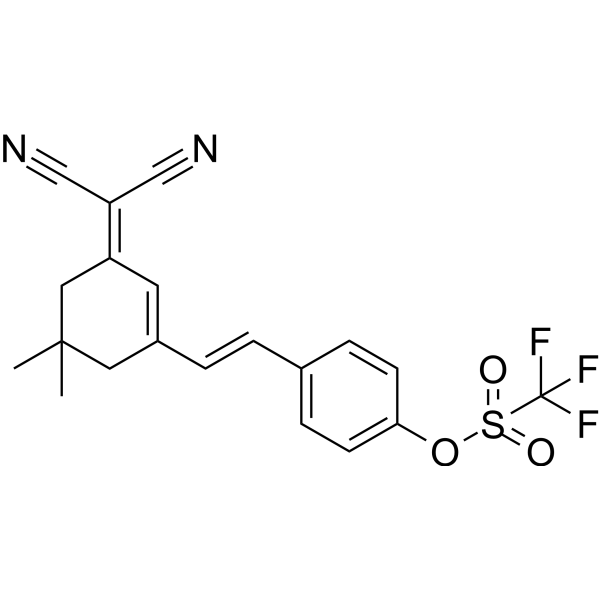 0 ImagesCat. No.: HY-149422NIR-FP is a near-infrared fluorescent probe with high sensitivity and selectivity for superoxide anion O2-. O2- is the main precursor of ROS, and ferroptosis-mediated epilepsy models can be dynamically tracked by detecting O2-. Ferroptosis-mediated epilepsy models include: kainic acid (HY-N2309)-induced chronic epilepsy model, Pentylenetetrazole-induced acute epilepsy model, and pilocarpine (HY-B0726A)-induced epilepsy model.
-
5-Nitro BAPTA
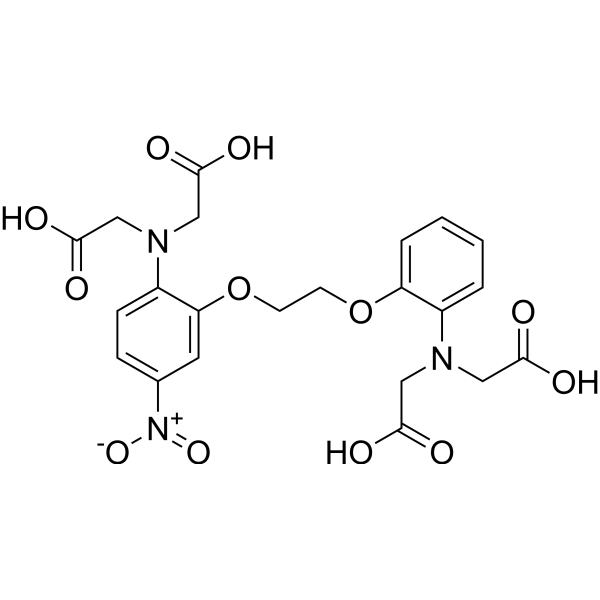 0 ImagesCat. No.: HY-D1636CAS No.: 124251-83-85-Nitro BAPTA is a calcium chelator, combinded with 2-Me-substituted TM ( as a fluorescent moiety), can be used to form a red fluorescent probe (CaTM-2 AM), for imaging of cytoplasmic Ca2+ in cultured living cells. 5-Nitro BAPTA is a building block used in the synthesis of Ca2+ specific chelators, Ca2+ buffers, and fluorescent Ca2+ indicators.
-
C12 NBD Globotriaosylceramide
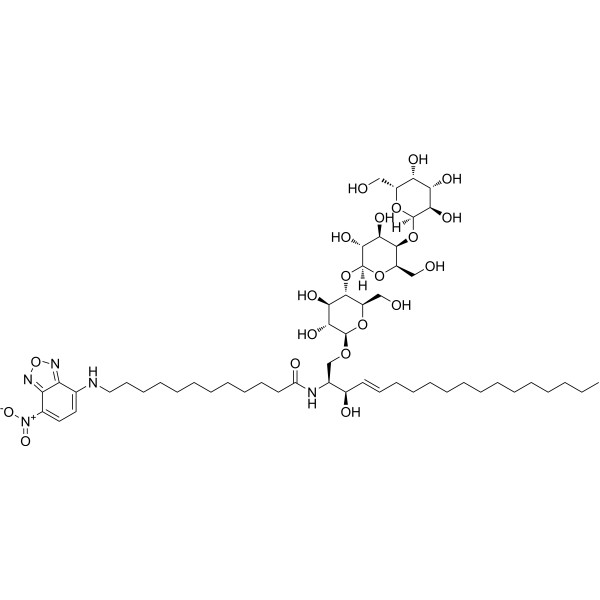 0 ImagesCat. No.: HY-D1579CAS No.: 2692623-26-8C12 NBD galactosylceramide is a biologically active derivative of galactosylceramide that is tagged with a fluorescent C12 nitrobenzoxadiazole (C12 NBD) group. C12 NBD galactosylceramide has been used to detect ceramide trihexoside.
-
6-TET Azide
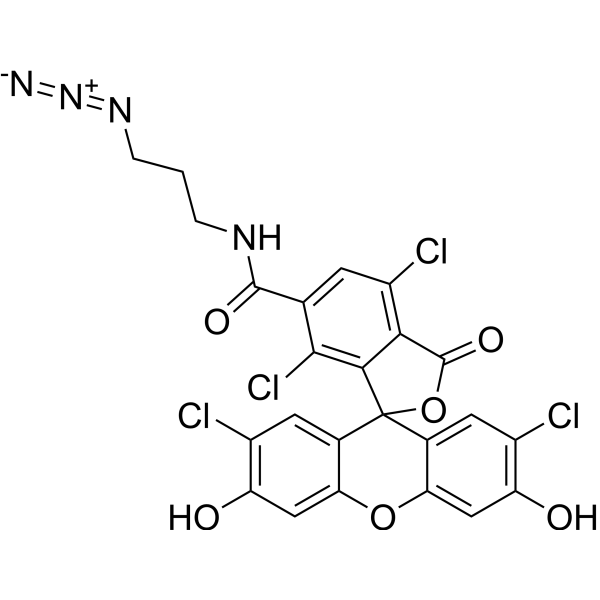 0 ImagesCat. No.: HY-D1898CAS No.: 1450752-90-56-TET Azide is a fluorescent probe that can be used for the preparation of fluorescent contrast agent and nucleic acid sequencing.
-
Chrysoidine G free base
 0 ImagesChrysoidine G (free base) (Solvent Orange 3; Chrysoidine Y base) is a multifunctional dye. Dyes are important tools in biological experiments. They can help researchers observe and analyze cell structures, track biomolecules, evaluate cell functions, distinguish cell types, detect biomolecules, study tissue pathology and monitor microorganisms. Their applications range from basic scientific research to clinical A wide range of diagnostics. Dyes are also widely used in traditional fields such as textile dyeing, as well as in emerging fields such as functional textile processing, food pigments and dye-sensitized solar cells.
-
Boc-Leu-Gly-Arg-pNA acetate
 0 ImagesCat. No.: HY-P10448CAS No.: 176786-91-7Synonyms: Boc-LGR-pNA acetateBoc-Leu-Gly-Arg-pNA is a chromogenic synthetic substrate.
-
TPh–PyBz–β–gal
 0 ImagesCat. No.: HY-D3096TPh-PyBz-β-gal is a fluorescent probe used for the detection and imaging of β-galactosidase (β-gal) in living cells. The detection mechanism of TPh-PyBz-β-gal relies on β-gal, which cleaves the glycosidic bond linking the AIE-active fluorophore and the D-galactose residue unit of the probe. The emission wavelength of TPh-PyBz-β-gal after activation is 606 nm. TPh-PyBz-β-gal has low cytotoxicity and can be applied to β-gal imaging in living cells.




