



Fluorescent Dye
Fluorescence is a phenomenon of photoluminescence in luminescence. When an atom is irradiated by light, some electrons around the nucleus jump from their original orbitals to higher energy orbitals under the influence of light energy, i.e., from the ground state to the first or second excited single-line state, etc. Due to the instability of the first or second excited singlet state, the electron returns from the excited singlet state to the ground state accompanied by released energy, resulting in fluorescence.
Fluorescent dyes can be covalently bound or physically adsorbed in the structure of the substance. The fluorescence properties allow for the characterization, localization and quantitative analysis of the labeled object. Fluorescent dyes have shown great potential for the detection of proteins, nucleic acids, cells, and immunoassays, attributed to the advantages in non-radioactive contamination, simple experimental operation and easy observation.
Fluorescent dyes have penetrated many fields such as pharmacology, physiology, environmental science, and information science, as well as functional studies of proteins and drug screening.
All Product Categories
-
Fluorescent Dye Related Products (4914)
Related Products (4914)

-
Antibodies (4)
-
CPP9
 0 ImagesCat. No.: HY-P10644CAS No.: 1831064-63-1CPP9 is a small, amphipathic, cyclic cell penetrating peptide (CPP). CPPs bind directly to the plasma membrane phospholipids and enter mammalian cells via endocytosis, followed by efficient release from the endosome. CPP9 can be used for intracellular delivery of therapeutic agents and chemical probes.
-
TAMRA-PEG3-biotin
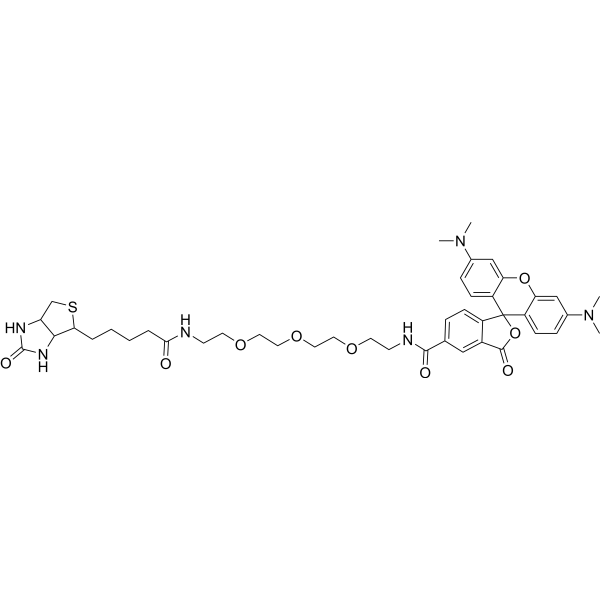 0 ImagesCat. No.: HY-140946CAS No.: 2279944-59-9TAMRA-PEG3-biotin is a dye derivative of TAMRA (HY-135640) containing 3 PEG units. TAMRA-PEG3-biotin is tagged with biotin.
-
M-H2S
 0 ImagesCat. No.: HY-D3003CAS No.: 2522921-17-9M-H2S is an endoplasmic reticulum-targeted ratio-type near-infrared fluorescent probe (Ex/Em : 480 nm/560 nm) specifically designed for the detection of hydrogen sulfide (H2S) in living cells and zebrafish. M-H2S exhibits detection limit for H2S of 39.1 nM, and the fluorescence intensity ratio (F₆₅₀/F₅₆₀) within the range of 0-40 μM shows a linear relationship with the H2S concentration. M-H2S responds best under pH = 7.2 (the normal physiological pH of the endoplasmic reticulum) conditions, making it suitable for the detection of the microenvironment of the endoplasmic reticulum. M-H2S can be used to study the role of H2S in endoplasmic reticulum function, stress response, and related diseases.
-
RB-PEG2000-DSPE
 0 ImagesCat. No.: HY-D2887CPurity: 98.71%Synonyms: Rhodamine B-PEG2000-DSPERB-PEG2000-DSPE (Rhodamine B-PEG2000-DSPE) is a PEG phospholipid labeled Rhodamine B (HY-Y0016). RB-PEG2000-DSPE can be used to prepare liposomes or nanoparticles for nutrients delivery such as mRNA or DNA vaccine (Ex/Em=546/610 nm).
-
Meso-Cl cyanine 7.5 free acid chloride
 0 ImagesCat. No.: HY-N16307CAS No.: 3091879-88-5Meso-Cl cyanine 7.5 free acid chloride is a Meso-Cl cyanine fluorescent dye. Meso-Cl cyanine 7.5 free acid chloride can be used for labelling amine groups such as those on antibodies, nucleic acids, and proteins and can be detected using a variety of fluorescence detection techniques such as microscopy and flow cytometry (Ex/Em = 815/825 nm).
-
Coelenteramine 400a hydrochloride
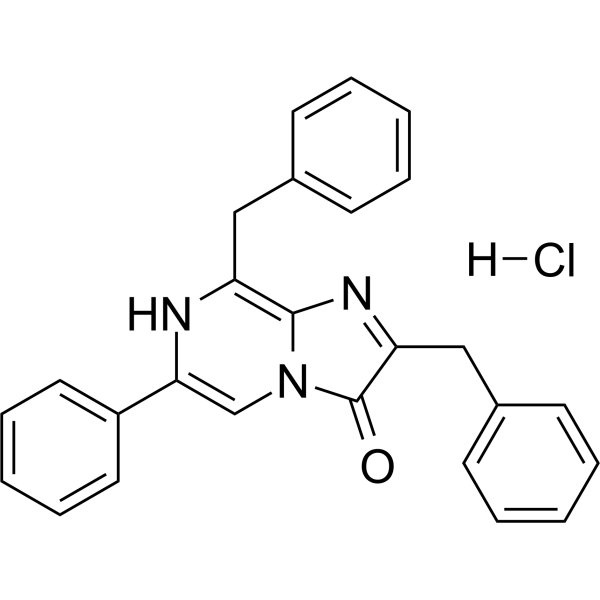 0 ImagesCat. No.: HY-118462ACAS No.: 2320429-05-6Synonyms: Coelenterazine 400a hydrochloride; Bisdeoxycoelenterazine hydrochlorideCoelenteramine (Coelenterazine) 400a hydrochloride, a derivative of Coelenterazine, is a Renilla luciferase (RLuc) substrate. In the presence of Coelenteramine 400a hydrochloride, RLuc can emit blue light at 395 nm. Coelenteramine 400a hydrochloride will causes color change in the bioluminescence reaction of Rluc by replacing the sulfur and oxygen heteroatoms of the methylene bridge. Coelenteramine 400a hydrochloride provides higher signal resolution and can be used in the research of bioluminescence resonance energy transfer (BRET).
-
BC-CPY
 0 ImagesCat. No.: HY-D2953Synonyms: CLIP-CPYBC-CPY is a CLIP-tagged probe based on the pyridine-benzoanthrone (CPY) fluorophore (Ex/Em: 580 nm/610 nm). BC-CPY has excellent cell membrane permeability, enabling deep imaging, low phototoxicity and high signal-to-noise ratio. BC-CPY can be used for super-resolution microscopy imaging of living cells.
-
6-HEX, SE
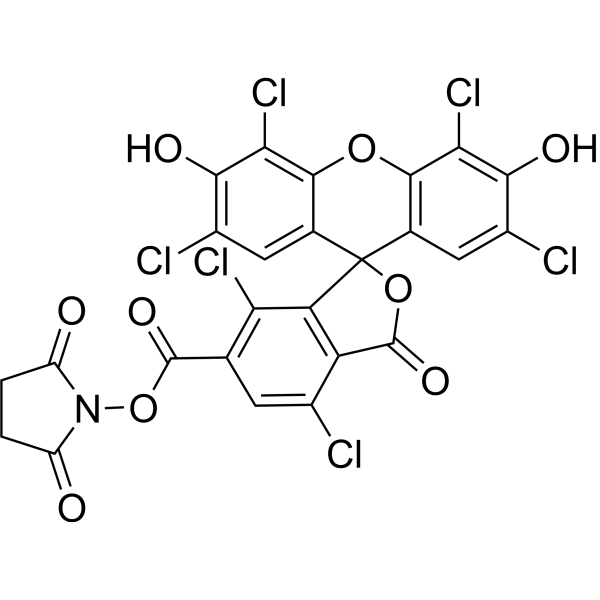 0 ImagesCat. No.: HY-D1891CAS No.: 902171-56-66-HEX, SE is a derivative of 6-HEX that is widely used in nucleic acid sequencing.
-
Cyanine 5.5 DBCO chloride
 0 ImagesCat. No.: HY-N16302CAS No.: 3091879-41-0


-
BODIPY-DOH
 0 ImagesCat. No.: HY-D3065CAS No.: 2587588-33-6BODIPY-DOH is a reversible near-infrared photoacoustic/fluorescence dual-modal redox probe. BODIPY-DOH undergoes conversion of its catechol group to o-quinone upon oxidation by O2•-, causing a red shift of the absorption peak from 680 nm to 750 nm, and can be reduced and restored by L-Glutathione reduced (GSH) (HY-D0187), thereby achieving a reversible response of the PA750/PA680 ratiometric signal (fluorescence Ex = 633 nm; photoacoustic dual-channel at 680/750 nm). BODIPY-DOH is applicable for research in tumor oxidative microenvironment imaging, spinal cord injury, and other oxidative stress-related disease fields.
-
Ac-VDVAD-AFC
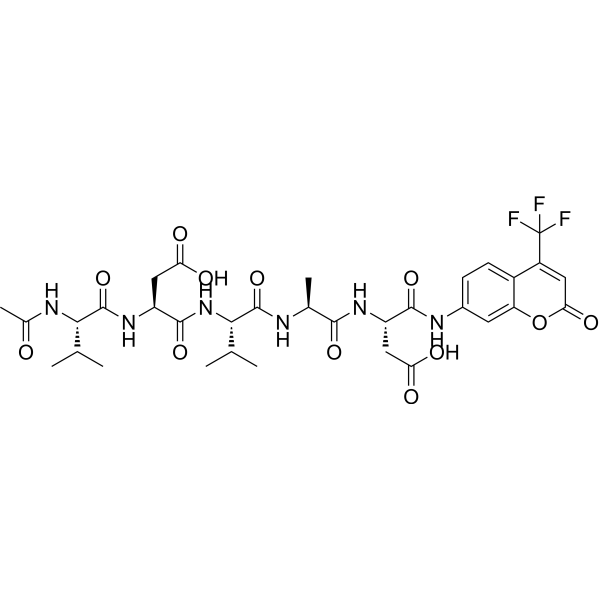 0 ImagesCat. No.: HY-P2615CAS No.: 210344-94-8Ac-VDVAD-AFC is a caspase-specific fluorescent substrate. Ac-VDVAD-AFC can measure caspase-3-like activity and caspase-2 activity and can be used for the research of tumor and cancer.
-
TSQ (solution)
 0 ImagesCat. No.: HY-DY1055CAS No.: 109628-27-5TSQ (solution) is a cytosolic zinc ion fluorescence probe that is membrane permeable and can be used for intracellular imaging of zinc proteins (λmax ~470 nm). TSQ can combine with Zn2+ in the presence of Ca2+ and Mg2+ to produce blue fluorescence (Ex/Em = 334/495 nm) .
Solvent and concentration: DMSO: 10 mM
-
Vicia Villosa Lectin
 0 ImagesCat. No.: HY-NP082Synonyms: VVLVicia Villosa Lectin (VVL) is a plant lectin that can be used as a probe to specifically bind biomolecules (such as polysaccharides, peptides, etc.).Vicia Villosa Lectin (VVL) is a biological material or organic compound that can be used in life science research.
-
Cy3 labled RGLS4326 sodium
 0 ImagesCat. No.: HY-139290ECy3 labled RGLS4326 sodium is a Cy3 labled RGLS4326 sodium.
-
FAM labled AGN-745 sodium
 0 ImagesCat. No.: HY-177612CFAM labled AGN-745 sodiumis a FAM labled AGN-745 sodium.
-
(BHQ-3)-OSu hexafluorophosphate
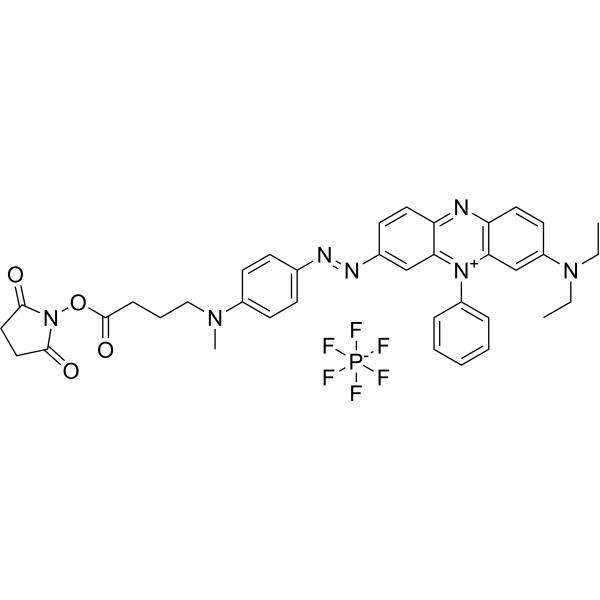 0 ImagesCat. No.: HY-136143CAS No.: 871240-95-8(BHQ-3)-OSu hexafluorophosphate is used for fluorescent labeling of protease substrates.
-
5-Carboxy-X-rhodamin N-succinimidyl ester
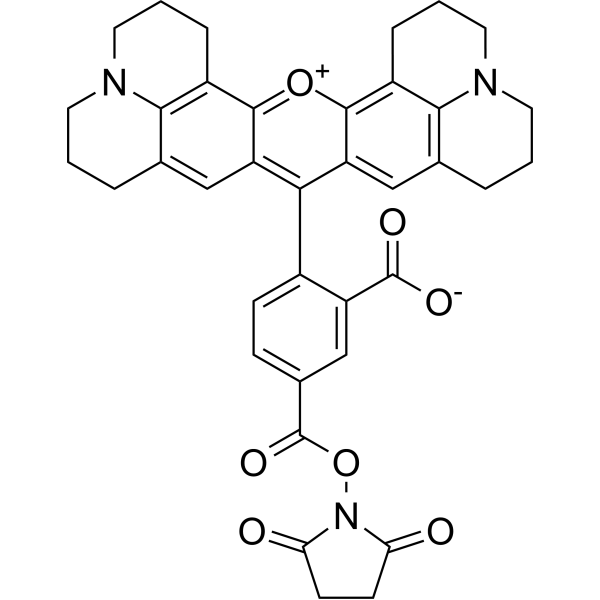 0 ImagesCat. No.: HY-D0045CAS No.: 209734-74-7Synonyms: 5-ROX, SE5-Carboxy-X-rhodamin N-succinimidyl ester (5-ROX, SE) is a labeling reagent. 5-Carboxy-X-rhodamin N-succinimidyl ester can be used in the preparation of charge-modified dye-labeled Dideoxynucleotide Triphosphates (ddNTP) to "direct-load" DNA sequencing.
-
Mini202
 0 ImagesCat. No.: HY-D3161CAS No.: 1234064-29-9Mini202 is a pH-responsive fluorescent false neurotransmitter with a pKa=6.4, and also serves as a substrate for vesicular monoamine transporters (VMAT1, VMAT2). Mini202 is widely applicable to studies related to cancer cells, transfected cells, adipose tissue, and other subjects.




