



Isotope-Labeled Compounds
Isotope-labeled compounds are chemical substances in which some atoms in their molecules are replaced by isotope atoms. The range of stable isotope products can cover from gases to complex molecules. Isotope-labeled compounds could provide a site-specific investigation of structures, making molecules easily detectable by mass spectrometry and NMR, and maintaining the physico-chemical properties of the target molecule at the same time.
MCE isotope-labeled compounds are all stable isotope-labeled compounds and are non-radioactive labeled substances. MCE isotope-labeled compounds are unique tools for identifying and understanding biological and chemical processes. Stable isotope-labeled products are now getting more and more popular among scientists. The scope of application is gradually penetrating into various scientific fields, such as life sciences, food and medicine, agriculture, environment, geology, etc. Stable isotope-labeled compounds have a wide range of applications in the Life Science areas, such as Metabolomics, Proteomics, Clinical studies, Deuterium drugs, etc.
All Product Categories
-
Isotope-Labeled Compounds Related Products (11100)
Related Products (11100)

-
Raltegravir-d4 potassium
 0 ImagesCat. No.: HY-10353AS2Synonyms: MK 0518-d4 potassiumRaltegravir-d4 (potassium) (MK 0518-d4 (potassium)) is deuterium labeled Raltegravir (potassium). Raltegravir (MK 0518) potassium is a potent integrase (IN) inhibitor, used to treat HIV infection.
-
S-(5’-Adenosyl)-L-methionine-d3 (disulfate)
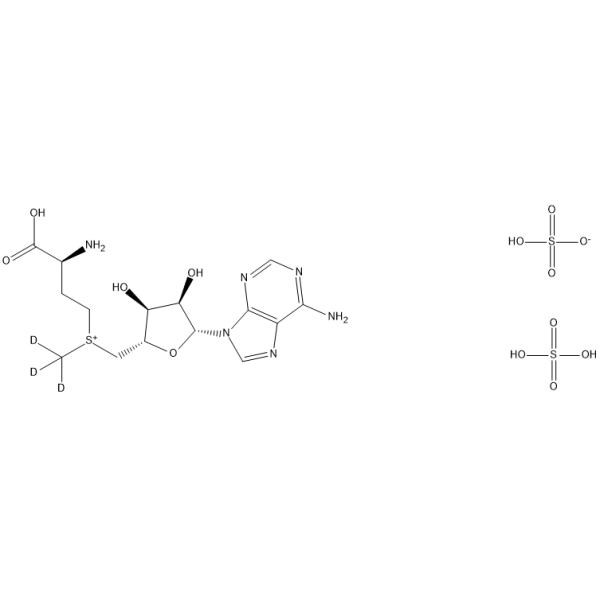 0 ImagesCat. No.: HY-144370SS-(5’-Adenosyl)-L-methionine-d3 disulfate is the deuterium labeled S-(5’-Adenosyl)-L-methionine disulfate.
-
Timolol-d9 maleate
 0 ImagesCat. No.: HY-17494S1Timolol-d9 (maleate) is deuterium labeled Timolol. Timolol is a β-blocker available for both topical and systemic administration. Topical Timolol is primarily used to reduce intraocular pressure with open-angle glaucoma and ocular hypertension. Timolol can also be used for the research of infantile hemangiomas, hypertension, myocardial infarction, migraine prophylaxis, and atrial fibrillation.Timolol also has cardioprotective effect.
-
8-(2-Hydroxybenzamido)octanoic acid-d4
 0 ImagesCat. No.: HY-W7283688-(2-Hydroxybenzamido)octanoic acid-d4 is the deuterium labeled 8-(2-Hydroxybenzamido)octanoic acid.
-
5-Azacytidine-15N4
 0 ImagesCat. No.: HY-W653970CAS No.: 2139283-40-0Synonyms: Azacitidine-15N4; 5-AzaC-15N4; Ladakamycin-15N45-Azacytidine-15N4 is 13C and 15N labeled 5-Azacytidine. 5-Azacytidine (Azacitidine; 5-AzaC; Ladakamycin) is a nucleoside analogue of cytidine that specifically inhibits DNA methylation. 5-Azacytidine is incorporated into DNA to covalently trap DNA methyltransferases and contributes to reverse epigenetic changes. 5-Azacytidine induces cell autophagy.
-
3-epi-Calcifediol-d3
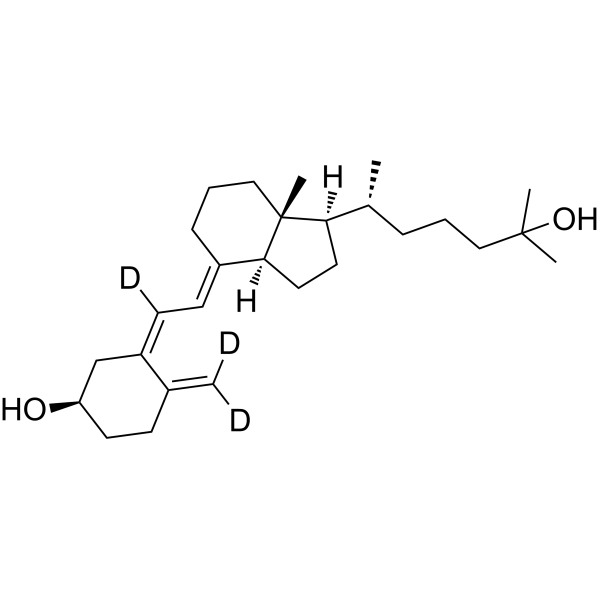 0 ImagesCat. No.: HY-141933SCAS No.: 2206653-61-2Synonyms: 3-epi-25-Hydroxy cholecalciferol-d33-Epi-25-Hydroxyvitamin D3-d3 is the deuterium labeled 3-Epi-25-Hydroxyvitamin D3.
-
Losartan-d6 hydrochloride
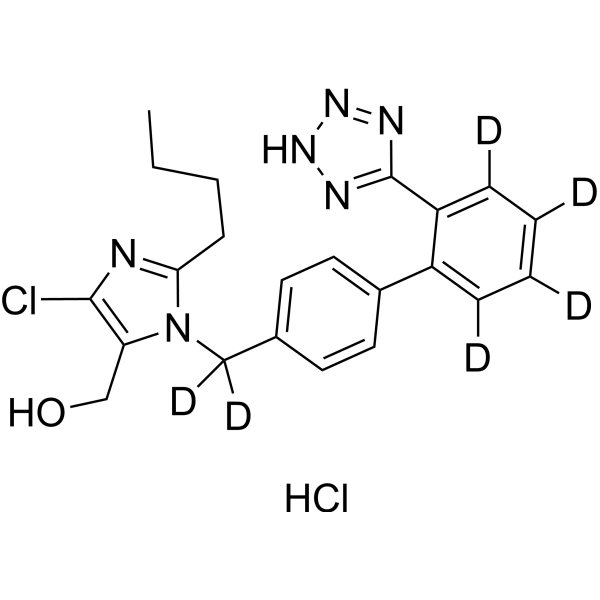 0 ImagesCat. No.: HY-17512ASSynonyms: DuP-753-d6 hydrochlorideLosartan-d6 hydrochloride is deuterated labeled Losartan potassium (HY-17512A). Losartan potassium (DuP-753 potassium) is an angiotensin II receptor type 1 (AT1) antagonist, competing with the binding of angiotensin II to AT1 with an IC50 of 20 nM.
-
GIFP(Leu-13C6,15N)AER TFA
 0 ImagesCat. No.: HY-173100SGIFP(Leu-13C6,15N)AER TFA is the 13C- and 15N-labeled GIFP(Leu)AER TFA.
-
GNSP(Ile-13C6,15N)SQR TFA
 0 ImagesCat. No.: HY-173099SGNSP(Ile-13C6,15N)SQR TFA is the 13C- and 15N-labeled GNSP(Ile)SQR TFA.
-
SAR107375E Impurity 14-d8
 0 ImagesCat. No.: HY-166879SSAR107375E Impurity 14-d8 is deuterium labeled SAR107375E Impurity 148.
-
Vedaprofen-d3
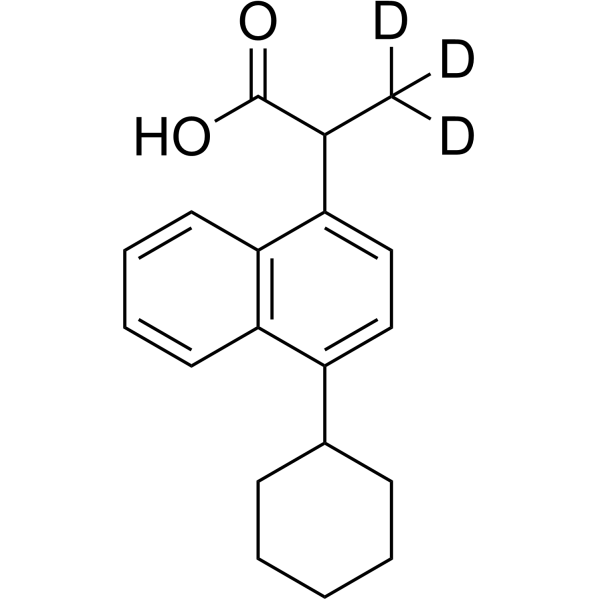 0 ImagesCat. No.: HY-118827SCAS No.: 1185054-34-5Vedaprofen-d3 is the deuterium labeled Vedaprofen. Vedaprofen (Quadrisol) is a COX-1 selective nonsteroidal anti-inflammatory agent (NSAID) for serum TxB2 and exudate PGE2 inhibition . Vedaprofen is a Escherichia coli (E. coli) sliding clamp (SC) inhibitor with the IC50 of 222 μM.
-
N-[2-(1H-Indol-3-yl)acetyl]-L-phenylalanine methyl ester-d4
![N-[2-(1H-Indol-3-yl)acetyl]-L-phenylalanine methyl ester-d4](https://file.medchemexpress.com/product_pic/hy-w746944s.gif "Click to View N-[2-(1H-Indol-3-yl)acetyl]-L-phenylalanine methyl ester-d4 Product Detail") 0 ImagesCat. No.: HY-W746944SN-[2-(1H-Indol-3-yl)acetyl]-L-phenylalanine methyl ester-d4 is deuterium labeled N-[2-(1H-Indol-3-yl)acetyl]-L-phenylalanine methyl ester.
0 ImagesCat. No.: HY-W746944SN-[2-(1H-Indol-3-yl)acetyl]-L-phenylalanine methyl ester-d4 is deuterium labeled N-[2-(1H-Indol-3-yl)acetyl]-L-phenylalanine methyl ester.
-
Alexidine-d10
 0 ImagesCat. No.: HY-B1474S1CAS No.: 1246818-47-2Alexidine-d10 is the deuterium labeled Alexidine (HY-B1474). Alexidine, a bis-biguanide, exhibits antifungal and antibiofilm activity against a diverse range of fungal pathogens. Alexidine is an anticancer agent that targets a mitochondrial tyrosine phosphatase, PTPMT1, in mammalian cells and causes mitochondrial apoptosis.
-
Tandospirone Acid Metabolite-d6
 0 ImagesCat. No.: HY-157074SCAS No.: 2012598-82-0Tandospirone Acid Metabolite-d6 is deuterium-labeled Tandospirone Acid Metabolite.
-
Gemfibrozil-d6-1
 0 ImagesCat. No.: HY-B0258S1CAS No.: 1160569-36-7Synonyms: CI-719-d6-1Gemfibrozil-d6-1 (CI-719-d6-1) is the deuterium labeled Gemfibrozil (HY-B0258). Gemfibrozil is an activator of PPAR-α, used as a lipid-lowering agent; Gemfibrozil is also a nonselective inhibitor of several P450 isoforms, with Ki values for CYP2C9, 2C19, 2C8, and 1A2 of 5.8, 24, 69, and 82 μM, respectively.
-
Methylcobalamin-d3
 0 ImagesCat. No.: HY-B0315S1CAS No.: 39818-96-7Synonyms: Mecobalamin-d3; CH3-B12-d3Methylcobalamin-d3 (Mecobalamin-d3) is the deuterium labeled Methylcobalamin (HY-B0586). Methylcobalamin (CH3-B12), a cobalamin, is a form of vitamin B12.
-
Naftopidil-d7
 0 ImagesCat. No.: HY-B0391S2Synonyms: KT-611-d7; BM-15275-d7Naftopidil-d7 (KT-611-d7 ) is deuterium labeled Naftopidil. Naftopidil (KT-611) is is a selective alpha1-adrenoceptor antagonist, with Kis of 3.7 nM, 20 nM and 1.2 nM for the cloned human α1a-, α1b- and α1d-adrenoceptor subtypes, respectively. Naftopidil has antiproliferative effects. Naftopidil can be used for the research of prostate hyperplasia.
-
Arbutin-d4
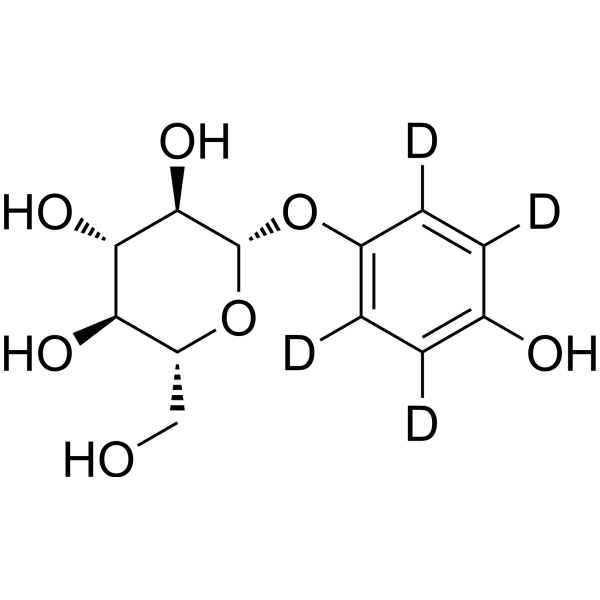 0 ImagesCat. No.: HY-N0192SSynonyms: β-Arbutin-d4Arbutin-d4 is deuterium labeled Arbutin. Arbutin (β-Arbutin) is a competitive inhibitor of tyrosinase in melanocytes, with Kiapp values of 1.42 mM for monophenolase; 0.9 mM for diphenolase. Arbutin is also used as depigmenting agents. Arbutin is a natural polyphenol isolated from the bearberry plant Arctostaphylos uvaursi, possesses with anti-oxidant, anti-inflammatory and anti-tumor properties.
-
2-Ethylhexyl 4-(dimethylamino)benzoate-d6
 0 ImagesCat. No.: HY-W011588SSynonyms: Photoinitiator-EHA-d62-Ethylhexyl 4-(dimethylamino)benzoate-d6 (Photoinitiator-EHA-d6) is deuterium labeled 2-Ethylhexyl 4-(dimethylamino)benzoate.
-
Bis(1,2,2,6,6-pentamethylpiperidin-4-yl) decanedioate-d6
 0 ImagesCat. No.: HY-W010774SBis(1,2,2,6,6-pentamethylpiperidin-4-yl) decanedioate-d6 is deuterium labeled Bis(1,2,2,6,6-pentamethylpiperidin-4-yl) decanedioate.



