



ADWX 1
Based on 1 publication(s) in Google Scholar
ADWX 1 is a new peptide inhibitor that is potent and selective for Kv1.3 with an IC50 value of 1.89 pM. ADWX 1 inhibits Kv1.3 channel activity specifically to inhibit both the initial calcium signaling and NF-κB activation. ADWX 1 ameliorates the disease in rats of experimental autoimmune encephalomyelitis (EAE) models. ADWX 1 can be used to study T cell-mediated autoimmune diseases.
For research use only. We do not sell to patients.
- Formula: C169H281N57O46S7
- Molecular Weight:4071.85
-
Storage:
Please store the product under the recommended conditions in the Certificate of Analysis.

To place orders, for customer services and technical support, please contact: MedChemExpress USA
Tel: 609-228-6898 E-mail: [email protected] [email protected]


-
 Biological Activity
-
Chemical Information
- Protocols
- Purity & Documentation
- References
-
 Help & FAQs


Publications Citing Use of MedChemExpress (MCE) ADWX 1
More

Biological Activity
Description
IC50 & Target
[1]|
Kv1.3 1.89 pM (IC50) |
Kv1.1 0.65 nM (IC50) |
In Vitro
ADWX 1 (1,10 nM, 1 h) inhibits IL-2 and IFN-γ productions, and inhibits humans CD4+ CCR7- TEM cells activation selectively[2].
ADWX 1 (1,10 nM, 50 min) reduces [Ca2+] in activated CD4+ CCR7- TCM cells from EAE rats[2].
ADWX 1 (1,10 nM, 1 h) reduces NF-κB activation and suppresses Kv1.3 expression at both mRNA and protein levels preferentially in myelin basic protein (MBP) (HY-P77995)-stimulated CD4+ CCR7- T cells from EAE rats[2].
ADWX 1 (1,10 nM, 3 days) suppresses Th17 activation but not differentiation in CD4+ CCR7- T cells[2].
MedChemExpress (MCE) has not independently confirmed the accuracy of these methods. They are for reference only.
-
Cell Line:CD4+ CCR7- T cells from EAE rats
-
Concentration:1, 10 nM
-
Incubation Time:1 h
-
Result:Suppressed Kv1.3 gene mRNA expression preferentially.
-
Cell Line:CD4+ CCR7- T cells from EAE rats
-
Concentration:1, 10 nM
-
Incubation Time:1 h
-
Result:Suppressed Kv1.3 protein expression preferentially.
In Vivo
ADWX 1 (5/10 mg/kg, s.c., 2 weeks) induces no pathological changes in the behavior or tissues of the rats (acute toxicity assay)[2].
MedChemExpress (MCE) has not independently confirmed the accuracy of these methods. They are for reference only.
-
Animal Model:Stable symptoms of acute experimental autoimmune encephalomyelitis (EAE) were induced by immunizing Sprague-Dawley rats[2].
-
Dosage:100 μg/kg/day, 3 days
-
Administration:subcutaneous injection (s.c.)
-
Result:Reduced neurological scores compared with vehicle-treated rats on days 10, 11, 12, 13 and 14.
Reduced in inflammatory infiltrates and demyelination in the affected spinal cord significantly.
Inhibited IL-2 and IFN-γ productions.
Inhibited the T cell proliferation triggered by high and low concentrations of myelin antigen in a dose-dependent manner.
Decreased CD4+ CCR7- TEM cells.


Chemical Information
-
Molecular Weight 4071.85
-
Formula C169H281N57O46S7
-
Sequence
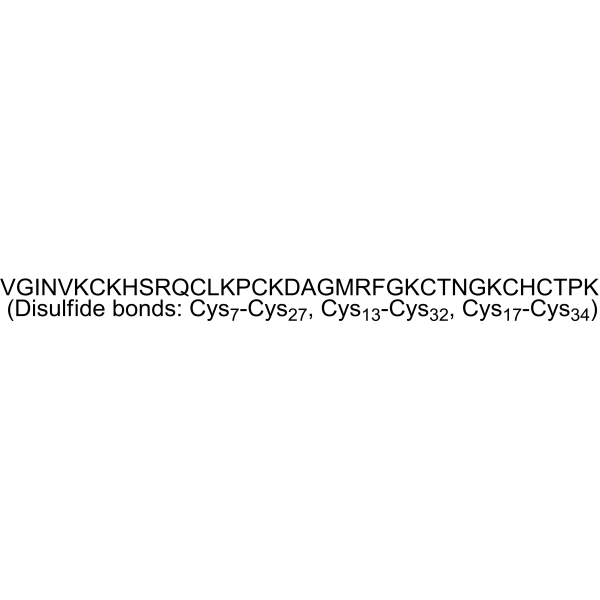
Val-Gly-Ile-Asn-Val-Lys-Cys-Lys-His-Ser-Arg-Gln-Cys-Leu-Lys-Pro-Cys-Lys-Asp-Ala-Gly-Met-Arg-Phe-Gly-Lys-Cys-Thr-Asn-Gly-Lys-Cys-His-Cys-Thr-Pro-Lys (Disulfide bonds: Cys7-Cys27, Cys13-Cys32, Cys17-Cys34)
-
Sequence Shortening
VGINVKCKHSRQCLKPCKDAGMRFGKCTNGKCHCTPK (Disulfide bonds: Cys7-Cys27, Cys13-Cys32, Cys17-Cys34)
-
Shipping
Room temperature in continental US; may vary elsewhere.
-
Storage
Please store the product under the recommended conditions in the Certificate of Analysis.


Publications (1)
-
Journal Impact Factor
-
Most Recent
-
Bioact Mater
Food-derived β-lactoglobulin nanofibrils: An efficacy, safe, and scalable solution to overcome oral insulin delivery challenges. [Abstract]2025 Nov 25:57:646-659. PMID: 41377894


Purity & Documentation
References
[1]. Han S, et al. Structural basis of a potent peptide inhibitor designed for Kv1.3 channel, a therapeutic target of autoimmune disease. J Biol Chem. 2008 Jul 4;283(27):19058-65. [Content Brief]
[2]. Li Z, et al. Selective inhibition of CCR7(-) effector memory T cell activation by a novel peptide targeting Kv1.3 channel in a rat experimental autoimmune encephalomyelitis model. J Biol Chem. 2012 Aug 24;287(35):29479-94. [Content Brief]

Calculators
Concentration (start) × Volume (start) = Concentration (final) × Volume (final)


ADWX 1 Related Classifications
HY-P1409 Related Classifications
 Powered by Bioz