



ALDH1A inhibitor 673A
Based on 2 publication(s) in Google Scholar
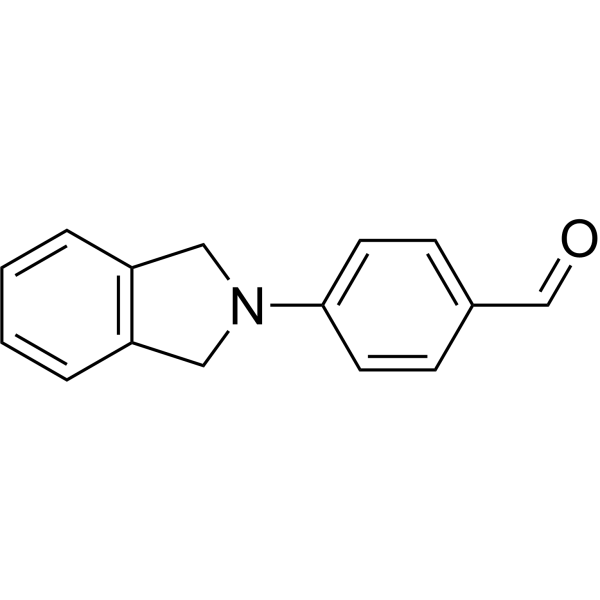
ALDH1A inhibitor 673A is an ALDH1A inhibitor with IC50s of 246 nM (ALDH1A1), 230 nM (ALDH1A2), 348 nM (ALDH1A3), respectively. ALDH1A inhibitor 673A has little or no inhibitory effect on other ALDH family members. ALDH1A inhibitor 673A induces necroptotic ovarian cancer stem-like cells (CSCs) death. ALDH1A inhibitor 673A induces DNA double stand breaks in cancer cells. ALDH1A inhibitor 673A can be used for the study of ovarian cancer.
Nos produits utilisent uniquement pour la recherche. Nous ne vendons pas aux patients.
- Pureté : 99.15%
- CAS No.: 109437-62-9
- Formule: C15H13NO
- Masse moléculaire:223.27
-
Stockage:Powder -20°C, 3 years , 4°C, 2 years ; In solvent -80°C, 6 months , -20°C, 1 month

To place orders, for customer services and technical support, please contact: MedChemExpress USA
Tel: 609-228-6898 E-mail: [email protected] [email protected]


-
 Activité biologique
-
Chemical Information
-
Solvant et solubilité
- Pureté et documentation
- Références
-
 Help & FAQs


Publications Citing Use of MedChemExpress (MCE) ALDH1A inhibitor 673A
More

Activité biologique
Description
In Vitro
ALDH1A inhibitor 673A (0.0001-0.1 μM) induces death in BRCAmutant PEO1/PEO4 cells[1].
ALDH1A inhibitor 673A (12 μM, 6 weeks) reduces tumor initiation capacity in BPRN-FTE organoids[1].
ALDH1A inhibitor 673A (0.6-10 μM, 12 h) causes a buildup in toxic aldehydes which induces DNA damage and cytotoxicity in OVCAR5 and OVCAR4 cells[2].
ALDH1A inhibitor 673A (1-2 μM, 96 h) induces death that can be exacerbated by exogenous aldehydes and ameliorated by aldehyde scavengers in OVCAR5 and OVCAR4 cells[2].
ALDH1A inhibitor 673A (10-20 μM) inhibits ALDH1A1 (IC50 = 246 nM), ALDH1A2 (IC50 = 230 nM), and ALDH1A3 (IC50 = 348 nM) with minimal or no inhibition of ALDH2 (IC50 = 14 μM) or numerous other ALDH family members[3].
ALDH1A inhibitor 673A (12.5 μM, 72 h) depletes CD133+ CSCs in all three cell lines (A2780, Ovsaho, and OVCAR5) with a CSC-selective median toxic dose (TD50) of 3-20 μM[3].
ALDH1A inhibitor 673A (2.5-12.5 μM, 72 h) induces nonapoptotic, caspase-independent cell death in A2780 cells[3].
ALDH1A inhibitor 673A (12.5 μM, 1.5-24 h) induces calcium-dependent necroptosis in A2780 cells[3].
ALDH1A inhibitor 673A (12.5 μM, 36-72 h) induces expression of the mitochondrial uncoupling proteins in PEO4 cells[3].
ALDH1A inhibitor 673A (12.5 μM, 1.5-24 h) treatment resulted in decreased OXPHOS capacity, associated with a significant decrease in basal and spare respiratory capacity and ATP production in primary HGSC cells[3].
ALDH1A inhibitor 673A (0.3-30 μM, 0-12 days) effectively depletes CSCs, synergizes with chemotherapy and radiotherapy, and significantly reduces tumor sphere formation and tumor initiation capacity in various cancer cell lines and primary patient samples[3].
MedChemExpress (MCE) has not independently confirmed the accuracy of these methods. They are for reference only.
-
Cell Line:OVCAR5 and OVCAR4 cells
-
Concentration:1, 3, 10 μM
-
Incubation Time:12 h
-
Result:Increased the levels of γ-H2AX, pChk1, pChk2 and pATR.
-
Cell Line:OVCAR5 and OVCAR4 cells
-
Concentration:1, 2 μM
-
Incubation Time:96 h
-
Result:Increased cell death when combined with 12.5 μM Retinaldehyde or 25 μM 4-Hydroxynonenal (4-HNE) (HY-113466).
Decreased cell death when combined with 10 μM Hydralazine (HY-B0464A) or 100 μM Metformin (HY-B0627).
-
Cell Line:A2780 cells and PEO4 cells
-
Concentration:2.5, 5, 12.5 μM
-
Incubation Time:48, 72 h
-
Result:Revealed no significant early or late induction of annexin-V.
Induced cell death which was not inhibited by pretreating cells with the pan-caspase inhibitor Z-VAD-FMK (HY-16658B) or the caspase-3 inhibitor Z-DEVD-FMK (HY-12466).
Induced necroptosis through an ALDH-dependent knockdown of ALDH1A3, causing cell death in PEO4 cells without significantly inducing annexin-V.
-
Cell Line:A2780 cells
-
Concentration:12.5 μM
-
Incubation Time:24 h
-
Result:Demonstrated clear nuclear swelling and loss of nuclear content consistent with necroptosis.
Revealed clear nuclear-to-cytoplasm translocation of the high mobility group-1 protein.
-
Cell Line:A2780 cells
-
Concentration:12.5 μM
-
Incubation Time:1.5, 2, 4, 5, 6, 8, 24 h
-
Result:Induced dephosphorylation of DRP1 and increased PGAM5 expression with the appearance of the PGAM5-S splice variant.
Increased both in the mitochondrial association of DRP1and in the proportion of MLKL protein localized to the cell membrane fraction.
-
Cell Line:PEO4 cells
-
Concentration:12.5 μM
-
Incubation Time:8, 20, 48 h
-
Result:Increased the expression of the mitochondrial UCPs (UCP1 and UCP3)
In Vivo
ALDH1A inhibitor 673A (20 mg/kg, i.p., five times a week, 4 weeks) enhances the tumor-inhibitory effects of ATM/ATR inhibitors(AZD1390 (HY-109566)/Ceralasertib (AZD6738) (HY-19323)) in an OVCAR5 cells xenograft mice model[2].
ALDH1A inhibitor 673A (4-20 mg/kg, i.p., daily, 3 weeks) inhibits the tumor growth in Ovsaho, HEY-1, and A2780 cell-line xenografts mice[3].
MedChemExpress (MCE) has not independently confirmed the accuracy of these methods. They are for reference only.
-
Animal Model:BPRN (Brca1, Trp53, Rb1, Nf1 inactivated) mouse model[1]
-
Dosage:20 mg/kg
-
Administration:i.p. daily for 5-7 days
-
Result:Showed no clear toxicity or any overt evidence of malignancy.
Reduced lesions in treated animals.
-
Animal Model:OVCAR5 cell were subcutaneously implanted bilaterally in the axilla of NSG mice[2]
-
Dosage:20 mg/kg combined with 20 mg/kg AZD1390 or 50 mg/kg AZD6738
-
Administration:i.p. five times a week for 4 weeks
-
Result:Reduced the tumor volume.
Increased the number of γ-H2AX positive nuclei.
-
Animal Model:7.5 × 10⁴ A2780 cells or 15,000 CD133+ (A2780) cells, 5 × 10⁶ OVCAR8, 5 × 10⁵ HEY-1, or 1 × 10⁵ CaOV3 cells were injected, in 100 μl of Matrigel (BD Biosciences), subcutaneously into the axillae of 8-week-old female NSG mice.[3]
-
Dosage:4, 20 mg/kg or a combination of Cisplatin (HY-17394) (i.p., 3 times a week)
-
Administration:i.p. daily for 3 weeks
-
Result:Prevented tumor growth and induced tumor regression.
Decreased tumor cell Ki67 expression.
Revealed necrotic morphology.
Upregulated the levels of UCP1 and UCP3 in treated tumors.
Reduced the number of ALDH1A1-expressing cells.
Decreased ALDEFLUOR activity in splenocytes of animals.
Demonstrated clear protection of the catalytic residue Cys303 in ALDH1A1, whereas no binding to noncatalytic residues was detected.
Upregulated the activity of ALDH.


Chemical Information
-
CAS No. 109437-62-9
-
Appearance Solid
-
Masse moléculaire 223.27
-
Formule C15H13NO
-
Color Off-white to light brown
-
SMILES
O=CC1=CC=C(N2CC3=C(C=CC=C3)C2)C=C1
-
Synonyms
ALDH1Ai 673A
-
Livraison
Room temperature in continental US; may vary elsewhere.
-
Stockage
Powder -20°C 3 years 4°C 2 years In solvent -80°C 6 months -20°C 1 month


Publications (2)
-
Journal Impact Factor
-
Most Recent
-
Cell Mol Life Sci
Reduced ALDH1A1 expression in multiple myeloma cells increases resistance to daratumumab via downregulation of retinoic acid. [Abstract]2025 Oct 7;82(1):352. PMID: 41055748 -
J Biol Chem
A cell-based assay for retinaldehyde dehydrogenase activity: Retinoid quantification as an alternative to current fluorescence-based approaches. [Abstract]2026 Jan 29;302(3):111211. PMID: 41617028


Solvant et solubilité
In Vitro:
DMSO : 29.17 mg/mL (130.65 mM; ultrasonic and warming and heat to 60°C; Hygroscopic DMSO has a significant impact on the solubility of product, please use newly opened DMSO)
Please refer to the solubility information to select the appropriate solvent. Once prepared, please aliquot and store the solution to prevent product inactivation from repeated freeze-thaw cycles.
Storage method and period of stock solution: -80°C, 6 months; -20°C, 1 month. When stored at -80°C, please use it within 6 months. When stored at -20°C, please use it within 1 month.
Please refer to the solubility information to select the appropriate solvent. Once prepared, please aliquot and store the solution to prevent product inactivation from repeated freeze-thaw cycles.
Storage method and period of stock solution: -80°C, 6 months; -20°C, 1 month. When stored at -80°C, please use it within 6 months. When stored at -20°C, please use it within 1 month.
Concentration (start) × Volume (start) = Concentration (final) × Volume (final)


Pureté et documentation
-
Fiche technique (284 KB)
-
SDS (393 KB)
- English - EN (393 KB)
- Français - FR (393 KB)
- Deutsch - DE (393 KB)
- Norwegian - NO (393 KB)
- Español - ES (393 KB)
- Swedish - SV (393 KB)
- Italian - IT (393 KB)
- Korean - KR (393 KB)
- Portuguese - PT (393 KB)
-
Instruction de manipulation (2659 KB)
Références
[1]. McGonigal S, et al. A putative role for ALDH inhibitors and chemoprevention of BRCA-mutation-driven tumors. Gynecol Oncol. 2023 Sep;176:139-146. [Content Brief]
[2]. Grimley E, et al. Aldehyde dehydrogenase inhibitors promote DNA damage in ovarian cancer and synergize with ATM/ATR inhibitors. Theranostics. 2021 Jan 20;11(8):3540-3551. [Content Brief]
[3]. Chefetz I, et al. A Pan-ALDH1A Inhibitor Induces Necroptosis in Ovarian Cancer Stem-like Cells. Cell Rep. 2019 Mar 12;26(11):3061-3075.e6. [Content Brief]


Complete Stock Solution Preparation Table
Please refer to the solubility information to select the appropriate solvent. Once prepared, please aliquot and store the solution to prevent product inactivation from repeated freeze-thaw cycles.
Storage method and period of stock solution: -80°C, 6 months; -20°C, 1 month. When stored at -80°C, please use it within 6 months. When stored at -20°C, please use it within 1 month.
| Optional Solvent | Concentration Solvent Mass | 1 mg | 5 mg | 10 mg | 25 mg |
|---|---|---|---|---|---|
| DMSO | 1 mM | 4.4789 mL | 22.3944 mL | 44.7888 mL | 111.9720 mL |
| 5 mM | 0.8958 mL | 4.4789 mL | 8.9578 mL | 22.3944 mL | |
| 10 mM | 0.4479 mL | 2.2394 mL | 4.4789 mL | 11.1972 mL | |
| 15 mM | 0.2986 mL | 1.4930 mL | 2.9859 mL | 7.4648 mL | |
| 20 mM | 0.2239 mL | 1.1197 mL | 2.2394 mL | 5.5986 mL | |
| 25 mM | 0.1792 mL | 0.8958 mL | 1.7916 mL | 4.4789 mL | |
| 30 mM | 0.1493 mL | 0.7465 mL | 1.4930 mL | 3.7324 mL | |
| 40 mM | 0.1120 mL | 0.5599 mL | 1.1197 mL | 2.7993 mL | |
| 50 mM | 0.0896 mL | 0.4479 mL | 0.8958 mL | 2.2394 mL | |
| 60 mM | 0.0746 mL | 0.3732 mL | 0.7465 mL | 1.8662 mL | |
| 80 mM | 0.0560 mL | 0.2799 mL | 0.5599 mL | 1.3997 mL | |
| 100 mM | 0.0448 mL | 0.2239 mL | 0.4479 mL | 1.1197 mL |


ALDH1A inhibitor 673A Related Classifications
HY-122912 Related Classifications
 Powered by Bioz