



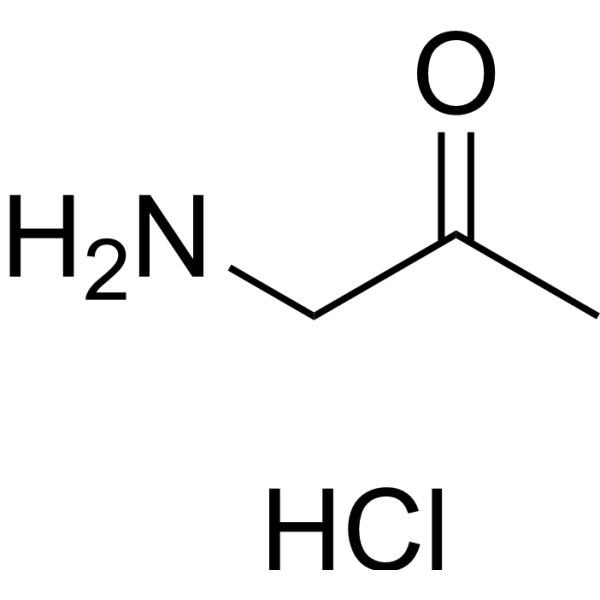
Aminoacetone hydrochloride

Based on 1 Customer Validation
Aminoacetone hydrochloride is an α-aminoketone and also a catabolite of threonine and glycine. When accumulated under pathological conditions, Aminoacetone hydrochloride participates in oxidative damage and protein dysfunction via the production of reactive oxygen species (ROS) and methylglyoxal, and it is associated with phenotypes such as diabetes, mitochondrial damage and sleep disorders.
For research use only. We do not sell to patients.
- Purity : 99.44%
- CAS No.: 7737-17-9
- Formula: C3H8ClNO
- Molecular Weight:109.55
-
Storage:
-20°C, sealed storage, away from moisture
* In solvent : -80°C, 6 months; -20°C, 1 month (sealed storage, away from moisture)

To place orders, for customer services and technical support, please contact: MedChemExpress USA
Tel: 609-228-6898 E-mail: [email protected] [email protected]


-
 Biological Activity
-
Chemical Information
-
Solvent & Solubility
- Purity & Documentation
- References
-
 Help & FAQs


All Endogenous Metabolite Isoforms
More

Biological Activity
Description
In Vitro
Aminoacetone (0.15-1.0 mM) induces dose-dependent, calcium-mediated swelling in isolated rat liver mitochondria, with 1.0 mM causing maximal swelling that is prevented by EGTA, MgCl2, or high-dose cyclosporine A[2].
Aminoacetone (0.2-1 mM) dose-dependently inhibits succinate-sustained oxygen consumption in isolated rat liver mitochondria, with 1 mM reducing the consumption rate from 9.1 to 0.7 nmol oxygen/min, via reactive oxygen species-mediated mechanisms[2].
Aminoacetone (0.5 mM; 20 min) reduces total protein thiol content by 31.8% in isolated rat liver mitochondria and induces formation of membrane protein aggregates, effects that are reversed by dithiothreitol[2].
MedChemExpress (MCE) has not independently confirmed the accuracy of these methods. They are for reference only.


Chemical Information
-
CAS No. 7737-17-9
-
Appearance Solid
-
Molecular Weight 109.55
-
Formula C3H8ClNO
-
Color Light yellow to yellow
-
SMILES
CC(CN)=O.Cl
-
Shipping
Room temperature in continental US; may vary elsewhere.
-
Storage
-20°C, sealed storage, away from moisture
* In solvent : -80°C, 6 months; -20°C, 1 month (sealed storage, away from moisture)


Solvent & Solubility
In Vitro:
DMSO : 200 mg/mL (1825.65 mM; Need ultrasonic; Hygroscopic DMSO has a significant impact on the solubility of product, please use newly opened DMSO)
Please refer to the solubility information to select the appropriate solvent. Once prepared, please aliquot and store the solution to prevent product inactivation from repeated freeze-thaw cycles.
Storage method and period of stock solution: -80°C, 6 months; -20°C, 1 month (sealed storage, away from moisture). When stored at -80°C, please use it within 6 months. When stored at -20°C, please use it within 1 month.
Please refer to the solubility information to select the appropriate solvent. Once prepared, please aliquot and store the solution to prevent product inactivation from repeated freeze-thaw cycles.
Storage method and period of stock solution: -80°C, 6 months; -20°C, 1 month (sealed storage, away from moisture). When stored at -80°C, please use it within 6 months. When stored at -20°C, please use it within 1 month.
Concentration (start) × Volume (start) = Concentration (final) × Volume (final)


Purity & Documentation
-
Data Sheet (272 KB)
-
SDS (476 KB)
- English - EN (476 KB)
- Français - FR (476 KB)
- Deutsch - DE (476 KB)
- Norwegian - NO (476 KB)
- Español - ES (476 KB)
- Swedish - SV (476 KB)
- Italian - IT (476 KB)
- Korean - KR (476 KB)
- Portuguese - PT (476 KB)
-
Handling Instructions (2659 KB)
References
[1]. Zhou S, et al. Aminoacetone is associated with sleep latency. Sleep Med. 2025;128:183-186. [Content Brief]
[2]. Dutra F, et al. Aminoacetone induces iron-mediated oxidative damage to isolated rat liver mitochondria. Arch Biochem Biophys. 2004;430(2):284-289. [Content Brief]
[3]. Ramos LD, et al. Aerobic co-oxidation of hemoglobin and aminoacetone, a putative source of methylglyoxal. Free Radic Biol Med. 2021;166:178-186. [Content Brief]


Complete Stock Solution Preparation Table
Please refer to the solubility information to select the appropriate solvent. Once prepared, please aliquot and store the solution to prevent product inactivation from repeated freeze-thaw cycles.
Storage method and period of stock solution: -80°C, 6 months; -20°C, 1 month (sealed storage, away from moisture). When stored at -80°C, please use it within 6 months. When stored at -20°C, please use it within 1 month.
| Optional Solvent | Concentration Solvent Mass | 1 mg | 5 mg | 10 mg | 25 mg |
|---|---|---|---|---|---|
| DMSO | 1 mM | 9.1283 mL | 45.6413 mL | 91.2825 mL | 228.2063 mL |
| 5 mM | 1.8257 mL | 9.1283 mL | 18.2565 mL | 45.6413 mL | |
| 10 mM | 0.9128 mL | 4.5641 mL | 9.1283 mL | 22.8206 mL | |
| 15 mM | 0.6086 mL | 3.0428 mL | 6.0855 mL | 15.2138 mL | |
| 20 mM | 0.4564 mL | 2.2821 mL | 4.5641 mL | 11.4103 mL | |
| 25 mM | 0.3651 mL | 1.8257 mL | 3.6513 mL | 9.1283 mL | |
| 30 mM | 0.3043 mL | 1.5214 mL | 3.0428 mL | 7.6069 mL | |
| 40 mM | 0.2282 mL | 1.1410 mL | 2.2821 mL | 5.7052 mL | |
| 50 mM | 0.1826 mL | 0.9128 mL | 1.8257 mL | 4.5641 mL | |
| 60 mM | 0.1521 mL | 0.7607 mL | 1.5214 mL | 3.8034 mL | |
| 80 mM | 0.1141 mL | 0.5705 mL | 1.1410 mL | 2.8526 mL | |
| 100 mM | 0.0913 mL | 0.4564 mL | 0.9128 mL | 2.2821 mL |


Aminoacetone hydrochloride Related Classifications
HY-W004850 Related Classifications
 Powered by Bioz