



ATG3 Antibody (YA602)
(Synonyms: APG3; APG3L; PC3-96; APG3-LIKE)Based on 1 Customer Validation
ATG3 Antibody (YA602) is a Rabbit-derived and non-conjugated IgG monoclonal antibody, targeting to ATG3.
-
Host:
Rabbit
-
Isotype:
IgG
-
Application:
WB, IHC-F, IHC-P, ICC/IF
-
Reactivity :
Human, Mouse, Rat
-
Formulation:
Supplied in 50 mM Tris-Glycine (pH 7.4), 0.15 M NaCl, 40% Glycerol and 0.05% BSA. Preservative: 0.01% Sodium azide
-
Conjugation:
Non-conjugated


To place orders, for customer services and technical support, please contact: MedChemExpress USA
Tel: 609-228-6898 E-mail: [email protected] [email protected]





Applications
| Application |
WB

WB: Western Blot
|
IHC-P
IHC-P: Immunohistochemistry-Paraffin
|
IHC-F
IHC-F: Immunohistochemistry-Frozen
|
ICC/IF
ICC/IF: Immunocytochemistry/
Immunofluorescence |
|---|---|---|---|---|
| Dilution Ratio | 1:500-1:1000 | 1:50-1:100 | 1:50-1:100 | 1:50-1:200 |


Product Details
ATG3 Antibody (YA602) is a Rabbit-derived and non-conjugated IgG monoclonal antibody, targeting to ATG3.
-
Host Rabbit

-
Clonality Recombinant,Monoclonal

-
Species ReactivityHuman, Mouse, Rat
-
Observed Molecular WeightObserved band size: 40 kDa
Note: Due to possible protein modifications or aggregation, the molecular weight should be confirmed by actual measurement, and the predicted value is for reference only.

-
Calculated Molecular Weight Predicted band size: 36 kDa

Entrez Gene: 64422 Human ; 67841 Mouse ; 171415 Rat
SwissProt: Q9NT62 Human ; Q9CPX6 Mouse ; Q6AZ50 Rat
OMIM: 609606 Human
Synthetic peptide corresponding to Human ATG3 aa2-20.
Endogenous
affinity purified
Non-conjugated
Unmodified
IgG


Product Properties
-
Appearance
Solution
-
Formulation
Supplied in 50 mM Tris-Glycine (pH 7.4), 0.15 M NaCl, 40% Glycerol and 0.05% BSA. Preservative: 0.01% Sodium azide
-
Concentration
Batch-dependent, Please check the COA for the concentration of each lot. Check Lot Concentration
-
Storage & Stability
Stored at -20°C for 1 year. Avoid repeated freeze / thaw cycles.
-
Shipping
Shipping with blue ice.


Verification Images
-
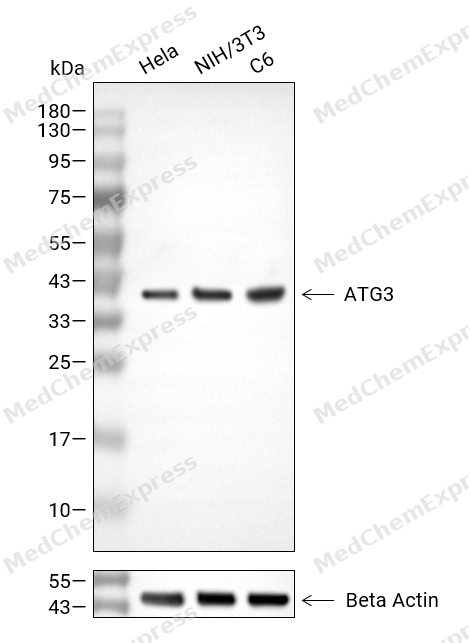 Western blot analysis of extracts from Hela (lane 2(20μg), NIH/3T3 (lane 3(20μg), C6 (lane 4(20μg), using ATG3 Antibody. Proteins were transferred to a PVDF membrane and blocked with 5% BSA in TBST for 2 hour at room temperature. The primary antibody and Loading control antibody (Beta Actin, HY-P80438, 1/3000) was used in 5% BSA in TBST at 4°C overnight. Goat Anti-Mouse/Rabbit IgG-HRP Secondary Antibody (HY-P8004/HY-P8001, 1/10,000) was used for 1 hour at room temperature.
 -
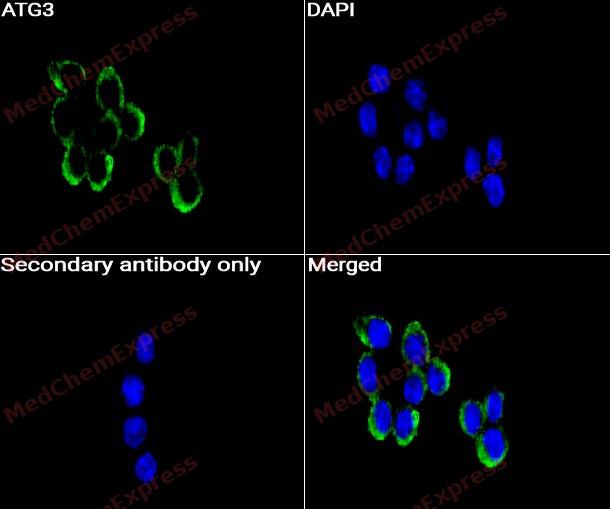 Immunocytochemistry analysis of Hela cells labeling ATG3 with ATG3 Antibody (HY-P80556) at 1/50 dilution. Cells were fixed in 4% paraformaldehyde for 15 minutes at room temperature, permeabilized with 0.1% Triton X-100 for 10 minutes at room temperature, then blocked with QuickBlock™ Blocking Buffer for Immunol Staining for 10 min at room temperature. Cells were then incubated with ATG3 Antibody (HY-P80556) at 1/50 dilution in QuickBlock™ Blocking Buffer for Immunol Staining at 4 ℃. Alexa Fluor® 488-conjugated AffiniPure Goat Anti-Rabbit IgG H&L(HY-P8002, Green) was used as the secondary antibody at 1/1,000 dilution. PBS instead of the primary antibody was used as the secondary antibody only control. The Nuclear counterstain was DAPI (Blue).
 -
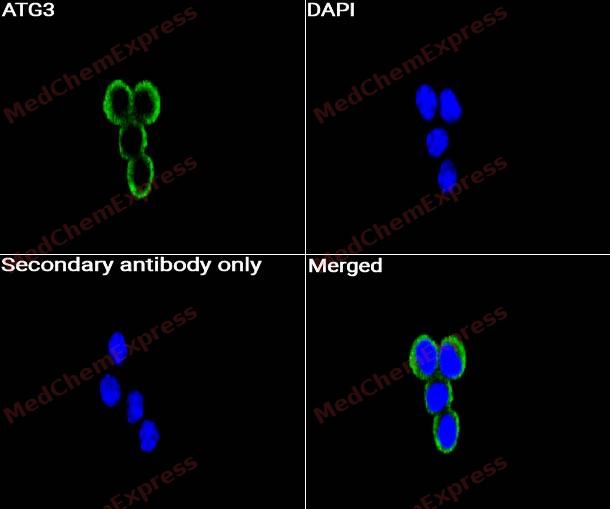 Immunocytochemistry analysis of Hela cells labeling ATG3 with ATG3 Antibody (HY-P80556) at 1/100 dilution. Cells were fixed in 4% paraformaldehyde for 15 minutes at room temperature, permeabilized with 0.1% Triton X-100 for 10 minutes at room temperature, then blocked with QuickBlock™ Blocking Buffer for Immunol Staining for 10 min at room temperature. Cells were then incubated with ATG3 Antibody (HY-P80556)at 1/100 dilution in QuickBlock™ Blocking Buffer for Immunol Staining at 4 ℃. Alexa Fluor® 488-conjugated AffiniPure Goat Anti-Rabbit IgG H&L(HY-P8002,Green) was used as the secondary antibody at 1/1,000 dilution. PBS instead of the primary antibody was used as the secondary antibody only control. The Nuclear counterstain was DAPI (Blue).


Background
-
Function
ATG3 is an E2 conjugating enzyme that catalyzes the covalent conjugation of the C-terminal Gly of ATG8-like proteins (GABARAP, GABARAPL1, GABARAPL2 or MAP1LC3A) to the amino group of phosphatidylethanolamine (PE)-containing lipids in the membrane resulting in membrane-bound ATG8-like proteins which is one of the key steps in the development of autophagic isolation membranes during autophagosome formation. Cycles back and forth between binding to ATG7 for loading with the ATG8-like proteins and binding to E3 enzyme, composed of ATG12, ATG5 and ATG16L1 to promote ATG8-like proteins lipidation. Also plays a role as a membrane curvature sensor that facilitates LC3/GABARAP lipidation by sensing local membrane stress associated with lipid-packing defects as occurs with high molar proportions of conical lipids or strident membrane curvature. Interacts with negatively-charged membranes promoting membrane tethering and enhancing LC3/GABARAP lipidation. Also acts as an autocatalytic E2-like enzyme by catalyzing the conjugation of ATG12 to itself in an ATG7-dependent manner, this complex thus formed, plays a role in mitochondrial homeostasis but not in autophagy. ATG12-ATG3 conjugation promotes late endosome to lysosome trafficking and basal autophagosome maturation via its interaction with PDCD6IP. ATG12-ATG3 conjugate is also formed upon viccina virus infection, leading to the disruption the cellular autophagy which is not necessary for vaccinia survival and proliferation. Promotes primary ciliogenesis by removing OFD1 from centriolar satellites via the autophagic pathway[1][2][3][4][5][6][7][8][9].
-
Subcellular Localization
Cytoplasm
-
Expression
Tissue_specificity:It is widely expressed, with the highest expression levels in the heart, skeletal muscle, kidneys, liver, and placenta. -
Isoforms & Post-Translational Modification
Q9NT62 has 2 isomers: Q9NT62-1: 35864 Da (predicted); Q9NT62-2: 35467 Da (predicted).
Cleaved by CASP8 upon death ligand binding such as tumor necrosis factor-alpha (PubMed:22644571). CASP8 cleavage blocks survival-related autophagy and favors apoptosis (PubMed:22644571);Conjugated to ATG12 at Lys-243. ATG12-conjugation plays a role in regulation of mitochondrial homeostasis and cell death, while it is not involved in phosphatidylethanolamine-conjugation to ATG8-like proteins and autophagy -
Subunit
Homdimer (PubMed:24191030). Interacts with ATG7; this interaction forms an E1-E2 complex that is essential for the transfer of GABARAP thioester from ATG7 to ATG3 and disrupts interaction with the E3 enzyme complex (PubMed:11825910, PubMed:22170151, PubMed:24186333, PubMed:26043688, PubMed:37252361). Interacts with ATG12; this interaction is ATG7-dependent, essential for phosphatidylethanolamine (PE)-conjugated ATG8-like proteins formation and also mediates the autoconjugation of ATG12 on ATG3 (PubMed:11825910, PubMed:12207896, PubMed:22170151, PubMed:24191030). Interacts with FNBP1L (PubMed:19342671). Interacts with the E3 enzyme complex composed of 4 sets of ATG12-ATG5 and ATG16L1 (400 kDa); this interaction disrupts interaction with ATG7 and promotes ATG8-like proteins lipidation (PubMed:24186333, PubMed:24191030, PubMed:37252361). Interacts with GABARAP and MAP1LC3A (PubMed:37252361). Interacts with the ATG12-ATG5 conjugate; this interaction inhibits ATG8-like proteins lipidation (PubMed:12207896). Interacts (ATG12-ATG3 conjugate form) with PDCD6IP (via the BRO1 domain); this interaction is bridged by ATG12 and promotes multiple PDCD6IP-mediated functions such as endolysosomal trafficking, macroautophagy and exosome biogenesis (By similarity)
-
SwissProt ID
-
Synonyms
APG3; APG3L; PC3-96; APG3-LIKE
-
Research Field
Cell Biology


Documentation
-
Data Sheet (262 KB)
-
SDS (251 KB)
- English - EN (251 KB)
- Français - FR (251 KB)
- Deutsch - DE (251 KB)
- Norwegian - NO (251 KB)
- Español - ES (251 KB)
- Swedish - SV (251 KB)
- Italian - IT (251 KB)
- Korean - KR (251 KB)
- Portuguese - PT (251 KB)
-
User Guide for Antibodies (1077 KB)
References
[1]. Metlagel Z, et al. Structural basis of ATG3 recognition by the autophagic ubiquitin-like protein ATG12. Proc Natl Acad Sci U S A. 2013 Nov 19;110(47):18844-9. [Content Brief]
[2]. Ye Y, et al. An N-terminal conserved region in human Atg3 couples membrane curvature sensitivity to conjugase activity during autophagy. Nat Commun. 2021 Jan 14;12(1):374. [Content Brief]
[3]. Farnung J, et al. Semisynthetic LC3 Probes for Autophagy Pathways Reveal a Noncanonical LC3 Interacting Region Motif Crucial for the Enzymatic Activity of Human ATG3. ACS Cent Sci. 2023 May 24;9(5):1025-1034. [Content Brief]
[4]. Tanida I, et al. Human Apg3p/Aut1p homologue is an authentic E2 enzyme for multiple substrates, GATE-16, GABARAP, and MAP-LC3, and facilitates the conjugation of hApg12p to hApg5p. J Biol Chem. 2002 Apr 19;277(16):13739-44. [Content Brief]
[5]. Tanida I, et al. Mammalian Apg12p, but not the Apg12p.Apg5p conjugate, facilitates LC3 processing. Biochem Biophys Res Commun. 2002 Sep 6;296(5):1164-70. [Content Brief]
[6]. Nemoto T, et al. The mouse APG10 homologue, an E2-like enzyme for Apg12p conjugation, facilitates MAP-LC3 modification. J Biol Chem. 2003 Oct 10;278(41):39517-26. [Content Brief]
[7]. Tanida I, et al. Atg8L/Apg8L is the fourth mammalian modifier of mammalian Atg8 conjugation mediated by human Atg4B, Atg7 and Atg3. FEBS J. 2006 Jun;273(11):2553-62. [Content Brief]
[8]. Qiu Y, et al. Binding to E1 and E3 is mutually exclusive for the human autophagy E2 Atg3. Protein Sci. 2013 Dec;22(12):1691-7. [Content Brief]
[9]. Hervás JH, et al. Human ATG3 binding to lipid bilayers: role of lipid geometry, and electric charge. Sci Rep. 2017 Nov 15;7(1):15614. [Content Brief]

 Powered by Bioz
