



Calcineurin A Antibody (YA2508)
(Synonyms: PPP3CA; CALNA; CNA; Serine/threonine-protein phosphatase 2B catalytic subunit alpha isoform; CAM-PRP catalytic subunit; Calmodulin-dependent calcineurin A subunit alpha isoform)
Based on 1 Customer Validation
Calcineurin A Antibody (YA2508) is a Rabbit-derived and non-conjugated IgG monoclonal antibody, targeting to Calcineurin A.
-
Host:
Rabbit
-
Isotype:
IgG
-
Application:
WB, ICC/IF, FC
-
Reactivity :
Human, Mouse, Rat
-
Formulation:
Supplied in Rabbit IgG in 10mM phosphate buffered saline , pH 7.4, 150mM sodium chloride, 0.05% BSA, 0.02% sodium azide and 50% glycerol.
-
Conjugation:
Non-conjugated


To place orders, for customer services and technical support, please contact: MedChemExpress USA
Tel: 609-228-6898 E-mail: [email protected] [email protected]





Applications
| Application |
WB

WB: Western Blot
|
ICC/IF
ICC/IF: Immunocytochemistry/
Immunofluorescence |
FC
FC: Flow Cytometry
|
|---|---|---|---|
| Dilution Ratio | 1:500-1:1000 | 1:50-1:200 | 1:50-1:100 |


Product Details
Calcineurin A Antibody (YA2508) is a Rabbit-derived and non-conjugated IgG monoclonal antibody, targeting to Calcineurin A.
-
Host Rabbit

-
Clonality Recombinant,Monoclonal

-
Species ReactivityHuman, Mouse, Rat
-
Observed Molecular WeightObserved band size: 59 kDa
Note: Due to possible protein modifications or aggregation, the molecular weight should be confirmed by actual measurement, and the predicted value is for reference only.

-
Calculated Molecular Weight Predicted band size: 59 kDa

Entrez Gene: 5530 Human ; 19055 Mouse ; 24674 Rat
SwissProt: Q08209 Human ; P63328 Mouse ; P63329 Rat
OMIM: 617711 Human
A synthesized peptide derived from human Calcineurin A aa470-521/521.
Endogenous
Affinity Chromatography
Non-conjugated
Unmodified
IgG


Product Properties
-
Appearance
Liquid
-
Formulation
Supplied in Rabbit IgG in 10mM phosphate buffered saline , pH 7.4, 150mM sodium chloride, 0.05% BSA, 0.02% sodium azide and 50% glycerol.
-
Concentration
Batch-dependent, Please check the COA for the concentration of each lot. Check Lot Concentration
-
Storage & Stability
Stored at -20°C for 1 year. Avoid repeated freeze / thaw cycles.
-
Shipping
Shipping with blue ice.


Verification Images
-
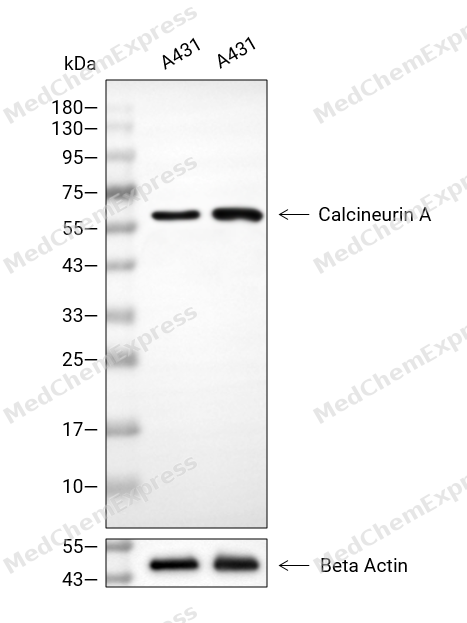 Western blot analysis of extracts from A431 (lane 2(20μg), A431 (lane 3(40μg), using Calcineurin A Antibody. Proteins were transferred to a PVDF membrane and blocked with 5% BSA in TBST for 2 hour at room temperature. The primary antibody and Loading control antibody (Beta Actin, HY-P80438, 1/3000) was used in 5% BSA in TBST at 4°C overnight. Goat Anti-Mouse/Rabbit IgG-HRP Secondary Antibody (HY-P8004/HY-P8001, 1/10,000) was used for 1 hour at room temperature.
 -
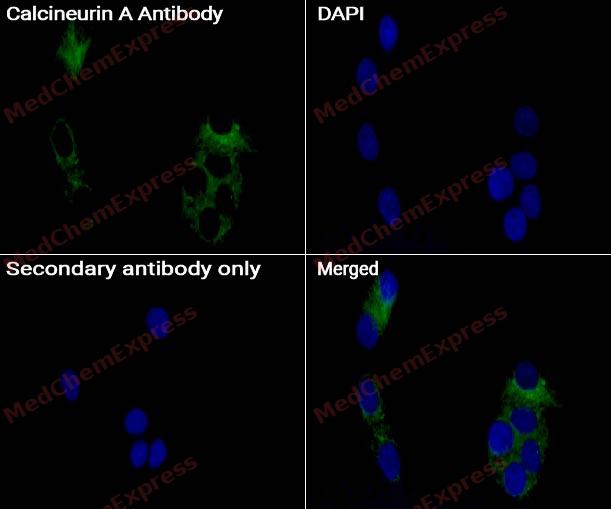 Immunocytochemistry analysis of MCF-7 cells labeling Calcineurin A with Calcineurin A antibody (HY-P82763) at 1/50 dilution. Cells were fixed in 4% paraformaldehyde for 15 minutes at room temperature, permeabilized with 0.1% Triton X-100 for 10 minutes at room temperature, then blocked with BSA for Immunol Staining for 10 min at room temperature. Cells were then incubated with Calcineurin A antibody (HY-P82763) at 1/50 dilution in BSA for Immunol Staining at 4 ℃, Stay overnight. AF488-conjugated AffiniPure Goat Anti-Rabbit IgG H&L(HY-P8002, Green) was used as the secondary antibody at 1/1,000 dilution. PBS instead of the primary antibody was used as the secondary antibody only control. The Nuclear counterstain was DAPI (Blue).
 -
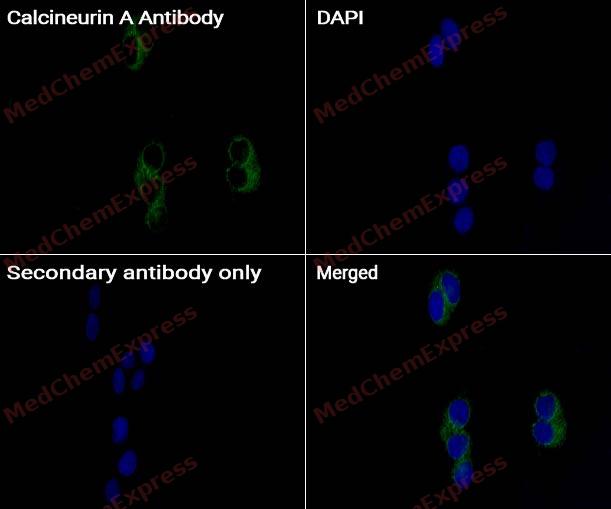 Immunocytochemistry analysis of MCF-7 cells labeling Calcineurin A with Calcineurin A antibody (HY-P82763) at 1/100 dilution. Cells were fixed in 4% paraformaldehyde for 15 minutes at room temperature, permeabilized with 0.1% Triton X-100 for 10 minutes at room temperature, then blocked with BSA for Immunol Staining for 10 min at room temperature. Cells were then incubated with Calcineurin A antibody (HY-P82763) at 1/100 dilution in BSA for Immunol Staining at 4℃, Stay overnight. AF488-conjugated AffiniPure Goat Anti-Rabbit IgG H&L(HY-P8002, Green) was used as the secondary antibody at 1/1,000 dilution. PBS instead of the primary antibody was used as the secondary antibody only control. The Nuclear counterstain was DAPI (Blue).


Background
-
Function
Calcineurin A is a Calcium-dependent, calmodulin-stimulated protein phosphatase which plays an essential role in the transduction of intracellular Ca(2+)-mediated signals. Many of the substrates contain a PxIxIT motif and/or a LxVP motif. In response to increased Ca(2+) levels, dephosphorylates and activates phosphatase SSH1 which results in cofilin dephosphorylation. In response to increased Ca(2+) levels following mitochondrial depolarization, dephosphorylates DNM1L inducing DNM1L translocation to the mitochondrion. Positively regulates the CACNA1B/CAV2.2-mediated Ca(2+) release probability at hippocampal neuronal soma and synaptic terminals. Dephosphorylates heat shock protein HSPB1. Dephosphorylates and activates transcription factor NFATC1. In response to increased Ca(2+) levels, regulates NFAT-mediated transcription probably by dephosphorylating NFAT and promoting its nuclear translocation. Dephosphorylates and inactivates transcription factor ELK1. Dephosphorylates DARPP32. May dephosphorylate CRTC2 at 'Ser-171' resulting in CRTC2 dissociation from 14-3-3 proteins. Dephosphorylates transcription factor TFEB at 'Ser-211' following Coxsackievirus B3 infection, promoting nuclear translocation. Required for postnatal development of the nepH2O2enic zone and superficial glomeruli in the kidneys, cell cycle homeostasis in the nepH2O2enic zone, and ultimately normal kidney function. Plays a role in intracellular AQP2 processing and localization to the apical membrane in the kidney, may thereby be required for efficient kidney filtration. Required for secretion of salivary enzymes amylase, peroxidase, lysozyme and sialic acid via formation of secretory vesicles in the submandibular glands. Required for calcineurin activity and homosynaptic depotentiation in the hippocampus. Required for normal differentiation and survival of keratinocytes and therefore required for epidermis superstructure formation. Positively regulates osteoblastic bone formation, via promotion of osteoblast differentiation. Positively regulates osteoclast differentiation, potentially via NFATC1 signaling. May play a role in skeletal muscle fiber type specification, potentially via NFATC1 signaling. Negatively regulates MAP3K14/NIK signaling via inhibition of nuclear translocation of the transcription factors RELA and RELB. Required for antigen-specific T-cell proliferation response. Dephosphorylates KLHL3, promoting the interaction between KLHL3 and WNK4 and subsequent degradation of WNK4. Negatively regulates SLC9A1 activity[1][2][3][4][5][6][7][8][9][10][11][12][13][14].
-
Subcellular Localization
Cytoplasm; Cell membrane; Peripheral membrane protein; Cell membrane, sarcolemma; Cytoplasm, myofibril, sarcomere, Z line; Cell projection, dendritic spine
-
Expression
Tissue_specificity:Expression (protein level) in keratinocytes (PubMed: 29043977) . Expression (protein level) in lymphoblasts (PubMed: 30254215) . -
Isoforms & Post-Translational Modification
Q08209 has 5 isomers: Q08209-1: 58688 Da (predicted); Q08209-2: 57659 Da (predicted); Q08209-3: 52672 Da (predicted); Q08209-4: 31736 Da (predicted); Q08209-5: 51245 Da (predicted).
-
Subunit
Forms a complex composed of a calmodulin-dependent catalytic subunit (also known as calcineurin A) and a regulatory Ca(2+)-binding subunit (also known as calcineurin B) (PubMed:12218175, PubMed:12357034, PubMed:17498738, PubMed:22343722, PubMed:23468591, PubMed:27974827, PubMed:8524402). There are three catalytic subunits, each encoded by a separate gene (PPP3CA, PPP3CB, and PPP3CC) and two regulatory subunits which are also encoded by separate genes (PPP3R1 and PPP3R2). In response to an increase in Ca(2+) intracellular levels, forms a complex composed of PPP3CA/calcineurin A, calcineurin B and calmodulin (By similarity). Interacts (via calcineurin B binding domain) with regulatory subunit PPP3R1/calcineurin B (PubMed:12218175, PubMed:12357034, PubMed:17498738, PubMed:22343722, PubMed:23468591, PubMed:27974827, PubMed:8524402). Interacts (via calmodulin-binding domain) with CALM1/calmodulin; the interaction depends on calmodulin binding to Ca(2+) (PubMed:18384083, PubMed:19404396, PubMed:25144868, Ref.34). Forms a complex composed of MYOZ2 and ACTN1 (By similarity). Within the complex interacts with MYOZ2 (PubMed:11114196). Interacts with MYOZ1 (PubMed:11114196). Interacts with MYOZ3 (PubMed:11842093). Interacts with CIB1; the interaction increases upon cardiomyocyte hypertrophy (By similarity). Interacts with CHP1 and CHP2 (By similarity). Interacts with CRTC1 (PubMed:30611118). Interacts with CRTC2 (PubMed:15454081, PubMed:30611118). Interacts with DNM1L; the interaction dephosphorylates DNM1L and promotes its translocation to mitochondria (PubMed:18838687). Interacts with CMYA5; this interaction represses calcineurin activity in muscle (By similarity). Interacts (constitutively active form) with SYNPO2 (PubMed:17923693). Interacts with scaffold protein AKAP5 (via IAIIIT motif); the interaction recruits PPP3CA to the plasma membrane following L-type Ca(2+)-channel activation (PubMed:22343722). Interacts with NFATC2 (PubMed:26248042). Interacts with RCAN3 (PubMed:26248042). Interacts with PPIA (PubMed:12218175, PubMed:12357034). Interacts with RCAN1 (PubMed:12809556). Interacts with UNC119 (By similarity). Interacts with C16orf74 (via PxIxIT motif, when phosphorylated on 'Thr-44') (PubMed:28881575). Interacts (via N-terminus) with MAP3K14/NIK (via C-terminus and kinase domain) (By similarity). Interacts with TRAF3 (By similarity). Interacts with SPATA33 (via PQIIIT motif) (PubMed:34446558)
-
SwissProt ID
-
Synonyms
PPP3CA; CALNA; CNA; Serine/threonine-protein phosphatase 2B catalytic subunit alpha isoform; CAM-PRP catalytic subunit; Calmodulin-dependent calcineurin A subunit alpha isoform
-
Research Field
Immunology


Documentation
-
Data Sheet (235 KB)
-
SDS (252 KB)
- English - EN (252 KB)
- Français - FR (252 KB)
- Deutsch - DE (252 KB)
- Norwegian - NO (252 KB)
- Español - ES (252 KB)
- Swedish - SV (252 KB)
- Italian - IT (252 KB)
- Korean - KR (252 KB)
- Portuguese - PT (252 KB)
-
User Guide for Antibodies (1077 KB)

 Powered by Bioz
