



CD248 Antibody (YA4508)
(Synonyms: TEM1; CD164L1)Based on 1 Customer Validation
CD248 Antibody (YA4508) is a Mouse-derived and non-conjugated IgG1 monoclonal antibody, targeting to CD248.
-
Host:
Mouse
-
Isotype:
IgG1
-
Application:
FC, ELISA
-
Reactivity :
Human
-
Formulation:
Supplied in PBS with 0.05% sodium azide
-
Conjugation:
Non-conjugated


To place orders, for customer services and technical support, please contact: MedChemExpress USA
Tel: 609-228-6898 E-mail: [email protected] [email protected]





Applications
| Application |
FC

FC: Flow Cytometry
|
ELISA
ELISA: Enzyme Linked Immunosorbent Assay
|
|---|---|---|
| Dilution Ratio | 1:200-1:400 | 1:10000 |


Product Details
CD248 Antibody (YA4508) is a Mouse-derived and non-conjugated IgG1 monoclonal antibody, targeting to CD248.
-
Host Mouse

-
Clonality Monoclonal

-
Species ReactivityHuman
-
Observed Molecular WeightObserved band size: 160 kDa
Note: Due to possible protein modifications or aggregation, the molecular weight should be confirmed by actual measurement, and the predicted value is for reference only.

-
Calculated Molecular Weight Predicted band size: 80.9 kDa

Purified recombinant fragment of human CD248 (AA: extra 18-180) expressed in E. Coli.
affinity purified.
Non-conjugated
Unmodified
IgG1


Product Properties
-
Appearance
Solution
-
Formulation
Supplied in PBS with 0.05% sodium azide
-
Concentration
Batch-dependent, Please check the COA for the concentration of each lot. Check Lot Concentration
-
Storage & Stability
Stored at -20°C for 1 year. Avoid repeated freeze / thaw cycles.
-
Shipping
Shipping with blue ice.


Verification Images
-
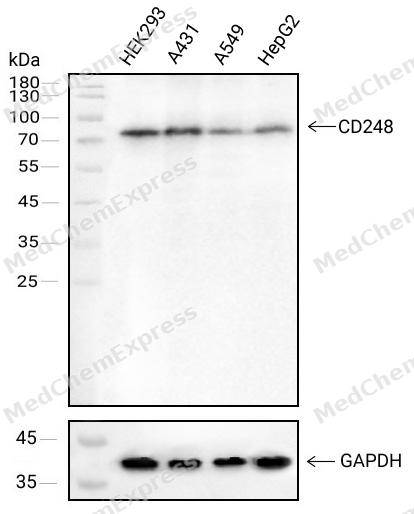 Western blot analysis of extracts from HEK293(lane 1(40μg) ),A431(lane 2(40μg) ),A549(lane 3(40μg) )and HepG2(lane 4(40μg) ) using CD248 antibody. Proteins were transferred to a NC membrane and blocked with 5% Skim milk in TBST for 2 hour at room temperature. The primary antibody ( 1/1000) and Loading control antibody (GAPDH, 1/1000) was used in 5% Skim milk in TBST at 4°C overnight. Goat Anti-Mouse IgG-HRP Secondary Antibody (1/10,000) was used for 1 hour at room temperature.
 -
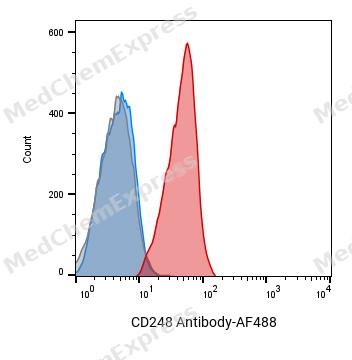 Flow cytometric analysis of 1X10^6 HL-60 cells labeling CD248 Antibody(red). Cells were fixed with 4% paraformaldehyde and permeabilised with 0.2% Triton X-100. Then stained with the primary antibody at 1/400 dilution overnight at 4℃. AF 488 Goat Anti-mouse IgG H&L was used as the secondary antibody at 1/1,000 dilution for 45 minutes at room temperature. Mouse IgG Isotype Control (blue) was used as the isotype control, cells without incubation with primary antibody were used as the unlabeled control (black).


Background
-
Function
CD248 cell surface glycoprotein involved in various biological processes including angiogenesis, immune response modulation, and tissue remodeling and repair. Participates in pericyte proliferation through positive modulation of the PDGF receptor signaling pathway. Acts as a scaffold for factor X, triggering allosteric changes and the spatial re-alignment of factor X with the TF-factor VIIa complex, thereby enhancing coagulation activation. Modulates the insulin signaling pathway by interacting with insulin receptor/INSR and by diminishing its capacity to be autophosphorylated in response to insulin. Also regulates LPS-induced inflammatory response in macrophages by favoring the production of proinflammatory cytokines. In human, negatively regulates T-cell proliferation compared with stromal cells where it increases proliferation[1][2].
-
Subcellular Localization
Membrane; Single-pass type I membrane protein
-
Expression
Tissue_specificity:Expressed in tumor endothelial cells but absent or barely detectable in normal endothelial cells. Expressed in metastatic lesions of the liver and during angiogenesis of corpus luteum formation and wound healing. Expressed in vascular endothelial cells of malignant tumors but not in normal blood vessels. Expressed in stromal fibroblasts. Strongly expressed in pericytes (PubMed:20484976) . Expressed on stromal cells and cells with lymphoid morphology such a T-cells (PubMed:21466550) -
Isoforms & Post-Translational Modification
Q9HCU0 has 2 isomers: Q9HCU0-1: 80859 Da (predicted); Q9HCU0-2: 46241 Da (predicted).
O-glycosylated with sialylated oligosaccharides;May be N-glycosylated -
Subunit
Interacts with PDGFRA; this interaction promotes PDGF receptor signaling pathway. Interacts with integrin beta-1/ITGB1.
-
SwissProt ID
-
Synonyms
TEM1; CD164L1


Documentation
-
Data Sheet (234 KB)
-
SDS (251 KB)
- English - EN (251 KB)
- Français - FR (251 KB)
- Deutsch - DE (251 KB)
- Norwegian - NO (251 KB)
- Español - ES (251 KB)
- Swedish - SV (251 KB)
- Italian - IT (251 KB)
- Korean - KR (251 KB)
- Portuguese - PT (251 KB)
-
User Guide for Antibodies (1077 KB)

 Powered by Bioz
