



CD31 Antibody (YA806)
(Synonyms: Platelet endothelial cell adhesion molecule; PECAM-1; EndoCAM; GPIIA'; PECA1; CD antigen CD31)Based on 1 publication(s) in Google Scholar
CD31 Antibody (YA806) is a Mouse-derived and non-conjugated IgG2a monoclonal antibody, targeting to CD31.
-
Host:
Mouse
-
Isotype:
IgG
-
Application:
WB, ICC/IF, IHC-P, mIHC
-
Reactivity :
Human, Mouse
-
Formulation:
Supplied in 1*TBS (pH7.4), 0.2% BSA, 50% Glycerol. Preservative: 0.05% Sodium Azide.
-
Conjugation:
Non-conjugated


To place orders, for customer services and technical support, please contact: MedChemExpress USA
Tel: 609-228-6898 E-mail: [email protected] [email protected]



-

HY-P8001
HRP-conjugated Goat Anti-Rabbit IgG H&L -
HY-P8005
AF488-conjugated Goat Anti-Mouse IgG H&L -
HY-P80665
F4/80 Antibody (YA002) -
HY-P80951
FITC-conjugated Goat Anti-Rabbit IgG H&L -
HY-P85776
VE-Cadherin Antibody (YA5468) -
HY-P83739
alpha smooth muscle Actin Antibody(YA3468) -
HY-P87176
CD8 alpha Antibody(YA6867) -
HY-P81018
Cy5-conjugated Goat Anti-Mouse IgG H&L -
HY-P83756
CD4 Antibody (YA3557)
Publications Citing Use of MedChemExpress (MCE) CD31 Antibody (YA806)
More

Applications
| Application |
WB

WB: Western Blot
|
ICC/IF
ICC/IF: Immunocytochemistry/
Immunofluorescence |
IHC-P
IHC-P: Immunohistochemistry-Paraffin
|
mIHC
mIHC: Multiplex Immunohistochemical
|
|---|---|---|---|---|
| Dilution Ratio | 1:1000-1:5000 | 1:50-1:200 | 1:500-1:2000 | 1:1000-1:3000 |


Product Details
CD31 Antibody (YA806) is a Mouse-derived and non-conjugated IgG2a monoclonal antibody, targeting to CD31.
-
Host Mouse

-
Clonality Monoclonal

-
Species ReactivityHuman, Mouse
-
Observed Molecular WeightObserved band size: 130 kDa
Note: Due to possible protein modifications or aggregation, the molecular weight should be confirmed by actual measurement, and the predicted value is for reference only.

-
Calculated Molecular Weight Predicted band size: 83 kDa

Entrez Gene: 5175 Human ; 18613 Mouse ; 29583 Rat
SwissProt: P16284 Human ; Q08481 Mouse ; Q3SWT0 Rat
OMIM: 173445 Human
Synthetic peptide (KLH-coupled) within C-terminal residues of human CD31.
Endogenous
affinity purified
Non-conjugated
Unmodified
IgG


Product Properties
-
Appearance
Solution
-
Formulation
Supplied in 1*TBS (pH7.4), 0.2% BSA, 50% Glycerol. Preservative: 0.05% Sodium Azide.
-
Concentration
Batch-dependent, Please check the COA for the concentration of each lot. Check Lot Concentration
-
Storage & Stability
Stored at -20°C for 1 year. Avoid repeated freeze / thaw cycles.
-
Shipping
Shipping with blue ice.


Publications (1)
-
Journal Impact Factor
-
Most Recent


Verification Images
-
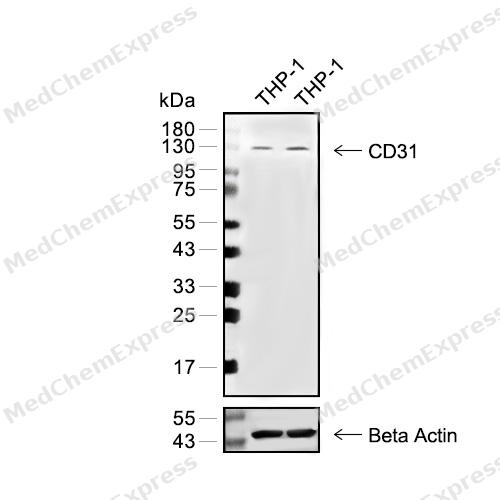 Western blot analysis of extracts from THP-1 (lane 2(20μg) and THP-1 (lane 3(40μg)using CD31 (HY-P80599) Mouse mAb. Proteins were transferred to a PVDF membrane and blocked with 5% defatted milk powder in TBST for 2 hour at room temperature. The primary antibody (HY-P80599, 1/1000) and Loading control antibody (Beta Actin, HY-P80438, 1/3000) was used in 5% defatted milk powder in TBST at 4°C overnight. Goat Anti-Mouse/Rabbit IgG-HRP Secondary Antibody (HY-P8004/HY-P8001, 1/10,000) was used for 1 hour at room temperature.
 -
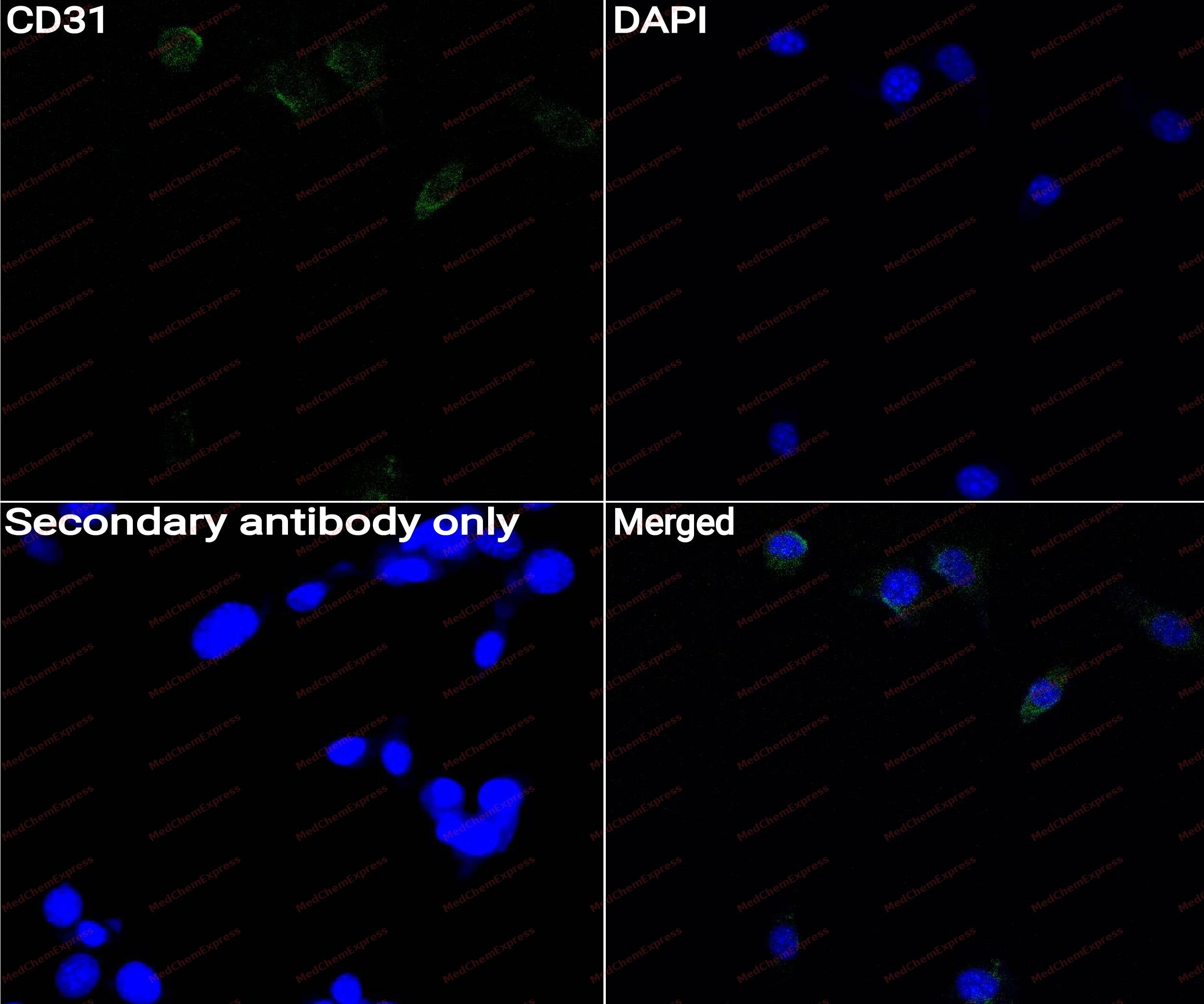 Immunocytochemistry analysis of NIH3T3 cells labeling CD31 with CD31 antibody (HY-P80599) at 1/50 dilution. Cells were fixed in 4% paraformaldehyde for 15 minutes at room temperature, then blocked with QuickBlock™ Blocking Buffer for Immunol Staining for 10 min at room temperature. Cells were then incubated with CD31 antibody (HY-P80599) at 1/50 dilution in QuickBlock™ Blocking Buffer for Immunol Staining at 4 ℃. Alexa Fluor® 488-conjugated AffiniPure Goat Anti-Mouse IgG H&L(HY-P8005, Green) was used as the secondary antibody at 1/1,000 dilution. PBS instead of the primary antibody was used as the secondary antibody only control. The Nuclear counterstain was DAPI (Blue).


Background
-
Function
CD31 cell adhesion molecule which is required for leukocyte transendothelial migration (TEM) under most inflammatory conditions. Tyr-690 plays a critical role in TEM and is required for efficient trafficking of PECAM1 to and from the lateral border recycling compartment (LBRC) and is also essential for the LBRC membrane to be targeted around migrating leukocytes. Trans-homophilic interaction may play a role in endothelial cell-cell adhesion via cell junctions. Heterophilic interaction with CD177 plays a role in transendothelial migration of neutrophils. Homophilic ligation of PECAM1 prevents macrophage-mediated phagocytosis of neighboring viable leukocytes by transmitting a detachment signal. Promotes macrophage-mediated phagocytosis of apoptotic leukocytes by tethering them to the phagocytic cells; PECAM1-mediated detachment signal appears to be disabled in apoptotic leukocytes. Modulates bradykinin receptor BDKRB2 activation. Regulates bradykinin- and hyperosmotic shock-induced ERK1/2 activation in endothelial cells. Induces susceptibility to atherosclerosis; Does not protect against apoptosis[1][2][3][4][5].
-
Subcellular Localization
Cell membrane; Single-pass type I membrane protein; Cell membrane; Single-pass type I membrane protein; Membrane raft; Cell junction; Cell junction
-
Expression
Tissue_specificity:This protein is expressed on platelets and leukocytes, primarily concentrated at the boundaries between endothelial cells (PubMed:18388311, PubMed:21464369) . It is also expressed (protein level) in human umbilical vein endothelial cells (HUVECs) (PubMed:17580308, PubMed:19342684) . It is also expressed (protein level) on neutrophils (PubMed:17580308) . The long subtype predominated in all tissues examined (PubMed:12433657) . The Δ12 subtype was detected only in the trachea (PubMed:12433657) . The Δ14-15 subtype was detected only in the lungs (PubMed:12433657) . The Delta14 subtype was detected in all tissues examined, with the strongest expression in the heart (PubMed:12433657) . Delta15 is expressed (protein level) in the brain, testes, ovaries, platelet cells, human umbilical vein endothelial cells (HUVECs) , Jurkat T-cell leukemia, human erythroleukemia (HEL) , and U-937 histiocytic lymphoma cell lines (PubMed:12433657, PubMed:18388311) . -
Isoforms & Post-Translational Modification
P16284 has 6 isomers: P16284-1: 82522 Da (predicted); P16284-2: 80465 Da (predicted); P16284-3: 80193 Da (predicted); P16284-4: 80405 Da (predicted); P16284-5: 79247 Da (predicted); P16284-6: 81364 Da (predicted).
Phosphorylated on Ser and Tyr residues after cellular activation by src kinases (PubMed:18710921, PubMed:19342684, PubMed:21464369, PubMed:9298995). Upon activation, phosphorylated on Ser-729 which probably initiates the dissociation of the membrane-interaction segment (residues 709-729) from the cell membrane allowing the sequential phosphorylation of Tyr-713 and Tyr-690 (PubMed:21464369). Constitutively phosphorylated on Ser-734 in resting platelets (PubMed:21464369). Phosphorylated on tyrosine residues by FER and FES in response to FCER1 activation (By similarity). In endothelial cells Fyn mediates mechanical-force (stretch or pull) induced tyrosine phosphorylation (PubMed:18710921);Palmitoylation by ZDHHC21 is necessary for cell surface expression in endothelial cells and enrichment in membrane rafts -
Subunit
Trans-homodimer (via Ig-like C2-type 1 and Ig-like C2-type 2 domains); trans-homodimerization is required for cell-cell interaction (PubMed:26702061, PubMed:27958302). Forms a complex with BDKRB2 and GNAQ (PubMed:18672896). Interacts with BDKRB2 and GNAQ (PubMed:18672896). Interacts with PTPN11; Tyr-713 is critical for PTPN11 recruitment (PubMed:18388311, PubMed:19342684). Interacts with FER (By similarity). Interacts (via Ig-like C2-type domain 6) with CD177; the interaction is Ca(2+)-dependent; the interaction is direct (PubMed:17580308)
-
SwissProt ID
-
Synonyms
Platelet endothelial cell adhesion molecule; PECAM-1; EndoCAM; GPIIA'; PECA1; CD antigen CD31
-
Research Field
Cardiovascular
Documentation
-
Data Sheet (261 KB)
-
SDS (252 KB)
- English - EN (252 KB)
- Français - FR (252 KB)
- Deutsch - DE (252 KB)
- Norwegian - NO (252 KB)
- Español - ES (252 KB)
- Swedish - SV (252 KB)
- Italian - IT (252 KB)
- Korean - KR (252 KB)
- Portuguese - PT (252 KB)
-
User Guide for Antibodies (1077 KB)
References
[1]. Sachs UJ, et al. The neutrophil-specific antigen CD177 is a counter-receptor for platelet endothelial cell adhesion molecule-1 (CD31). J Biol Chem. 2007 Aug 10;282(32):23603-12. [Content Brief]
[2]. Dasgupta B, et al. A novel and critical role for tyrosine 663 in platelet endothelial cell adhesion molecule-1 trafficking and transendothelial migration. J Immunol. 2009 Apr 15;182(8):5041-51. [Content Brief]
[3]. Hu M, et al. Structural Basis for Human PECAM-1-Mediated Trans-homophilic Cell Adhesion. Sci Rep. 2016 Dec 13;6:38655. [Content Brief]
[4]. Brown S, et al. Apoptosis disables CD31-mediated cell detachment from phagocytes promoting binding and engulfment. Nature. 2002 Jul 11;418(6894):200-3. [Content Brief]
[5]. Yeh JC, et al. Regulation of G protein-coupled receptor activities by the platelet-endothelial cell adhesion molecule, PECAM-1. Biochemistry. 2008 Aug 26;47(34):9029-39. [Content Brief]

 Powered by Bioz
