



CD370 Antibody (YA4342)
(Synonyms: CLEC9A; DNGR1; DNGR-1; UNQ9341)Based on 1 Customer Validation
CD370 Antibody (YA4342) is a Mouse-derived and non-conjugated IgG2b monoclonal antibody, targeting to CD370.
-
Host:
Mouse
-
Isotype:
IgG2b
-
Application:
ICC/IF, FC, ELISA
-
Reactivity :
Human
-
Formulation:
Supplied in PBS with 0.05% sodium azide
-
Conjugation:
Non-conjugated


To place orders, for customer services and technical support, please contact: MedChemExpress USA
Tel: 609-228-6898 E-mail: [email protected] [email protected]





Applications
| Application |
ICC/IF

ICC/IF: Immunocytochemistry/
Immunofluorescence |
FC
FC: Flow Cytometry
|
ELISA
ELISA: Enzyme Linked Immunosorbent Assay
|
|---|---|---|---|
| Dilution Ratio | 1:50-1:200 | 1:200-1:400 | 1:10000 |


Product Details
CD370 Antibody (YA4342) is a Mouse-derived and non-conjugated IgG2b monoclonal antibody, targeting to CD370.
-
Host Mouse

-
Clonality Monoclonal

-
Species ReactivityHuman
-
Observed Molecular WeightObserved band size: 27 kDa
Note: Due to possible protein modifications or aggregation, the molecular weight should be confirmed by actual measurement, and the predicted value is for reference only.

-
Calculated Molecular Weight Predicted band size: 27 kDa

Purified recombinant fragment of human CD370 (AA: extra 57-241) expressed in E. Coli.
affinity purified.
Non-conjugated
Unmodified
IgG2b


Product Properties
-
Appearance
Solution
-
Formulation
Supplied in PBS with 0.05% sodium azide
-
Concentration
Batch-dependent, Please check the COA for the concentration of each lot. Check Lot Concentration
-
Storage & Stability
Stored at -20°C for 1 year. Avoid repeated freeze / thaw cycles.
-
Shipping
Shipping with blue ice.


Verification Images
-
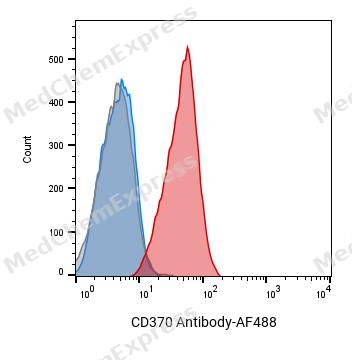 Flow cytometric analysis of 1X10^6 HL-60 cells labeling CD370 Antibody(red). Cells were fixed with 4% paraformaldehyde and permeabilised with 0.2% Triton X-100. Then stained with the primary antibody at 1/400 dilution overnight at 4℃. AF 488 Goat Anti-mouse IgG H&L was used as the secondary antibody at 1/1,000 dilution for 45 minutes at room temperature. Mouse IgG Isotype Control (blue) was used as the isotype control, cells without incubation with primary antibody were used as the unlabeled control (black).
 -
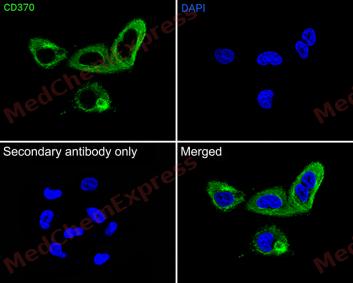 Immunofluorescence analysis of A549 cells labeling CD370 antibody at 1/50 dilution. Cells were fixed in 4% paraformaldehyde for 15 minutes at room temperature, permeabilized with 0.1% Triton X-100 in PBS for 15 minutes at room temperature, then blocked with 1% BSA in 10% negative goat serum for 1 hour at room temperature.Cells were then incubated with CD370 antibody at 1/50 dilution in 1% BSA in PBST overnight at 4 ℃. AF 488 Goat Anti-mouse IgG H&L (green) was used as the secondary antibody at 1/500 dilution. PBS instead of the primary antibody was used as the secondary antibody only control. The Nuclear counterstain was DAPI (Blue)
 -
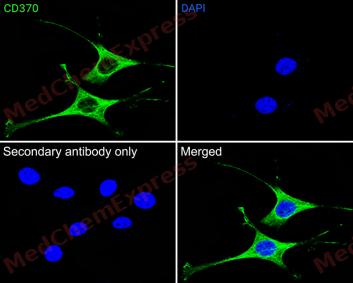 Immunofluorescence analysis of Sk-Br-3 cells labeling CD370 antibody at 1/50 dilution. Cells were fixed in 4% paraformaldehyde for 15 minutes at room temperature, permeabilized with 0.1% Triton X-100 in PBS for 15 minutes at room temperature, then blocked with 1% BSA in 10% negative goat serum for 1 hour at room temperature.Cells were then incubated with CD370 antibody at 1/50 dilution in 1% BSA in PBST overnight at 4 ℃. AF 488 Goat Anti-mouse IgG H&L (green) was used as the secondary antibody at 1/500 dilution. PBS instead of the primary antibody was used as the secondary antibody only control. The Nuclear counterstain was DAPI (Blue)


Background
-
Function
CD370 functions as an endocytic receptor on a small subset of myeloid cells specialized for the uptake and processing of material from dead cells. Recognizes filamentous form of actin in association with particular actin-binding domains of cytoskeletal proteins, including spectrin, exposed when cell membranes are damaged, and mediate the cross-presentation of dead-cell associated antigens in a Syk-dependent manner
-
Subcellular Localization
Membrane; Single-pass type II membrane protein
-
Expression
Tissue_specificity:In peripheral blood highly restricted on the surface of BDCA31 (+) dendritic cells and on a small subset of CD14 (+) and CD16 (-) monocytes -
Subunit
Homodimer
-
SwissProt ID
-
Synonyms
CLEC9A; DNGR1; DNGR-1; UNQ9341


Documentation

 Powered by Bioz
