



CEBP-alpha Antibody
(Synonyms: Apoptotic cysteine protease; Apoptotic protease Mch 5; C/EBP alpha; CAP4; Caspase 8 precursor; CCAAT Enhancer Binding Protein alpha; CEBP; CEBP A; CEBP alpha; CEBPA; FADD homologous ICE/CED 3 like protease; FADD like ICE; FLICE; ICE like apoptotic protease 5; ICE8; MACH; MCH5; MORT1 associated CED 3 homolog; CEBP α, CEBP-α.)
Based on 1 Customer Validation
CEBP-alpha Antibody is a Rabbit-derived and non-conjugated IgG polyclonal antibody, targeting to CEBP-alpha.
-
Host:
Rabbit
-
Isotype:
IgG
-
Application:
WB, ELISA, IHC-P, IHC-F, FC, ICC/IF
-
Reactivity :
Human, Rat
-
Formulation:
Supplied in 0.01M TBS(pH7.4) with 1% BSA, 0.03% Proclin300 and 50% Glycerol.
-
Conjugation:
Non-conjugated


To place orders, for customer services and technical support, please contact: MedChemExpress USA
Tel: 609-228-6898 E-mail: [email protected] [email protected]





Applications
| Application |
WB

WB: Western Blot
|
ELISA
ELISA: Enzyme Linked Immunosorbent Assay
|
IHC-P
IHC-P: Immunohistochemistry-Paraffin
|
IHC-F
IHC-F: Immunohistochemistry-Frozen
|
FC
FC: Flow Cytometry
|
ICC/IF
ICC/IF: Immunocytochemistry/
Immunofluorescence |
ICC/IF
ICC/IF: Immunocytochemistry/
Immunofluorescence |
|---|---|---|---|---|---|---|---|
| Dilution Ratio | 1:500-2000 | 1:5000-10000 | 1:100-500 | 1:100-500 | 1ug:Test | 1:100 | 1:100-500 |


Product Details
CEBP-alpha Antibody is a Rabbit-derived and non-conjugated IgG polyclonal antibody, targeting to CEBP-alpha.
-
Host Rabbit

-
Clonality Polyclonal

-
Species ReactivityHuman, Rat Predicted Reactivity: Mouse,Dog,Pig,Cow,Rabbit,Sheep,Goat
Note: The predicted reactivity is for reference only and should not be considered a guarantee of product performance.
-
Observed Molecular WeightObserved band size: 42 kDa
Note: Due to possible protein modifications or aggregation, the molecular weight should be confirmed by actual measurement, and the predicted value is for reference only.

-
Calculated Molecular Weight Predicted band size: 39kDa

Entrez Gene: 1050 Human ; 12606 Mouse ; 24252 Rat
SwissProt: P49715 Human ; P53566 Mouse ; P05554 Rat
OMIM: 601626 Human
KLH conjugated synthetic peptide derived from human CEBP-alpha: 251-358/358
Endogenous
affinity purified
Non-conjugated
Unmodified
IgG


Product Properties
-
Appearance
Solution
-
Formulation
Supplied in 0.01M TBS(pH7.4) with 1% BSA, 0.03% Proclin300 and 50% Glycerol.
-
Concentration
Batch-dependent, Please check the COA for the concentration of each lot. Check Lot Concentration
-
Storage & Stability
Stored at -20°C for 1 year. Avoid repeated freeze / thaw cycles.
-
Shipping
Shipping with blue ice.


Verification Images
-
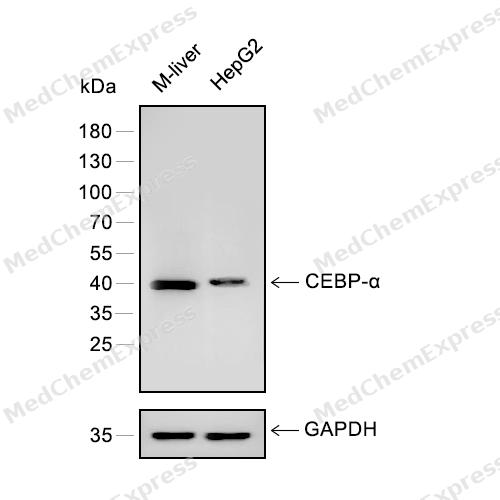 Western blot analysis of extracts from M-Liver (lane 1) and HepG2 (lane 2) using CEBP-α antibody. Proteins were transferred to a PVDF membrane and blocked with 5% nonfat powdered milk in PBST for 2 hour at room temperature. The primary antibody (1/2000) and Loading control antibody (GAPDH, 1/3000) was diluted with 5% nonfat powdered milk in PBST at 4°C overnight. Goat Anti-Rabbit IgG-HRP Secondary Antibody (1/8,000) was incubated for 45min at room temperature.
 -
 Flow cytometric analysis of 1X10⁶ THP-1 cells labeling CEBP-alpha Antibody (HY-P81161, red). Cells were fixed with 4% paraformaldehyde and permeabilised with 90% methanol. Then stained with the primary antibody at 1μg/Test dilution for an hour at 4℃. AF488-conjugated Goat Anti-Rabbit IgG H&L (HY-P8002) was used as the secondary antibody at 1/1,000 dilution for 30 minutes at 4℃. Rabbit IgG Isotype Control (HY-P80879, blue) was used as the isotype control, cells without incubation with primary antibody were used as the unlabeled control (black).
 -
 Flow cytometric analysis of 1X10⁶ THP-1 cells labeling CEBP-alpha Antibody (HY-P81161, red). Cells were fixed with 4% paraformaldehyde and permeabilised with 90% methanol. Then stained with the primary antibody at 1μg/Test dilution for an hour at 4℃. AF488-conjugated Goat Anti-Rabbit IgG H&L (HY-P8002) was used as the secondary antibody at 1/1,000 dilution for 30 minutes at 4℃. Rabbit IgG Isotype Control (HY-P80879, blue) was used as the isotype control, cells without incubation with primary antibody were used as the unlabeled control (black).


Background
-
Function
CEBP-alpha transcription factor that coordinates proliferation arrest and the differentiation of myeloid progenitors, adipocytes, hepatocytes, and cells of the lung and the placenta. Binds directly to the consensus DNA sequence 5'-T[TG]NNGNAA[TG]-3' acting as an activator on distinct target genes. During early embryogenesis, plays essential and redundant functions with CEBPB. Essential for the transition from common myeloid progenitors (CMP) to granulocyte/monocyte progenitors (GMP). Critical for the proper development of the liver and the lung. Necessary for terminal adipocyte differentiation, is required for postnatal maintenance of systemic energy homeostasis and lipid storage. To regulate these different processes at the proper moment and tissue, interplays with other transcription factors and modulators. Down-regulates the expression of genes that maintain cells in an undifferentiated and proliferative state through E2F1 repression, which is critical for its ability to induce adipocyte and granulocyte terminal differentiation. Reciprocally E2F1 blocks adipocyte differentiation by binding to specific promoters and repressing CEBPA binding to its target gene promoters. Proliferation arrest also depends on a functional binding to SWI/SNF complex. In liver, regulates gluconeogenesis and lipogenesis through different mechanisms. To regulate gluconeogenesis, functionally cooperates with FOXO1 binding to IRE-controlled promoters and regulating the expression of target genes such as PCK1 or G6PC1. To modulate lipogenesis, interacts and transcriptionally synergizes with SREBF1 in promoter activation of specific lipogenic target genes such as ACAS2. In adipose tissue, seems to act as FOXO1 coactivator accessing to ADIPOQ promoter through FOXO1 binding sites; Can act as dominant-negative. Binds DNA and have transctivation activity, even if much less efficiently than isoform 2. Does not inhibit cell proliferation; Directly and specifically enhances ribosomal DNA transcription interacting with RNA polymerase I-specific cofactors and inducing histone acetylation[1][2].
-
Subcellular Localization
Nucleus; Nucleus, nucleolus
-
Isoforms & Post-Translational Modification
P49715 has 4 isomers: P49715-1: 37561 Da (predicted); P49715-2: 35940 Da (predicted); P49715-3: 25540 Da (predicted); P49715-4: 41249 Da (predicted).
Phosphorylation at Ser-190 is required for interaction with CDK2, CDK4 and SWI/SNF complex leading to cell cycle inhibition. Dephosphorylated at Ser-190 by protein phosphatase 2A (PP2A) through PI3K/AKT signaling pathway regulation (PubMed:15107404). Phosphorylation at Thr-226 and Thr-230 by GSK3 is constitutive in adipose tissue and lung. In liver, both Thr-226 and Thr-230 are phosphorylated only during feeding but not during fasting. Phosphorylation of the GSK3 consensus sites selectively decreases transactivation activity on IRE-controlled promoters;Sumoylated, sumoylation blocks the inhibitory effect on cell proliferation by disrupting the interaction with SMARCA2;Ubiquitinated by COP1 upon interaction with TRIB1 -
Subunit
Binds DNA as a homodimer and as a heterodimer. Can form stable heterodimers with CEBPB, CEBPD, CEBPE and CEBPG (By similarity). Interacts with PRDM16 (By similarity). Interacts with UBN1 (PubMed:10725330). Interacts with ZNF638; this interaction increases transcriptional activation (By similarity). Interacts with the complex TFDP2:E2F1; the interaction prevents CEBPA binding to target gene promoters and represses its transcriptional activity (PubMed:20176812). Interacts with RB1 (PubMed:15107404). Interacts (when phosphorylated at Ser-190) with CDK2, CDK4, E2F4 and SMARCA2 (PubMed:15107404). Interacts with SREBPF1 (By similarity). Interacts with FOXO1 (via the Fork-head domain); the interaction increases when FOXO1 is deacetylated (By similarity). Interacts with SIX1 (PubMed:27923061). Interacts (via recognition sequence) with TRIB1 (PubMed:20410507, PubMed:26455797). Interacts (via bZIP domain) with OVOL2 (via zinc-finger domains); the interaction inhibits the transcription factor activity of CEBPA and is required to repress adipogenesis (By similarity)
-
SwissProt ID
-
Synonyms
Apoptotic cysteine protease; Apoptotic protease Mch 5; C/EBP alpha; CAP4; Caspase 8 precursor; CCAAT Enhancer Binding Protein alpha; CEBP; CEBP A; CEBP alpha; CEBPA; FADD homologous ICE/CED 3 like protease; FADD like ICE; FLICE; ICE like apoptotic protease 5; ICE8; MACH; MCH5; MORT1 associated CED 3 homolog; CEBP α, CEBP-α.


Documentation
-
Data Sheet (262 KB)
-
SDS (252 KB)
- English - EN (252 KB)
- Français - FR (252 KB)
- Deutsch - DE (252 KB)
- Norwegian - NO (252 KB)
- Español - ES (252 KB)
- Swedish - SV (252 KB)
- Italian - IT (252 KB)
- Korean - KR (252 KB)
- Portuguese - PT (252 KB)
-
User Guide for Antibodies (1077 KB)
References
[1]. Pabst T, et al. Dominant-negative mutations of CEBPA, encoding CCAAT/enhancer binding protein-alpha (C/EBPalpha), in acute myeloid leukemia. Nat Genet. 2001 Mar;27(3):263-70. [Content Brief]
[2]. Müller C, et al. The CCAAT enhancer-binding protein alpha (C/EBPalpha) requires a SWI/SNF complex for proliferation arrest. J Biol Chem. 2004 Feb 20;279(8):7353-8. [Content Brief]

 Powered by Bioz
