



CX3CR1 Antibody (YA4051)
(Synonyms: V28; CCRL1; GPR13; CMKDR1; GPRV28; CMKBRL1)
Based on 1 Customer Validation
CX3CR1 Antibody (YA4051) is a Mouse-derived and non-conjugated IgG2a monoclonal antibody, targeting to CX3CR1.
-
Host:
Mouse
-
Isotype:
IgG
-
Application:
ICC/IF, FC, ELISA
-
Reactivity :
Human
-
Formulation:
Supplied in PBS with 0.05% sodium azide
-
Conjugation:
Non-conjugated


To place orders, for customer services and technical support, please contact: MedChemExpress USA
Tel: 609-228-6898 E-mail: [email protected] [email protected]





Applications
| Application |
ICC/IF

ICC/IF: Immunocytochemistry/
Immunofluorescence |
FC
FC: Flow Cytometry
|
ELISA
ELISA: Enzyme Linked Immunosorbent Assay
|
|---|---|---|---|
| Dilution Ratio | 1:200-1:1000 | 1:200-1:400 | 1:10000 |


Product Details
CX3CR1 Antibody (YA4051) is a Mouse-derived and non-conjugated IgG2a monoclonal antibody, targeting to CX3CR1.
-
Host Mouse

-
Clonality Monoclonal

-
Species ReactivityHuman
-
Observed Molecular WeightObserved band size: 40 kDa
Note: Due to possible protein modifications or aggregation, the molecular weight should be confirmed by actual measurement, and the predicted value is for reference only.

-
Calculated Molecular Weight Predicted band size: 40 kDa

Purified recombinant fragment of human CX3CR1 (AA: extra mix) expressed in E. Coli.
affinity purified.
Non-conjugated
Unmodified
IgG


Product Properties
-
Appearance
Solution
-
Formulation
Supplied in PBS with 0.05% sodium azide
-
Concentration
Batch-dependent, Please check the COA for the concentration of each lot. Check Lot Concentration
-
Storage & Stability
Stored at -20°C for 1 year. Avoid repeated freeze / thaw cycles.
-
Shipping
Shipping with blue ice.


Verification Images
-
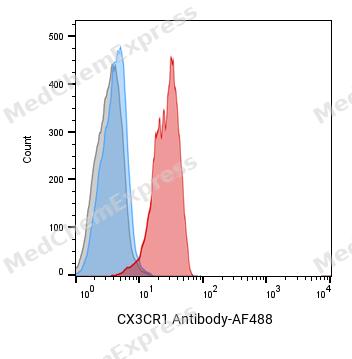 Flow cytometric analysis of 1X10^6 HL-60 cells labeling CX3CR1 Antibody(red). Cells were fixed with 4% paraformaldehyde and permeabilised with 0.2% Triton X-100. Then stained with the primary antibody at 1/400 dilution overnight at 4℃. AF 488 Goat Anti-mouse IgG H&L was used as the secondary antibody at 1/1,000 dilution for 45 minutes at room temperature. Mouse IgG Isotype Control (blue) was used as the isotype control, cells without incubation with primary antibody were used as the unlabeled control (black).
 -
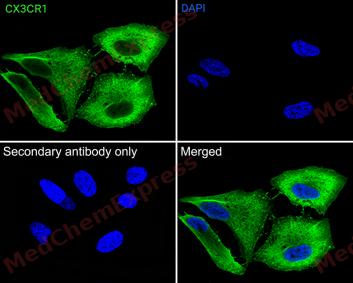 Immunofluorescence analysis of Hela cells labeling CX3CR1 antibody at 1/50 dilution. Cells were fixed in 4% paraformaldehyde for 15 minutes at room temperature, permeabilized with 0.1% Triton X-100 in PBS for 15 minutes at room temperature, then blocked with 1% BSA in 10% negative goat serum for 1 hour at room temperature.Cells were then incubated with CX3CR1 antibody at 1/50 dilution in 1% BSA in PBST overnight at 4 ℃. AF 488 Goat Anti-mouse IgG H&L (green) was used as the secondary antibody at 1/500 dilution. PBS instead of the primary antibody was used as the secondary antibody only control. The Nuclear counterstain was DAPI (Blue)


Background
-
Function
CX3C chemokine receptor1 (CX3CR1), also known as the fractalkine receptor or GPR13, is the specific receptor to the CX3CL1. As the name suggests, CX3CR1 binds the chemokine CX3CL1 (also called fractalkine (in humans) or neurotactin (in mouse) ) . CX3CL1 is a member of the CX3C family and that has been detected on activated endothelial cells, smooth muscle cells (SMCs), macrophages and platelets. CX3CL1 is the only neuronal chemokine in the body with pro-inflammatory, anti-inflammatory and neuroprotective effects, and is involved in the development of numerous inflammatory pathologies including atherosclerosis, rheumatoid arthritis, or graft rejection.
-
Subcellular Localization
Cell membrane; Multi-pass membrane protein
-
Expression
Tissue_specificity:Expressed in lymphoid and neural tissues (PubMed:7590284) . Expressed in lymphocyte subsets, such as natural killer (NK) cells, gamma-delta T-cells and terminally differentiated CD8 (+) T-cells (PubMed:12055230) . Expressed in smooth muscle cells in atherosclerotic plaques (PubMed:14581400)
Induction:Expression is down-regulated by miR-27a-5p microRNA in natural killer (NK) cell lymphocytes in response to TGF-beta1 -
Isoforms & Post-Translational Modification
P49238 has 4 isomers: P49238-1: 40396 Da (predicted); P49238-2: 43935 Da (predicted); P49238-3: 41062 Da (predicted); P49238-4: 43969 Da (predicted).
This protein is not N-glycosylated which is unusual for G-protein-coupled receptors -
Subunit
Found in a ternary complex with CX3CL1 and ITGAV:ITGB3 or ITGA4:ITGB1
-
SwissProt ID
-
Synonyms
V28; CCRL1; GPR13; CMKDR1; GPRV28; CMKBRL1


Documentation
-
Data Sheet (235 KB)
-
SDS (252 KB)
- English - EN (252 KB)
- Français - FR (252 KB)
- Deutsch - DE (252 KB)
- Norwegian - NO (252 KB)
- Español - ES (252 KB)
- Swedish - SV (252 KB)
- Italian - IT (252 KB)
- Korean - KR (252 KB)
- Portuguese - PT (252 KB)
-
User Guide for Antibodies (1077 KB)

 Powered by Bioz
