



Cyclophilin A Antibody (YA481)
(Synonyms: CYPA, PPIA, Peptidyl-prolyl cis-trans isomerase A, PPIase A, Cyclophilin A, Cyclosporin A-binding protein, Rotamase A)
Based on 1 Customer Validation
Cyclophilin A Antibody (YA481) is a Rabbit-derived and non-conjugated IgG monoclonal antibody, targeting to Cyclophilin A.
-
Host:
Rabbit
-
Isotype:
IgG
-
Application:
WB, IHC-P
-
Reactivity :
Human, Mouse
-
Formulation:
Supplied in 1*TBS (pH7.4), 0.05% BSA and 40% Glycerol. Preservative: 0.05% Sodium Azide.
-
Conjugation:
Non-conjugated


To place orders, for customer services and technical support, please contact: MedChemExpress USA
Tel: 609-228-6898 E-mail: [email protected] [email protected]





Applications
| Application |
WB

WB: Western Blot
|
IHC-P
IHC-P: Immunohistochemistry-Paraffin
|
|---|---|---|
| Dilution Ratio | 1:1000-1:5000 | 1:50-1:200 |


Product Details
Cyclophilin A Antibody (YA481) is a Rabbit-derived and non-conjugated IgG monoclonal antibody, targeting to Cyclophilin A.
-
Host Rabbit

-
Clonality Recombinant,Monoclonal

-
Species ReactivityHuman, Mouse
-
Observed Molecular WeightObserved band size: 15 kDa
Note: Due to possible protein modifications or aggregation, the molecular weight should be confirmed by actual measurement, and the predicted value is for reference only.

-
Calculated Molecular Weight Predicted band size: 18 kDa;

Entrez Gene: 5478 Human ; 268373 Mouse ;
SwissProt: P62937 Human ; P17742 Mouse ;
OMIM: 123840 Human
Synthetic peptide corresponding to Human Cyclophilin A.AA range:131-159.
Endogenous
Protein A affinity purified.
Non-conjugated
Unmodified
IgG


Product Properties
-
Appearance
Solution
-
Formulation
Supplied in 1*TBS (pH7.4), 0.05% BSA and 40% Glycerol. Preservative: 0.05% Sodium Azide.
-
Concentration
Batch-dependent, Please check the COA for the concentration of each lot. Check Lot Concentration
-
Storage & Stability
Stored at -20°C for 1 year. Avoid repeated freeze / thaw cycles.
-
Shipping
Shipping with blue ice.


Verification Images
-
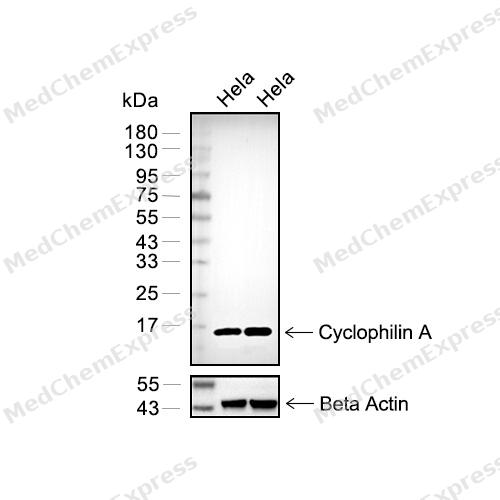 Western blot analysis of extracts from Hela (lane 2(20μg) , Hela (lane 3(20μg),using Cyclophilin A Antibody (HY-P80101). Proteins were transferred to a PVDF membrane and blocked with 5% BSA in TBST for 2 hour at room temperature. The primary antibody and Loading control antibody (Beta Actin, HY-P80438, 1/3000) was used in 5% BSA in TBST at 4°C overnight. Goat Anti-Mouse/Rabbit IgG-HRP Secondary Antibody (HY-P8004/HY-P8001, 1/10,000) was used for 1 hour at room temperature.
 -
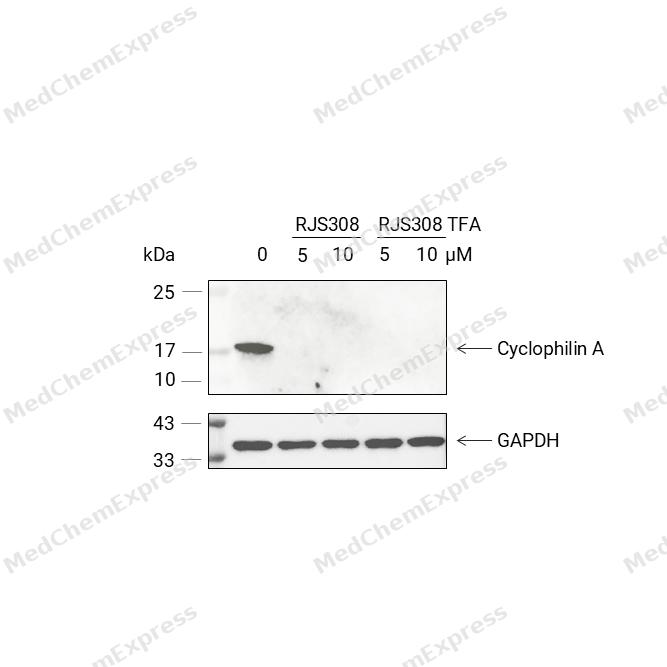 HeLa cells were seeded in a 6-well plate and were cultured overnight. Then, cells are treated with 5 and 10 μM RJS308 (HY-173011) and 5 and 10 μM RJS308 TFA (HY-173011A) for 48 hours to assess the expression of Cyclophilin A via Western blotting.
 -
 THP-1 cells were seeded in a 6-well plate with a density of 50%-60%. Then, cells were treated with 0-10 μM RJS308 (HY-173011) or RJS308 TFA (HY-173011A) for 48 hours to assess the expression of Cyclophilin A. The results demonstrated that RJS308 or RJS308 TFA effectively degraded Cyclophilin A protein. Primary antibody: Cyclophilin A antibody (HY-P80101).
 -
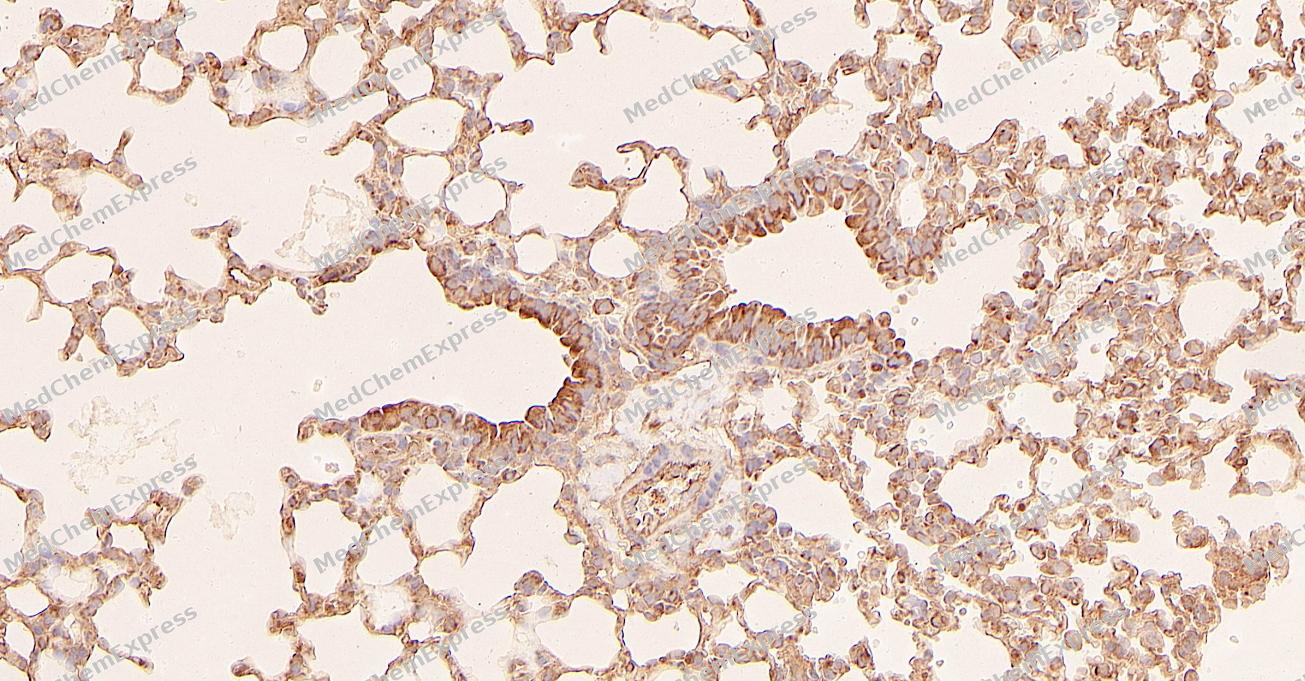 Immunohistochemical analysis of paraffin-embedded Mouse lung tissue using Cyclophilin A Antibody. The section was pre-treated using heat mediated antigen retrieval with Tris-EDTA buffer (pH 9.0) for 8 minutes. The tissues were blocked in QuickBlock for 20 minutes at room temperature, washed with ddH2O and PBS, and then probed with the primary antibody (HY-P80101, 1/200) in 4℃ overnight. The detection was performed using an HRP conjugated compact polymer system. DAB was used as the chromogen. Tissues were counterstained with hematoxylin and mounted with DPX.
 -
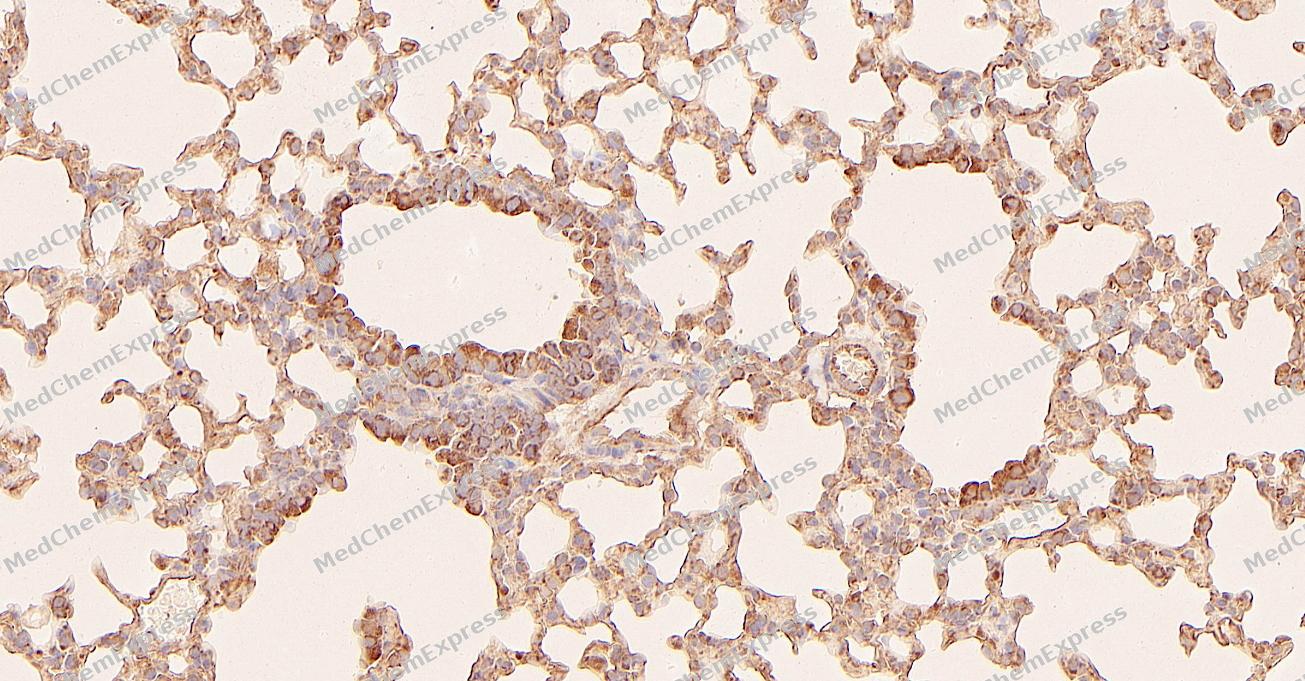 Immunohistochemical analysis of paraffin-embedded Mouse lung tissue using Cyclophilin A Antibody. The section was pre-treated using heat mediated antigen retrieval with Tris-EDTA buffer (pH 9.0) for 8 minutes. The tissues were blocked in QuickBlock for 20 minutes at room temperature, washed with ddH2O and PBS, and then probed with the primary antibody (HY-P80101, 1/200) in 4℃ overnight. The detection was performed using an HRP conjugated compact polymer system. DAB was used as the chromogen. Tissues were counterstained with hematoxylin and mounted with DPX.


Background
-
Function
Cyclophilin A (CyPA), encoded by PPIA, is a highly abundant cytosolic immunophilin that exhibits peptidyl-prolyl cis-trans isomerase (PPIase) activity and regulates protein folding, trafficking, and conformational transitions of client proteins[1][2][3]. Mechanistically, CyPA catalyzes proline isomerization, thereby functioning as a molecular chaperone that controls protein activation, degradation, and signaling processes across multiple cellular pathways[2][4]. In addition to its intracellular functions, CyPA can be secreted in response to inflammatory stimuli and subsequently participates in extracellular signaling events associated with vascular inflammation, immune responses, and tissue remodeling[3][5][6]. Disease studies have linked CyPA to cardiovascular disorders, kidney diseases, viral infection, cancer-associated signaling, and inflammatory pathologies, highlighting its broad relevance as a stress-responsive regulatory factor[3][5][7]. In viral experimental models, CyPA directly interacts with HIV-1 capsid proteins and promotes key steps of viral replication, making the PPIA pathway a valuable system for mechanistic studies of host-virus interactions[8][9]. Compared with related cyclophilin isoforms that exhibit specialized subcellular localization, including endoplasmic reticulum-associated Cyclophilin B and mitochondrial Cyclophilin D, CyPA is predominantly cytosolic and represents the major cellular target of cyclosporin A[1][10]. For experimental applications, cyclosporin A and related cyclophilin inhibitors suppress PPIase activity and remain widely used tools for investigating CyPA-dependent signaling, protein folding, and disease mechanisms[4][11].
-
Subcellular Localization
Cytoplasm; Secreted; Nucleus
-
Subunit
Interacts with protein phosphatase PPP3CA/calcineurin A (PubMed:12218175, PubMed:12357034). Interacts with PRPF19 isoform 2 (via N-terminus) (By similarity). Interacts with isoform 2 of BSG/CD147 (PubMed:11353871, PubMed:11943775, PubMed:15688292, PubMed:21245143). Interacts with FOXO1; the interaction promotes FOXO1 dephosphorylation, nuclear accumulation and transcriptional activity (PubMed:31063815). Interacts with integrin ITGA2B:ITGB3; the interaction is ROS and peptidyl-prolyl cis-trans isomerase (PPIase) activity-dependent and is increased in the presence of thrombin (By similarity). Interacts with MAP3K5 (PubMed:26095851). Interacts with TARDBP; the interaction is dependent on the RNA-binding activity of TARDBP and the PPIase activity of PPIA/CYPA and the acetylation of PPIA/CYPA at Lys-125 favors the interaction (PubMed:25678563). Interacts with HNRNPA1, HNRNPA2B1, HNRNPC, RBMX, HNRNPK and HNRNPM (PubMed:25678563)
-
SwissProt ID
-
Synonyms
CYPA, PPIA, Peptidyl-prolyl cis-trans isomerase A, PPIase A, Cyclophilin A, Cyclosporin A-binding protein, Rotamase A
-
Research Field
Immunology


Documentation
-
Data Sheet (262 KB)
-
SDS (313 KB)
- English - EN (313 KB)
- Français - FR (313 KB)
- Deutsch - DE (313 KB)
- Norwegian - NO (313 KB)
- Español - ES (313 KB)
- Swedish - SV (313 KB)
- Italian - IT (313 KB)
- Korean - KR (313 KB)
- Portuguese - PT (313 KB)
-
User Guide for Antibodies (1077 KB)
References
[1]. Wang P, et al. The cyclophilins. Genome Biol. 2005;6(7):226. [Content Brief]
[2]. Dunyak BM, et al. Peptidyl-Proline Isomerases (PPIases): Targets for Natural Products and Natural Product-Inspired Compounds. J Med Chem. 2016 Nov 10;59(21):9622-9644. [Content Brief]
[3]. Nigro P, et al. Cyclophilin A: a key player for human disease. Cell Death Dis. 2013 Oct 31;4(10):e888. [Content Brief]
[4]. Takahashi N, et al. Peptidyl-prolyl cis-trans isomerase is the cyclosporin A-binding protein cyclophilin. Nature. 1989 Feb 2;337(6206):473-5. [Content Brief]
[5]. Peter EK, et al. A Hybrid Hamiltonian for the Accelerated Sampling along Experimental Restraints. Int J Mol Sci. 2019 Jan 16;20(2):370. [Content Brief]
[6]. Xue C, et al. Extracellular and Intracellular Cyclophilin A, Native and Post-Translationally Modified, Show Diverse and Specific Pathological Roles in Diseases. Arterioscler Thromb Vasc Biol. 2018 May;38(5):986-993. [Content Brief]
[7]. Zhao X, et al. Inhibitors of Cyclophilin A: Current and Anticipated Pharmaceutical Agents for Inflammatory Diseases and Cancers. Molecules. 2024 Mar 11;29(6):1235. [Content Brief]
[8]. An P, et al. Regulatory polymorphisms in the cyclophilin A gene, PPIA, accelerate progression to AIDS. PLoS Pathog. 2007 Jun;3(6):e88. [Content Brief]
[9]. Cyclophilin A gene information from NCBI.
[10]. Wikipedia.
[11]. Stauffer WT, et al. Cyclophilin inhibition as a strategy for the treatment of human disease. Front Pharmacol. 2024 Jul 8;15:1417945. [Content Brief]

 Powered by Bioz
