



Galectin 8 Antibody (YA2186)
(Synonyms: LGALS8; Galectin-8g; Galectin-8; Po66-CBP; PCTA-1; Gal-8; Galectin 8; PCTA1)
Based on 1 Customer Validation
Galectin 8 Antibody (YA2186) is a Rabbit-derived and non-conjugated IgG monoclonal antibody, targeting to Galectin 8.
-
Host:
Rabbit
-
Isotype:
IgG
-
Application:
WB, IHC-P, ICC/IF, IP, FC
-
Reactivity :
Human
-
Formulation:
Supplied in 50mM Tris-Glycine(pH 7.4), 0.15M NaCl, 40%Glycerol, 0.01% sodium azide and 0.05% BSA.
-
Conjugation:
Non-conjugated


To place orders, for customer services and technical support, please contact: MedChemExpress USA
Tel: 609-228-6898 E-mail: [email protected] [email protected]





Applications
| Application |
WB

WB: Western Blot
|
IHC-P
IHC-P: Immunohistochemistry-Paraffin
|
ICC/IF
ICC/IF: Immunocytochemistry/
Immunofluorescence |
IP
IP: Immunoprecipitation
|
FC
FC: Flow Cytometry
|
|---|---|---|---|---|---|
| Dilution Ratio | 1:500-1:1000 | 1:50-1:100 | 1:50-1:200 | 1:50 | 1:50-1:100 |


Product Details
Galectin 8 Antibody (YA2186) is a Rabbit-derived and non-conjugated IgG monoclonal antibody, targeting to Galectin 8.
-
Host Rabbit

-
Clonality Recombinant,Monoclonal

-
Species ReactivityHuman
-
Observed Molecular WeightObserved band size: 40 kDa
Note: Due to possible protein modifications or aggregation, the molecular weight should be confirmed by actual measurement, and the predicted value is for reference only.

-
Calculated Molecular Weight Predicted band size: 36 kDa

A synthesized peptide derived from human Galectin 8 aa10-59.
Endogenous
Affinity Chromatography
Non-conjugated
Unmodified
IgG


Product Properties
-
Appearance
Solution
-
Formulation
Supplied in 50mM Tris-Glycine(pH 7.4), 0.15M NaCl, 40%Glycerol, 0.01% sodium azide and 0.05% BSA.
-
Concentration
Batch-dependent, Please check the COA for the concentration of each lot. Check Lot Concentration
-
Storage & Stability
Stored at -20°C for 1 year. Avoid repeated freeze / thaw cycles.
-
Shipping
Shipping with blue ice.


Verification Images
-
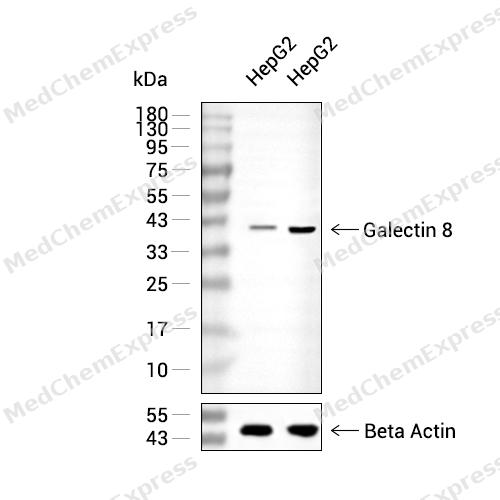 Western blot analysis of extracts from HepG2 (lane 2(20μg) , HepG2 (lane 3(40μg),using Galectin 8 Antibody. Proteins were transferred to a PVDF membrane and blocked with 5% BSA in TBST for 2 hour at room temperature. The primary anti-body and Loading control antibody (Beta Actin, HY-P80438, 1/3000) was used in 5% BSA in TBST at 4°C overnight. Goat Anti-Mouse/Rabbit IgG-HRP Secondary Anti-body (HY-P8004/HY-P8001, 1/10,000) was used for 1 hour at room temperature.
 -
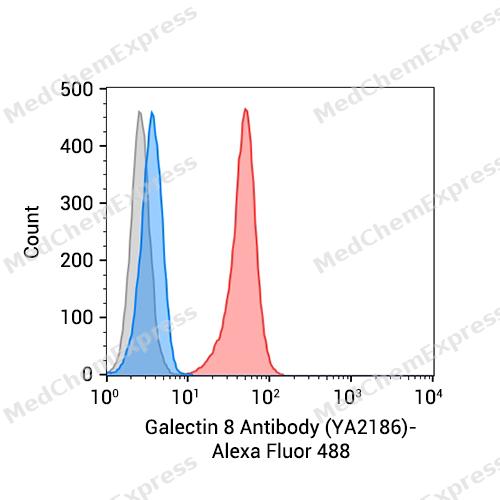 Flow cytometric analysis of 1X10^6 Hela cells labeling Galectin 8 Antibody (YA2186) (HY-P82441, red). Cells were fixed with 4% paraformaldehyde and permeabilised with 90% methanol. Then stained with the primary antibody at 1/50 dilution for an hour at 4℃. Alexa Fluor® 488-conjugated AffiniPure Goat Anti-Rabbit IgG H&L (HY-P8002) was used as the secondary antibody at 1/1,000 dilution for 30 minutes at 4℃. Rabbit IgG Isotype Control (HY-P80879, blue) was used as the isotype control, cells without incubation with primary antibody were used as the unlabeled control (black).


Background
-
Function
Galectin-8 is a secreted β-galactoside-binding lectin that modulates cell adhesion by ligating integrins and triggering focal adhesion kinase and paxillin phosphorylation[1]. Mechanistically, Galectin-8 also monitors endosomal and lysosomal integrity by binding host glycans exposed on damaged Salmonella-containing vacuoles and recruiting NDP52 to activate antibacterial autophagy[2]. In lysosomal damage models, Galectin-8 associates with the mTOR apparatus on lysosomes and inhibits mTOR activity through Ragulator-Rag signaling, linking membrane injury to autophagy and defense against Mycobacterium tuberculosis[3]. In disease-relevant cartilage models, Galectin-8 correlated with cartilage degeneration, was secreted by osteoarthritic chondrocytes, and induced a pro-degradative/inflammatory NF-κB-controlled gene signature[4]. Compared with related isoforms, this tandem-repeat Galectin-8 signature overlapped with Galectin-1 and Galectin-3 responses but also showed supplementary features, while osteoclast studies identified predominant activity of the short Galectin-8 isoform in bone resorption[4][5]. For experimental applications, recombinant Galectin-8 has been used to induce RANKL expression, osteoclastogenesis, cytokine secretion, and cancer-cell migration, whereas thiodigalactoside or sugar-binding-defective Galectin-8 variants help separate glycan-dependent from glycan-independent mechanisms[6][7].
-
Subcellular Localization
Cytoplasmic vesicle; Cytoplasm, cytosol
-
Expression
Tissue_specificity:Ubiquitous. Selective expression by prostate carcinomas versus normal prostate and benign prostatic hypertrophy -
Isoforms & Post-Translational Modification
O00214 has 2 isomers: O00214-1: 35808 Da (predicted); O00214-2: 40397 Da (predicted).
-
Subunit
Homodimer (PubMed:21288902, Ref.15). Interacts with CALCOCO2/NDP52 (PubMed:22246324). Interacts with PDPN; the interaction is glycosylation-dependent; may participate in connection of the lymphatic endothelium to the surrounding extracellular matrix
-
SwissProt ID
-
Synonyms
LGALS8; Galectin-8g; Galectin-8; Po66-CBP; PCTA-1; Gal-8; Galectin 8; PCTA1
-
Research Field
Cancer


Documentation
-
Data Sheet (262 KB)
-
SDS (251 KB)
- English - EN (251 KB)
- Français - FR (251 KB)
- Deutsch - DE (251 KB)
- Norwegian - NO (251 KB)
- Español - ES (251 KB)
- Swedish - SV (251 KB)
- Italian - IT (251 KB)
- Korean - KR (251 KB)
- Portuguese - PT (251 KB)
-
User Guide for Antibodies (1077 KB)
References
[1]. Levy Y, et al. Galectin-8 functions as a matricellular modulator of cell adhesion. J Biol Chem. 2001 Aug 17;276(33):31285-95. [Content Brief]
[2]. Thurston TL, et al. Galectin 8 targets damaged vesicles for autophagy to defend cells against bacterial invasion. Nature. 2012 Jan 15;482(7385):414-8. [Content Brief]
[3]. Jia J, et al. Galectins Control mTOR in Response to Endomembrane Damage. Mol Cell. 2018 Apr 5;70(1):120-135.e8. [Content Brief]
[4]. Weinmann D, et al. Galectin-8 induces functional disease markers in human osteoarthritis and cooperates with galectins-1 and -3. Cell Mol Life Sci. 2018 Nov;75(22):4187-4205. [Content Brief]
[5]. Roy M, et al. Galectin-8 modulates human osteoclast activity partly through isoform-specific interactions. Life Sci Alliance. 2024 Feb 23;7(5):e202302348. [Content Brief]
[6]. Vinik Y, et al. The mammalian lectin galectin-8 induces RANKL expression, osteoclastogenesis, and bone mass reduction in mice. Elife. 2015 May 8;4:e05914. [Content Brief]
[7]. Shatz-Azoulay H, et al. The Animal Lectin Galectin-8 Promotes Cytokine Expression and Metastatic Tumor Growth in Mice. Sci Rep. 2020 Apr 30;10(1):7375. [Content Brief]

 Powered by Bioz
