



Granulin Antibody (YA1162)
(Synonyms: Acrogranin; CLN11; GEP; GP88; Granulins; GRN; PCDGF; PEPI; PGRN; Proepithelin; Progranulin)
Based on 1 Customer Validation
Granulin Antibody (YA1162) is a Rabbit-derived and non-conjugated IgG monoclonal antibody, targeting to Granulin.
-
Host:
Rabbit
-
Isotype:
IgG
-
Application:
WB, IHC-P, ICC/IF, IP, FC
-
Reactivity :
Human
-
Formulation:
Supplied in 50mM Tris-Glycine(pH 7.4), 0.15M NaCl, 40%Glycerol, 0.01% sodium azide and 0.05% BSA.
-
Conjugation:
Non-conjugated


To place orders, for customer services and technical support, please contact: MedChemExpress USA
Tel: 609-228-6898 E-mail: [email protected] [email protected]





Applications
| Application |
WB

WB: Western Blot
|
IHC-P
IHC-P: Immunohistochemistry-Paraffin
|
ICC/IF
ICC/IF: Immunocytochemistry/
Immunofluorescence |
IP
IP: Immunoprecipitation
|
FC
FC: Flow Cytometry
|
|---|---|---|---|---|---|
| Dilution Ratio | 1:500-1:1000 | 1:50-1:100 | 1:50-1:200 | 1:50 | 1:50-1:100 |


Product Details
Granulin Antibody (YA1162) is a Rabbit-derived and non-conjugated IgG monoclonal antibody, targeting to Granulin.
-
Host Rabbit

-
Clonality Monoclonal, Recombinant

-
Species ReactivityHuman
-
Observed Molecular WeightObserved band size: 55,75 kDa
Note: Due to possible protein modifications or aggregation, the molecular weight should be confirmed by actual measurement, and the predicted value is for reference only.

-
Calculated Molecular Weight Predicted band size: 64 kDa

A synthesized peptide derived from human Granulin Granulin aa15-85.
Endogenous
Affinity Purified
Non-conjugated
Unmodified
IgG


Product Properties
-
Appearance
Liquid
-
Formulation
Supplied in 50mM Tris-Glycine(pH 7.4), 0.15M NaCl, 40%Glycerol, 0.01% sodium azide and 0.05% BSA.
-
Concentration
Batch-dependent, Please check the COA for the concentration of each lot. Check Lot Concentration
-
Storage & Stability
Stored at -20°C for 1 year. Avoid repeated freeze / thaw cycles.
-
Shipping
Shipping with blue ice.


Verification Images
-
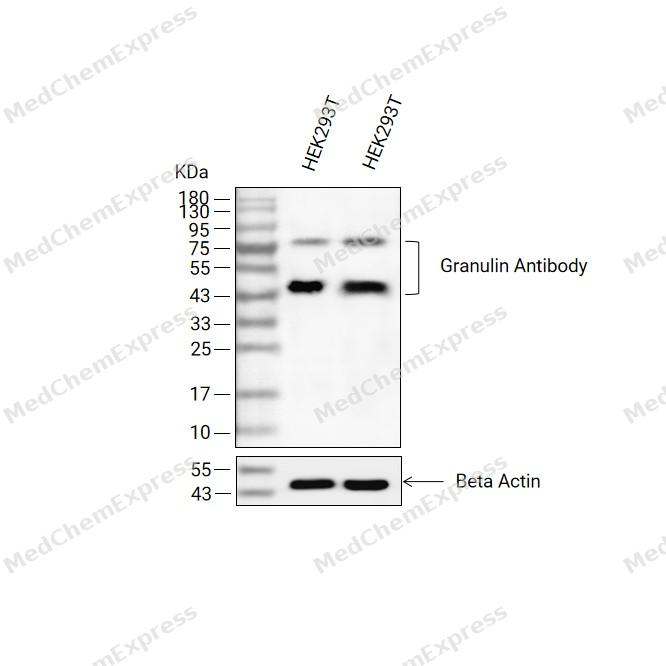 Western blot analysis of extracts from HEK293T(lane 2(20ug) and HEK293T(lane 3(40ug) using Granulin Antibody (HY-P81417) Rabbit mAb. Proteins were transferred to a PVDF membrane and blocked with 5% non-fat milk in TBST for 2 hour at room temperature. The primary antibody (1/1000) and Loading control antibody (Beta Actin, HY-P83730, 1/10000) was used in 5% non-fat milk in TBST at 4°C overnight. Goat Anti-Mouse/Rabbit IgG-HRP Secondary Antibody (1/10000) was used for 1 hour at room temperature.
 -
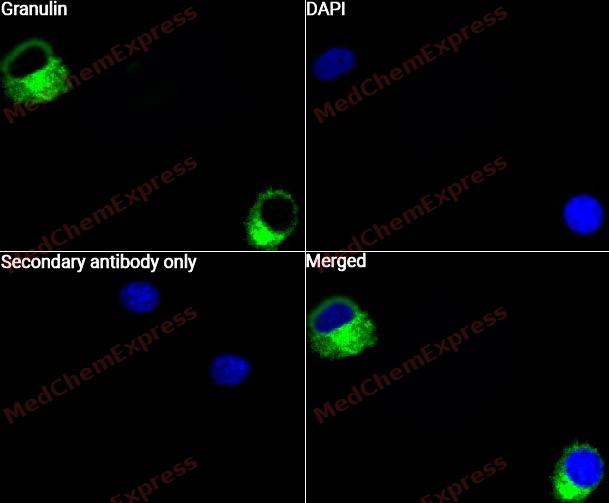 Immunocytochemistry analysis of J774A.1 cells labeling Granulin with Granulin Antibody (HY-P81417) at 1/50 dilution. Cells were fixed in 4% paraformaldehyde for 15 minutes at room temperature, permeabilized with 0.1% Triton X-100 for 10 minutes at room temperature, then blocked with QuickBlock™ Blocking Buffer for Immunol Staining for 10 min at room temperature. Cells were then incubated with Granulin Antibody (HY-P81417) at 1/50 dilution in QuickBlock™ Blocking Buffer for Immunol Staining at 4 ℃. Alexa Fluor® 488-conjugated AffiniPure Goat Anti-Rabbit IgG H&L(HY-P8002, Green) was used as the secondary antibody at 1/1,000 dilution. PBS instead of the primary antibody was used as the secondary antibody only control. The Nuclear counterstain was DAPI (Blue).
 -
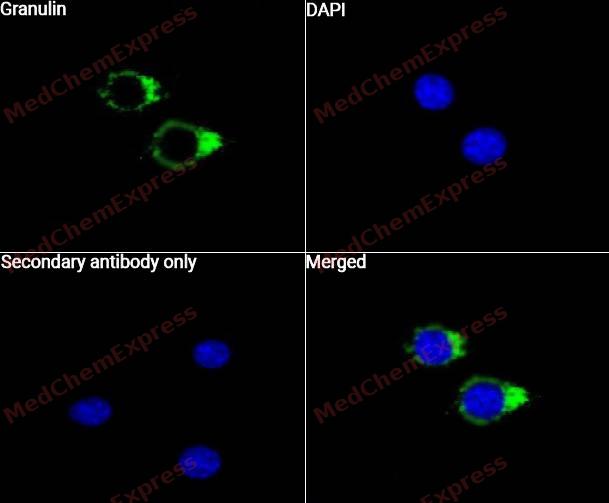 Immunocytochemistry analysis of J774A.1 cells labeling Granulin with Granulin Antibody (HY-P81417) at 1/100 dilution. Cells were fixed in 4% paraformaldehyde for 15 minutes at room temperature, permeabilized with 0.1% Triton X-100 for 10 minutes at room temperature, then blocked with QuickBlock™ Blocking Buffer for Immunol Staining for 10 min at room temperature. Cells were then incubated with Granulin Antibody (HY-P81417) at 1/100 dilution in QuickBlock™ Blocking Buffer for Immunol Staining at 4 ℃. Alexa Fluor® 488-conjugated AffiniPure Goat Anti-Rabbit IgG H&L(HY-P8002, Green) was used as the secondary antibody at 1/1,000 dilution. PBS instead of the primary antibody was used as the secondary antibody only control. The Nuclear counterstain was DAPI (Blue).


Background
-
Function
Granulin secreted protein that acts as a key regulator of lysosomal function and as a growth factor involved in inflammation, wound healing and cell proliferation. Regulates protein trafficking to lysosomes, and also the activity of lysosomal enzymes. Also facilitates the acidification of lysosomes, causing degradation of mature CTSD by CTSB. In addition, functions as a wound-related growth factor that acts directly on dermal fibroblasts and endothelial cells to promote division, migration and the formation of capillary-like tubule structures. Also promotes epithelial cell proliferation by blocking TNF-mediated neutrophil activation preventing release of oxidants and proteases. Moreover, modulates inflammation in neurons by preserving neurons survival, axonal outgrowth and neuronal integrity; Promotes proliferation of the epithelial cell line A431 in culture; Inhibits epithelial cell proliferation and induces epithelial cells to secrete IL-8; Stabilizes CTSD through interaction with CTSD leading to maintain its aspartic-type peptidase activity[1][2][3][4][5].
-
Subcellular Localization
Secreted; Lysosome
-
Expression
Tissue_specificity:In myelogenous leukemic cell lines of promonocytic, promyelocytic, and proerythroid lineage, in fibroblasts, and very strongly in epithelial cell lines. Present in inflammatory cells and bone marrow. Highest levels in kidney
Induction:Increased in response to lysosome alkalization -
Isoforms & Post-Translational Modification
P28799 has 3 isomers: P28799-1: 63544 Da (predicted); P28799-2: 46991 Da (predicted); P28799-3: 44132 Da (predicted).
Cleaved by ELANE; proteolysis is blocked by SLPI and is concentration- and time-dependent and induces CXCL8/IL-8 production; granulin-3 and granulin-4 are resistant to ELANE (PubMed:12526812, PubMed:28743268). Cleaved by CTSL in lysosome thus regulating the maturation and turnover of progranulin within the lysosome (PubMed:28743268) -
Subunit
Progranulin is secreted as a homodimer (PubMed:23364791). Interacts with SLPI; interaction protects progranulin from proteolysis (PubMed:12526812). Interacts (via region corresponding to granulin-7 peptide) with CTSD; stabilizes CTSD and increases its proteolytic activity (PubMed:28453791). Interacts (via region corresponding to granulin-7 peptide) with SORT1; this interaction mediates endocytosis and lysosome delivery of progranulin; interaction occurs at the neuronal cell surface in a stressed nervous system (PubMed:21092856). Interacts with PSAP; facilitates lysosomal delivery of progranulin from the extracellular space and the biosynthetic pathway (PubMed:26370502). Forms a complex with PSAP and M6PR; PSAP bridges the binding between progranulin and M6PR (PubMed:26370502). Forms a complex with PSAP and SORT1; progranulin bridges the interaction between PSAP and SORT1; facilitates lysosomal targeting of PSAP via SORT1; interaction enhances PSAP uptake in primary cortical neurons (PubMed:28541286). Interacts (via regions corresponding to granulin-2 and granulin-7 peptides) with GBA1; this interaction prevents aggregation of GBA1-SCARB2 complex via interaction with HSPA1A upon stress (PubMed:27789271). Interacts (via region corresponding to granulin-7 peptide) with HSPA1A; mediates recruitment of HSPA1A to GBA1 and prevents GBA1 aggregation in response to stress (PubMed:27789271)
-
SwissProt ID
-
Synonyms
Acrogranin; CLN11; GEP; GP88; Granulins; GRN; PCDGF; PEPI; PGRN; Proepithelin; Progranulin
-
Research Field
Neuroscience


Documentation
-
Data Sheet (234 KB)
-
SDS (252 KB)
- English - EN (252 KB)
- Français - FR (252 KB)
- Deutsch - DE (252 KB)
- Norwegian - NO (252 KB)
- Español - ES (252 KB)
- Swedish - SV (252 KB)
- Italian - IT (252 KB)
- Korean - KR (252 KB)
- Portuguese - PT (252 KB)
-
User Guide for Antibodies (1077 KB)

 Powered by Bioz
