



IKB alpha Antibody (YA350)
(Synonyms: NFKBIA; IKBA; MAD3; NFKBI; NF-kappa-B inhibitor alpha; I-kappa-B-alpha; IkB-alpha; IkappaBalpha; Major histocompatibility complex enhancer-binding protein MAD3)Based on 1 publication(s) in Google Scholar
IKB alpha Antibody (YA350) is a Rabbit-derived and non-conjugated IgG monoclonal antibody, targeting to IKB alpha.
-
Host:
Rabbit
-
Isotype:
IgG
-
Application:
WB, IHC-P, IP
-
Reactivity :
Human, Mouse, Rat
-
Formulation:
Supplied in 50 mM Tris-Glycine (pH 7.4), 0.15 M NaCl, 40% Glycerol and 0.05% BSA. Preservative: 0.01% Sodium azide
-
Conjugation:
Non-conjugated


To place orders, for customer services and technical support, please contact: MedChemExpress USA
Tel: 609-228-6898 E-mail: [email protected] [email protected]



-

HY-P80839
Phospho-NF-KB p65 (Ser536) Antibody -
HY-P80765
NF-KB p65 Antibody (YA268) -
HY-P80826
Phospho-IKB alpha (Ser32) Antibody (YA185) -
HY-P80466
Phospho-IKB alpha (Ser32) Antibody (YA183) -
HY-P80245
NF-KB p65 Antibody (YA267) -
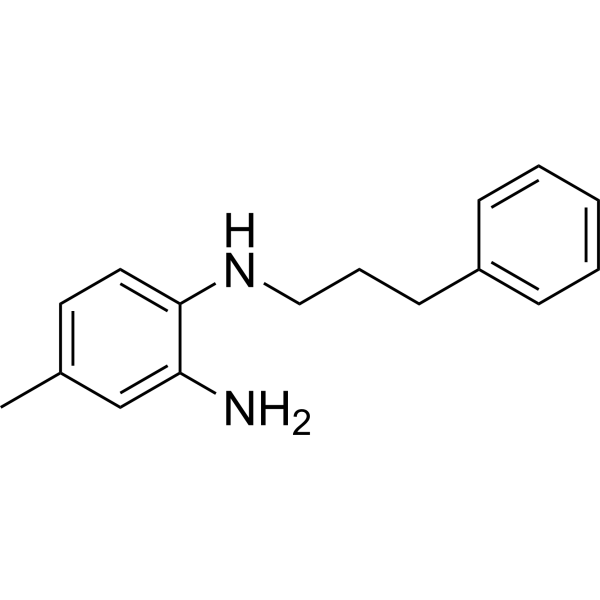
HY-13982
JSH-23 -
HY-P80827
Phospho-IKB alpha (Ser36) Antibody (YA184) -
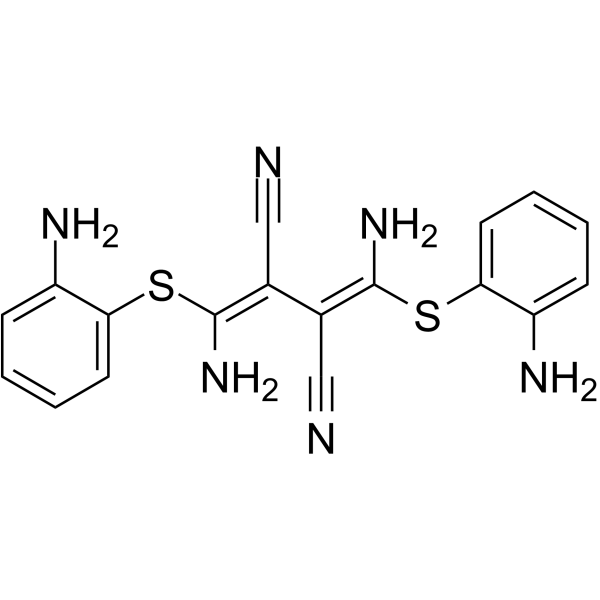
HY-12031A
U0126 -
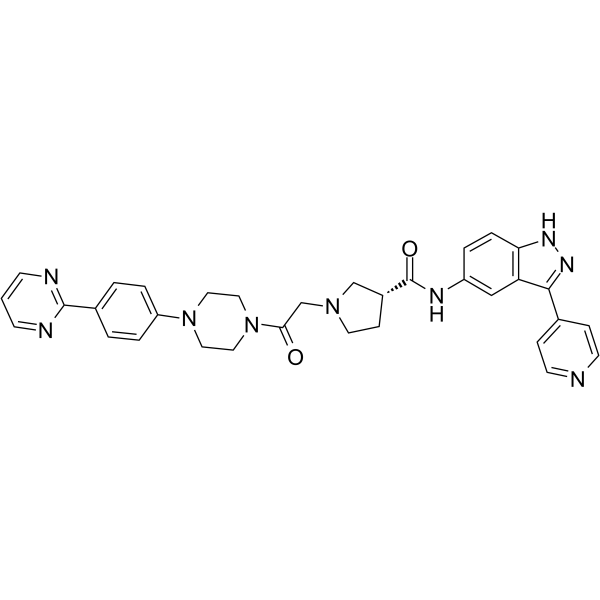
HY-50846
SCH772984 -
HY-P8001
HRP-conjugated Goat Anti-Rabbit IgG H&L -
HY-P8004
HRP-conjugated Goat Anti-Mouse IgG H&L -
HY-P80535
AKT1+AKT2+AKT3 Antibody (YA635)
Publications Citing Use of MedChemExpress (MCE) IKB alpha Antibody (YA350)
More

Applications
| Application |
WB

WB: Western Blot
|
IHC-P
IHC-P: Immunohistochemistry-Paraffin
|
IP
IP: Immunoprecipitation
|
|---|---|---|---|
| Dilution Ratio | 1:500-1:1000 | 1:50-1:100 | 1:20 |


Product Details
IKB alpha Antibody (YA350) is a Rabbit-derived and non-conjugated IgG monoclonal antibody, targeting to IKB alpha.
-
Host Rabbit

-
Clonality Recombinant,Monoclonal

-
Species ReactivityHuman, Mouse, Rat
-
Observed Molecular WeightObserved band size: 39 kDa
Note: Due to possible protein modifications or aggregation, the molecular weight should be confirmed by actual measurement, and the predicted value is for reference only.

-
Calculated Molecular Weight Predicted band size: 36 kDa

Entrez Gene: 4792 Human ; 18035 Mouse ; 25493 Rat
SwissProt: P25963 Human ; Q9Z1E3 Mouse ; Q63746 Rat
OMIM: 612132 Human
Synthetic peptide corresponding to Human IKB alpha.The exact sequence is proprietary to MCE.
Endogenous
affinity purified
Non-conjugated
Unmodified
IgG


Product Properties
-
Appearance
Solution
-
Formulation
Supplied in 50 mM Tris-Glycine (pH 7.4), 0.15 M NaCl, 40% Glycerol and 0.05% BSA. Preservative: 0.01% Sodium azide
-
Concentration
Batch-dependent, Please check the COA for the concentration of each lot. Check Lot Concentration
-
Storage & Stability
Stored at -20°C for 1 year. Avoid repeated freeze / thaw cycles.
-
Shipping
Shipping with blue ice.


Publications (1)
-
Journal Impact Factor
-
Most Recent
-
J Ethnopharmacol
Phytochemical characterization and anti-inflammatory evaluation of compounds extracted from Ficus erecta roots. [Abstract]2025 Sep 9:120592. PMID: 40935213


Verification Images
-
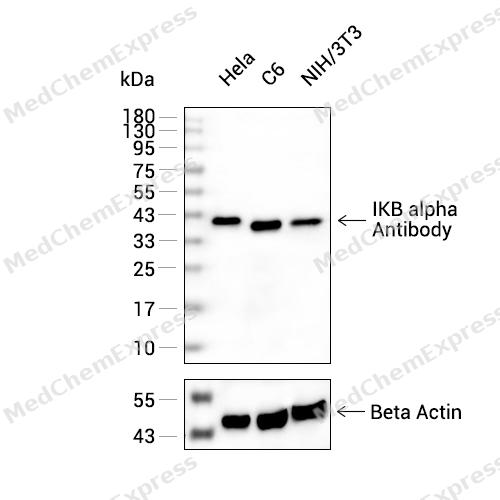 Western blot analysis of extracts from Hela(lane 2(20μg) , C6(lane 3(20ug) and NIH/3T3(lane 4(20ug) using IKB alpha Antibody (HY-P80718) Rabbit mAb. Proteins were transferred to a PVDF membrane and blocked with 5% non-fat milk in TBST for 2 hour at room temperature. The primary antibody (1/1000) and Loading control antibody (Beta Actin, HY-P80438, 1/10000) was used in 5% non-fat milk in TBST at 4°C overnight. Goat Anti-Mouse/Rabbit IgG-HRP Secondary Antibody (1/10000) was used for 1 hour at room temperature.
 -
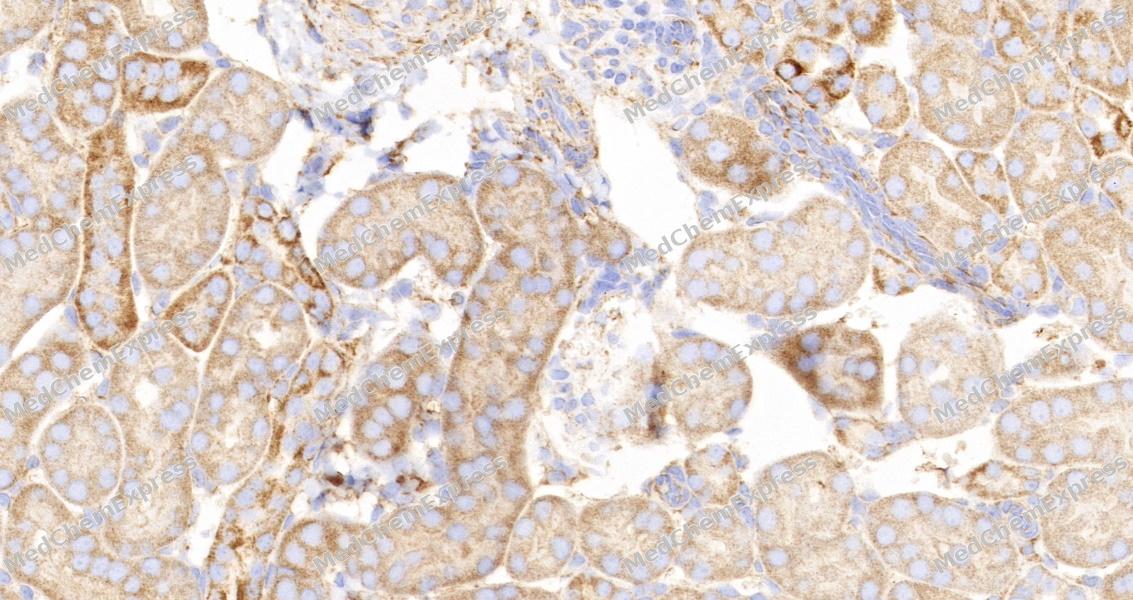 Immunohistochemical analysis of paraffin-embedded mouse kidney tissue using IKB alpha Antibody. The section was pre-treated using heat mediated antigen retrieval with Tris-EDTA buffer (pH 9.0) for 8 minutes. The tissues were blocked in QuickBlock for 20 minutes at room temperature, washed with ddH2O and PBS, and then probed with the primary antibody at 1/100 dilution in 4℃ overnight. The detection was performed using an HRP conjugated compact polymer system. DAB was used as the chromogen. Tissues were counterstained with hematoxylin and mounted with DPX.
 -
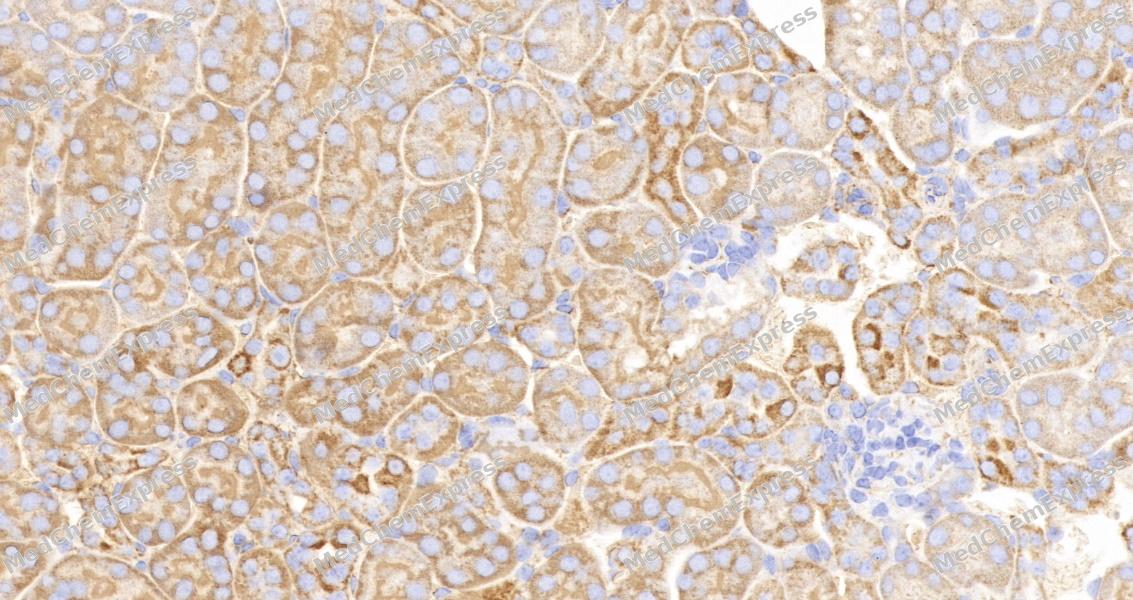 Immunohistochemical analysis of paraffin-embedded mouse kidney tissue using IKB alpha Antibody. The section was pre-treated using heat mediated antigen retrieval with Tris-EDTA buffer (pH 9.0) for 8 minutes. The tissues were blocked in QuickBlock for 20 minutes at room temperature, washed with ddH2O and PBS, and then probed with the primary antibody at 1/100 dilution in 4℃ overnight. The detection was performed using an HRP conjugated compact polymer system. DAB was used as the chromogen. Tissues were counterstained with hematoxylin and mounted with DPX.


Background
-
Function
IKB alpha inhibits the activity of dimeric NF-kappa-B/REL complexes by trapping REL (RELA/p65 and NFKB1/p50) dimers in the cytoplasm by masking their nuclear localization signals. On cellular stimulation by immune and pro-inflammatory responses, becomes phosphorylated promoting ubiquitination and degradation, enabling the dimeric RELA to translocate to the nucleus and activate transcription[1][2][3][4][5][6].
-
Subcellular Localization
Cytoplasm; Nucleus
-
Expression
Induction:Induced in adherent monocytes -
Subunit
Interacts with RELA; the interaction requires the nuclear import signal (PubMed:1493333). Part of a 70-90 kDa complex at least consisting of CHUK, IKBKB, NFKBIA, RELA, ELP1 and MAP3K14 (PubMed:9751059). Interacts with NKIRAS1 and NKIRAS2 (PubMed:10657303). Interacts with isoform 1 and isoform 2 of RWDD3; the interaction enhances sumoylation (PubMed:17956732, PubMed:23469069). Interacts with PRMT2 (PubMed:16648481). Interacts with PRKACA in platelets; this interaction is disrupted by thrombin and collagen (PubMed:20356841). Interacts with MEFV (PubMed:18577712). Interacts with DDRGK1; positively regulates NFKBIA phosphorylation and degradation (PubMed:23675531). Interacts with HNRNPA2B1; the interaction may be mediated by the RRM2 domain of HNRNPA2B1, and HNRNPA2B1 may interact simultaneously with FAM76B and either NFKBIA or NFKBIE to form a complex (PubMed:37643469)
-
SwissProt ID
-
Synonyms
NFKBIA; IKBA; MAD3; NFKBI; NF-kappa-B inhibitor alpha; I-kappa-B-alpha; IkB-alpha; IkappaBalpha; Major histocompatibility complex enhancer-binding protein MAD3
-
Research Field
Epigenetics and Nuclear Signaling
Documentation
-
Data Sheet (262 KB)
-
SDS (252 KB)
- English - EN (252 KB)
- Français - FR (252 KB)
- Deutsch - DE (252 KB)
- Norwegian - NO (252 KB)
- Español - ES (252 KB)
- Swedish - SV (252 KB)
- Italian - IT (252 KB)
- Korean - KR (252 KB)
- Portuguese - PT (252 KB)
-
User Guide for Antibodies (1077 KB)
References
[1]. Ganchi PA, et al. I kappa B/MAD-3 masks the nuclear localization signal of NF-kappa B p65 and requires the transactivation domain to inhibit NF-kappa B p65 DNA binding. Mol Biol Cell. 1992 Dec;3(12):1339-52. [Content Brief]
[2]. Quan J, et al. USP39 Regulates NF-κB-Mediated Inflammatory Responses through Deubiquitinating K48-Linked IκBα. J Immunol. 2023 Mar 1;210(5):640-652. [Content Brief]
[3]. Scherer DC, et al. Signal-induced degradation of I kappa B alpha requires site-specific ubiquitination. Proc Natl Acad Sci U S A. 1995 Nov 21;92(24):11259-63. [Content Brief]
[4]. Chen Z, et al. Signal-induced site-specific phosphorylation targets I kappa B alpha to the ubiquitin-proteasome pathway. Genes Dev. 1995 Jul 1;9(13):1586-97. [Content Brief]
[5]. Traenckner EB, et al. Phosphorylation of human I kappa B-alpha on serines 32 and 36 controls I kappa B-alpha proteolysis and NF-kappa B activation in response to diverse stimuli. EMBO J. 1995 Jun 15;14(12):2876-83. [Content Brief]
[6]. Brown K, et al. Control of I kappa B-alpha proteolysis by site-specific, signal-induced phosphorylation. Science. 1995 Mar 10;267(5203):1485-8. [Content Brief]

 Powered by Bioz
