



JAK3 Antibody (YA2466)
(Synonyms: JAK3; Tyrosine-protein kinase JAK3; Janus kinase 3; JAK-3; Leukocyte janus kinase; L-JAK)Based on 1 Customer Validation
JAK3 Antibody (YA2466) is a Rabbit-derived and non-conjugated IgG monoclonal antibody, targeting to JAK3.
-
Host:
Rabbit
-
Isotype:
IgG
-
Application:
WB, ICC/IF
-
Reactivity :
Human
-
Formulation:
Supplied in 50 mM Tris-Glycine(pH 7.4), 0.15 M NaCl, 40% Glycerol, 0.01% sodium azide and 0.05% BSA.
-
Conjugation:
Non-conjugated


To place orders, for customer services and technical support, please contact: MedChemExpress USA
Tel: 609-228-6898 E-mail: [email protected] [email protected]





Applications
| Application |
WB

WB: Western Blot
|
ICC/IF
ICC/IF: Immunocytochemistry/
Immunofluorescence |
|---|---|---|
| Dilution Ratio | 1:500-1:1000 | 1:50-1:200 |


Product Details
JAK3 Antibody (YA2466) is a Rabbit-derived and non-conjugated IgG monoclonal antibody, targeting to JAK3.
-
Host Rabbit

-
Clonality Recombinant,Monoclonal

-
Species ReactivityHuman
-
Observed Molecular WeightObserved band size: 125 kDa
Note: Due to possible protein modifications or aggregation, the molecular weight should be confirmed by actual measurement, and the predicted value is for reference only.

-
Calculated Molecular Weight Predicted band size: 125 kDa

A synthesized peptide derived from human JAK3 aa1-35.
Endogenous
Affinity Chromatography
Non-conjugated
Unmodified
IgG


Product Properties
-
Appearance
Solution
-
Formulation
Supplied in 50 mM Tris-Glycine(pH 7.4), 0.15 M NaCl, 40% Glycerol, 0.01% sodium azide and 0.05% BSA.
-
Concentration
Batch-dependent, Please check the COA for the concentration of each lot. Check Lot Concentration
-
Storage & Stability
Stored at -20°C for 1 year. Avoid repeated freeze / thaw cycles.
-
Shipping
Shipping with blue ice.


Verification Images
-
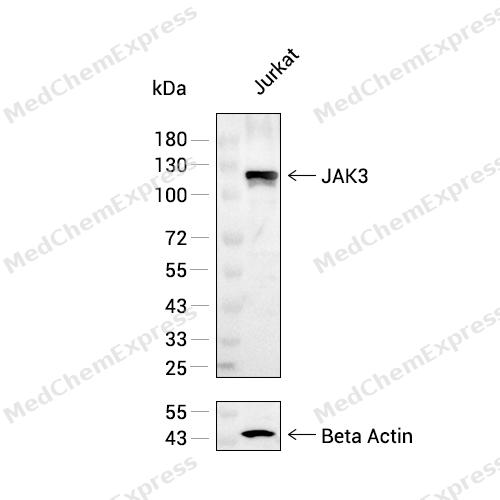 Western blot analysis was performed on extracts from Jurkat (lane 1, 20 μg),using JAK3 Rabbit mAb.Proteins were transferred to a PVDF membrane and blocked with 5% non - fat milk in TBST at 4°C overnight.The primary antibody (1:1000 dilution) and the loading control antibody (beta-Actin, HY-P83730, 1:5000 dilution) were incubated in 5% non-fat milk in TBST for 1 hour at 37°C.Goat Anti - Mouse/Rabbit IgG - HRP Secondary Antibody (1:20000 dilution) was then applied for 40 minutes at 37°C.


Background
-
Function
Janus kinase 3 (JAK3) is a non-receptor tyrosine kinase of the JAK family that mediates cytokine receptor signaling and transduces extracellular immune signals through the JAK/STAT signaling pathway[1]. JAK3 functions downstream of cytokine receptors and participates in receptor-associated signaling events that regulate immune cell development, activation, and homeostasis through STAT phosphorylation and transcriptional regulation[1][2]. Mechanistically, cytokine-induced receptor dimerization activates JAK proteins, leading to receptor phosphorylation, STAT recruitment, STAT activation, and subsequent regulation of target gene expression involved in immunity and inflammatory responses[2][3]. In disease contexts, dysregulated JAK/STAT signaling is associated with immune-mediated disorders and inflammatory diseases, making JAK family members important therapeutic targets for pathway modulation[2][3]. Compared with the broadly expressed isoforms JAK1, JAK2, and TYK2, JAK3 exhibits a more restricted expression pattern and is primarily produced in hematopoietic and lymphoid cells, providing a key biological distinction among JAK family members[2][3]. This lineage-associated distribution links JAK3 more closely to adaptive immune regulation and supports its relevance in immune system research models[3]. For experimental applications, JAK3 has attracted substantial interest as a drug target because selective inhibition of cytokine-triggered JAK/STAT signaling can modulate immune responses while exploiting the relatively restricted cellular distribution of this isoform[3][4]. Consequently, the development of selective JAK3 inhibitors continues to provide valuable tools for investigating cytokine signaling mechanisms and immune-related disease biology[3][4].
-
Subcellular Localization
Endomembrane system; Peripheral membrane protein; Cytoplasm
-
Expression
Tissue_specificity:This protein can be detected in NK cells and NK-like cell lines, but not in resting T cells or other tissues. The S-type protein is more common in hematopoietic cell lines, while the B-type protein can be detected in both hematopoietic cells and epithelial cells. -
Isoforms & Post-Translational Modification
P52333 has 3 isomers: P52333-1: 125099 Da (predicted); P52333-2: 121268 Da (predicted); P52333-4: 68279 Da (predicted).
Tyrosine phosphorylated in response to IL-2 and IL-4. Dephosphorylation of Tyr-980 and Tyr-981 by PTPN2 negatively regulates cytokine-mediated signaling (Probable) -
Subunit
Interacts with STAM2 and MYO18A (PubMed:10899310). Interacts with SHB (PubMed:12200137). Interacts with CD69 (By similarity)
-
SwissProt ID
-
Synonyms
JAK3; Tyrosine-protein kinase JAK3; Janus kinase 3; JAK-3; Leukocyte janus kinase; L-JAK
-
Research Field
Signal Transduction


Documentation
-
Data Sheet (261 KB)
-
SDS (251 KB)
- English - EN (251 KB)
- Français - FR (251 KB)
- Deutsch - DE (251 KB)
- Norwegian - NO (251 KB)
- Español - ES (251 KB)
- Swedish - SV (251 KB)
- Italian - IT (251 KB)
- Korean - KR (251 KB)
- Portuguese - PT (251 KB)
-
User Guide for Antibodies (1077 KB)
References
[1]. Kawamura M, et al. Molecular cloning of L-JAK, a Janus family protein-tyrosine kinase expressed in natural killer cells and activated leukocytes. Proc Natl Acad Sci U S A. 1994 Jul 5;91(14):6374-8. [Content Brief]
[2]. Hu X, et al. The JAK/STAT signaling pathway: from bench to clinic. Signal Transduct Target Ther. 2021 Nov 26;6(1):402. [Content Brief]
[3]. Kwon S. Molecular dissection of Janus kinases as drug targets for inflammatory diseases. Front Immunol. 2022 Dec 8;13:1075192. doi: 10.3389/fimmu.2022.1075192. PMID: 36569926; PMCID: PMC9773558. et al. Molecular dissection of Janus kinases as drug targets for inflammatory diseases. Front Immunol. 2022 Dec 8;13:1075192. [Content Brief]
[4]. Chen C, et al. A highly selective JAK3 inhibitor is developed for treating rheumatoid arthritis by suppressing γc cytokine-related JAK-STAT signal. Sci Adv. 2022 Aug 19;8(33):eabo4363. [Content Brief]

 Powered by Bioz
