



LRP1 Antibody (YA306)
(Synonyms: A2MR; alpha 2MR; Alpha 2 macroglobulin receptor; CD91; APR; LRP1; LRP85; TGFBR5)Based on 1 publication(s) in Google Scholar
LRP1 Antibody (YA306) is a Rabbit-derived and non-conjugated IgG monoclonal antibody, targeting to LRP1.
-
Host:
Rabbit
-
Isotype:
IgG
-
Application:
WB, IHC-P, ICC/IF, IP
-
Reactivity :
Human, Mouse, Rat
-
Formulation:
Supplied in 50 mM Tris-Glycine (pH 7.4), 0.15 M NaCl, 40% Glycerol and 0.05% BSA. Preservative: 0.01% Sodium azide
-
Conjugation:
Non-conjugated


To place orders, for customer services and technical support, please contact: MedChemExpress USA
Tel: 609-228-6898 E-mail: [email protected] [email protected]



Publications Citing Use of MedChemExpress (MCE) LRP1 Antibody (YA306)
More

Applications
| Application |
WB

WB: Western Blot
|
IHC-P
IHC-P: Immunohistochemistry-Paraffin
|
ICC/IF
ICC/IF: Immunocytochemistry/
Immunofluorescence |
IP
IP: Immunoprecipitation
|
|---|---|---|---|---|
| Dilution Ratio | 1:500-1:1000 | 1:50-1:100 | 1:50-1:200 | 1:20 |


Product Details
LRP1 Antibody (YA306) is a Rabbit-derived and non-conjugated IgG monoclonal antibody, targeting to LRP1.
-
Host Rabbit

-
Clonality Recombinant,Monoclonal

-
Species ReactivityHuman, Mouse, Rat
-
Observed Molecular WeightObserved band size: 85 kDa
Note: Due to possible protein modifications or aggregation, the molecular weight should be confirmed by actual measurement, and the predicted value is for reference only.

-
Calculated Molecular Weight Predicted band size: 505 kDa

Entrez Gene: 4035 Human ; 16971 Mouse ; 299858 Rat
SwissProt: Q07954 Human ; Q91ZX7 Mouse ;
OMIM: 604093 Human
Synthetic peptide corresponding to Human LRP1 aa4491-4504.
Endogenous
affinity purified
Non-conjugated
Unmodified
IgG


Product Properties
-
Appearance
Solution
-
Formulation
Supplied in 50 mM Tris-Glycine (pH 7.4), 0.15 M NaCl, 40% Glycerol and 0.05% BSA. Preservative: 0.01% Sodium azide
-
Concentration
Batch-dependent, Please check the COA for the concentration of each lot. Check Lot Concentration
-
Storage & Stability
Stored at -20°C for 1 year. Avoid repeated freeze / thaw cycles.
-
Shipping
Shipping with blue ice.


Publications (1)
-
Journal Impact Factor
-
Most Recent
-
ACS Nano
Deciphering Apolipoprotein A4 in the Protein Corona of Ligand-Modified Liposomes for Tumor Targeting and Penetration. [Abstract]2026 Apr 21;20(15):11673-11691. PMID: 41941209


Verification Images
-
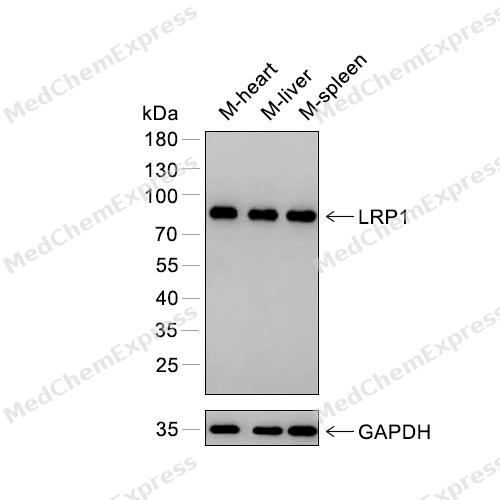 Western blot analysis of extracts from M-heart (lane 1) and M-liver (lane 2) and M-spleen (lane 3) using LRP1 antibody. Proteins were transferred to a PVDF membrane and blocked with 5% nonfat powdered milk in PBST for 2 hour at room temperature. The primary antibody (1/1000) and loading control antibody (GAPDH, 1/3000) was diluted with 5% nonfat powdered milk in PBST at 4°C overnight. Goat Anti-Rabbit IgG-HRP Secondary Antibody (1/8,000) was incubated for 45min at room temperature.
 -
 Immunocytochemistry analysis of Hela cells labeling LRP1 with LRP1 Antibody (HY-P80746) at 1/100 dilution. Cells were fixed in 4% paraformaldehyde for 15 minutes at room temperature, permeabilized with 0.1% Triton X-100 in PBS for 15 minutes at room temperature, then blocked with quick block buffer for 10 minutes at room temperature. Cells were then incubated with LRP1 Antibody (HY-P80746) at 1/100 dilution in quick block buffer overnight at 4 ℃. AF488-conjugated Goat Anti-Rabbit IgG H&L(HY-P8002, Green) was used as the secondary antibody at 1/1,000 dilution. PBS instead of the primary antibody was used as the secondary antibody only control. The Nuclear counterstain was DAPI (Blue).
 -
 Immunocytochemistry analysis of U87 cells labeling LRP1 with LRP1 Antibody (HY-P80746) at 1/100 dilution. Cells were fixed in 4% paraformaldehyde for 15 minutes at room temperature, permeabilized with 0.1% Triton X-100 in PBS for 15 minutes at room temperature, then blocked with quick block buffer for 10 minutes at room temperature. Cells were then incubated with LRP1 Antibody (HY-P80746) at 1/100 dilution in quick block buffer overnight at 4 ℃. AF488-conjugated Goat Anti-Rabbit IgG H&L(HY-P8002, Green) was used as the secondary antibody at 1/1,000 dilution. PBS instead of the primary antibody was used as the secondary antibody only control. The Nuclear counterstain was DAPI (Blue).


Background
-
Function
Low-density lipoprotein receptor-related protein 1 (LRP1) is a multifunctional endocytic and signaling receptor of the LDL receptor family that regulates lipoprotein metabolism, protease clearance, cellular signaling, and tissue homeostasis across multiple organ systems[1][2]. Mechanistically, LRP1 couples rapid ligand internalization with signal transduction, allowing coordinated control of extracellular protein turnover and intracellular responses involved in cell survival, migration, inflammation, and vascular biology[1][2]. Through its broad ligand repertoire, LRP1 participates in key biological processes including endocytosis, phagocytosis, and receptor-mediated clearance pathways that maintain physiological balance in the liver, vasculature, and central nervous system[1][2]. In disease contexts, LRP1 has been extensively studied in neurodegenerative disorders because it contributes to amyloid-β (Aβ) homeostasis through cellular uptake, lysosomal trafficking, and clearance mechanisms[3][4]. Experimental evidence demonstrates that LRP1-mediated endocytosis promotes neuronal Aβ42 uptake and accumulation within lysosomal compartments, highlighting a central role in neuronal Aβ metabolism[3]. LRP1 is also implicated in vascular disease, inflammation, and tissue remodeling through its ability to integrate endocytic and signaling functions within a single receptor system[1][2]. Compared with related LDL receptor family members, LRP1 is distinguished by its exceptionally broad ligand-binding capacity and dual role as both a scavenger receptor and signaling receptor, enabling regulation of diverse physiological pathways[1][2]. Consequently, genetic manipulation of LRP1 has become a widely used experimental approach for investigating receptor-mediated transport, neurodegeneration, vascular biology, and cell-signaling mechanisms[1][3][4].
-
Subcellular Localization
Cell membrane; Single-pass type I membrane protein; Membrane, coated pit; Cell membrane; Peripheral membrane protein; Extracellular side; Membrane, coated pit; Cytoplasm; Nucleus; Golgi outpost; Cytoplasm, cytoskeleton, microtubule organizing center
-
Expression
Tissue_specificity:It is most abundant in the liver, brain, and lungs. -
Isoforms & Post-Translational Modification
Q07954 has 2 isomers: Q07954-1: 504606 Da (predicted); Q07954-2: 31631 Da (predicted).
Cleaved into a 85 kDa membrane-spanning subunit (LRP-85) and a 515 kDa large extracellular domain (LRP-515) that remains non-covalently associated. Gamma-secretase-dependent cleavage of LRP-85 releases the intracellular domain from the membrane;The N-terminus is blocked;Phosphorylated on serine and threonine residues;Phosphorylated on tyrosine residues upon stimulation with PDGF. Tyrosine phosphorylation promotes interaction with SHC1 -
Subunit
Heterodimer of an 85-kDa membrane-bound carboxyl subunit and a non-covalently attached 515-kDa N-terminal subunit. Intracellular domain interacts with MAFB (By similarity). Found in a complex with PID1/PCLI1, LRP1 and CUBNI (PubMed:17124247). Interacts with SNX17, PID1/PCLI1, PDGF and CUBN. The intracellular domain interacts with SHC1, GULP1 and DAB1. Can weakly interact (via NPXY motif) with DAB2 (via PID domain); the interaction is enhanced by tyrosine phosphorylation of the NPXY motif. Interacts with MDK; promotes neuronal survival (PubMed:10772929). Interacts with LRPAP1; this interaction is followed by rapid internalization (PubMed:15053742, PubMed:16938309, PubMed:32296178). Interacts with uPA/PLAU and PAI1/SERPINE1, either individually or in complex with each other, leading to rapid endocytosis; this interaction is abolished in the presence of LRPAP1/RAP (PubMed:1423604, PubMed:15053742). Also interacts with tPA/PLAT alone or in complex with SERPINE1 (PubMed:15053742). Interacts with the urokinase receptor PLAUR; this interaction leads to PLAUR internalization and is impaired in the presence of SORL1 (PubMed:14764453). Interacts with PDGFB (PubMed:15053742). Interacts with TAU/MAPT, leading to endocytosis; this interaction is reduced in the presence of LRPAP1/RAP (PubMed:32296178). Interacts with IGFBP3; this interaction mediates cell growth inhibition independently of IGF1 (PubMed:9252371). Interacts with ADGRG6 (By similarity)
-
SwissProt ID
-
Synonyms
A2MR; alpha 2MR; Alpha 2 macroglobulin receptor; CD91; APR; LRP1; LRP85; TGFBR5
-
Research Field
Neuroscience
Documentation
-
Data Sheet (261 KB)
-
SDS (252 KB)
- English - EN (252 KB)
- Français - FR (252 KB)
- Deutsch - DE (252 KB)
- Norwegian - NO (252 KB)
- Español - ES (252 KB)
- Swedish - SV (252 KB)
- Italian - IT (252 KB)
- Korean - KR (252 KB)
- Portuguese - PT (252 KB)
-
User Guide for Antibodies (1077 KB)
References
[1]. Strickland DK, et al. Low-density lipoprotein receptor-related protein-1: role in the regulation of vascular integrity. Arterioscler Thromb Vasc Biol. 2014 Mar;34(3):487-98. [Content Brief]
[2]. Fuentealba RA, et al. Low-density lipoprotein receptor-related protein 1 (LRP1) mediates neuronal Abeta42 uptake and lysosomal trafficking. PLoS One. 2010 Jul 29;5(7):e11884. [Content Brief]

 Powered by Bioz
