



MED1 Antibody (YA5564)
(Synonyms: Mediator of RNA polymerase II transcription subunit 1; Activator-recruited cofactor 205 kDa component; ARC205; Mediator complex subunit 1; Peroxisome proliferator-activated receptor-binding protein; PBP; PPAR-binding protein; Thyroid hormone receptor-associated protein complex 220 kDa component; Trap220; Thyroid receptor-interacting protein 2; TR-interacting protein 2; TRIP-2; Vitamin D receptor-interacting protein complex component DRIP205; )
Based on 1 Customer Validation
MED1 Antibody (YA5564) is a Mouse-derived and non-conjugated IgG1 monoclonal antibody, targeting to MED1.
-
Host:
Mouse
-
Isotype:
IgG1
-
Application:
WB, ICC/IF, ELISA
-
Reactivity :
Human
-
Formulation:
Supplied in PBS, 50% glycerol, 0.05% Proclin 300, 0.05%BSA
-
Conjugation:
Non-conjugated


To place orders, for customer services and technical support, please contact: MedChemExpress USA
Tel: 609-228-6898 E-mail: [email protected] [email protected]





Applications
| Application |
WB

WB: Western Blot
|
ICC/IF
ICC/IF: Immunocytochemistry/
Immunofluorescence |
ELISA
ELISA: Enzyme Linked Immunosorbent Assay
|
|---|---|---|---|
| Dilution Ratio | 1:500-2000 | 1:100-500 | 1:1000-5000 |


Product Details
MED1 Antibody (YA5564) is a Mouse-derived and non-conjugated IgG1 monoclonal antibody, targeting to MED1.
-
Host Mouse

-
Clonality Monoclonal

-
Species ReactivityHuman
-
Observed Molecular WeightObserved band size: 220 kDa
Note: Due to possible protein modifications or aggregation, the molecular weight should be confirmed by actual measurement, and the predicted value is for reference only.

-
Calculated Molecular Weight Predicted band size: 220 kDa

Synthesized peptide derived from human MED1. AA range: 650-750
Protein G
Non-conjugated
Unmodified
IgG1


Product Properties
-
Appearance
Liquid
-
Formulation
Supplied in PBS, 50% glycerol, 0.05% Proclin 300, 0.05%BSA
-
Concentration
Batch-dependent, Please check the COA for the concentration of each lot. Check Lot Concentration
-
Storage & Stability
Stored at -20°C for 1 year. Avoid repeated freeze / thaw cycles.
-
Shipping
Shipping with blue ice.


Verification Images
-
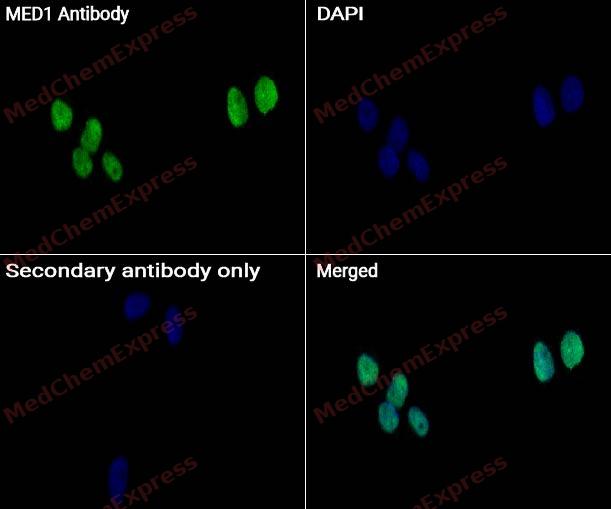 Immunocytochemistry analysis of HeLa cells labeling MED1 with MED1 Antibody (HY-P85872) at 1/100 dilution. Cells were fixed in 4% paraformaldehyde for 15 minutes at room temperature, permeabilized with 0.1% Triton X-100 in PBS for 15 minutes at room temperature, then blocked with quick block buffer for 10 minutes at room temperature. Cells were then incubated with MED1 Antibody (HY-P85872) at 1/100 dilution in quick block buffer overnight at 4 ℃. AF488-conjugated Goat Anti-Mouse IgG H&L(HY-P8005, Green) was used as the secondary antibody at 1/1,000 dilution. PBS instead of the primary antibody was used as the secondary antibody only control. The Nuclear counterstain was DAPI (Blue).
 -
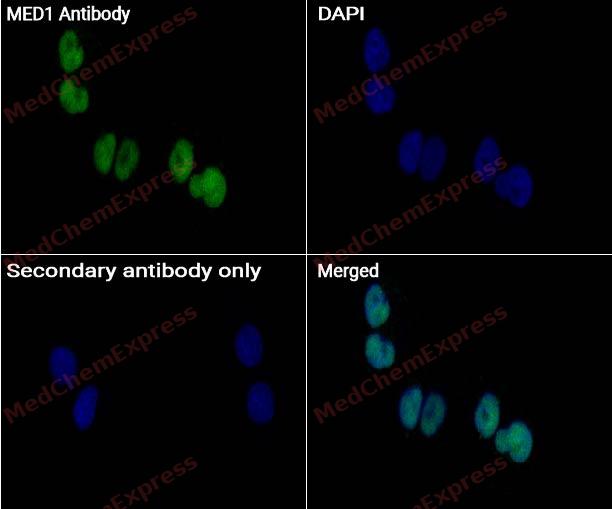 Immunocytochemistry analysis of HeLa cells labeling MED1 with MED1 Antibody (HY-P85872) at 1/200 dilution. Cells were fixed in 4% paraformaldehyde for 15 minutes at room temperature, permeabilized with 0.1% Triton X-100 in PBS for 15 minutes at room temperature, then blocked with quick block buffer for 10 minutes at room temperature. Cells were then incubated with MED1 Antibody (HY-P85872) at 1/200 dilution in quick block buffer overnight at 4 ℃. AF488-conjugated Goat Anti-Mouse IgG H&L(HY-P8005, Green) was used as the secondary antibody at 1/1,000 dilution. PBS instead of the primary antibody was used as the secondary antibody only control. The Nuclear counterstain was DAPI (Blue).


Background
-
Function
MED1 component of the Mediator complex, a coactivator involved in the regulated transcription of nearly all RNA polymerase II-dependent genes. Mediator functions as a bridge to convey information from gene-specific regulatory proteins to the basal RNA polymerase II transcription machinery. Mediator is recruited to promoters by direct interactions with regulatory proteins and serves as a scaffold for the assembly of a functional preinitiation complex with RNA polymerase II and the general transcription factors. Acts as a coactivator for GATA1-mediated transcriptional activation during erythroid differentiation of K562 erythroleukemia cells[1][2][3][4][5][6][7][8][9][10][11][12].
-
Subcellular Localization
Nucleus
-
Expression
Tissue_specificity:Ubiquitously expressed -
Isoforms & Post-Translational Modification
Q15648 has 2 isomers: Q15648-1: 168478 Da (predicted); Q15648-3: 61563 Da (predicted).
Phosphorylated by MAPK1 or MAPK3 during G2/M phase which may enhance protein stability and promote entry into the nucleolus (PubMed:16314496). Phosphorylation increases its interaction with PSIP1 (PubMed:29997176) -
Subunit
Component of the Mediator complex, which is composed of MED1, MED4, MED6, MED7, MED8, MED9, MED10, MED11, MED12, MED13, MED13L, MED14, MED15, MED16, MED17, MED18, MED19, MED20, MED21, MED22, MED23, MED24, MED25, MED26, MED27, MED29, MED30, MED31, CCNC, CDK8 and CDC2L6/CDK11. The MED12, MED13, CCNC and CDK8 subunits form a distinct module termed the CDK8 module. Mediator containing the CDK8 module is less active than Mediator lacking this module in supporting transcriptional activation. Individual preparations of the Mediator complex lacking one or more distinct subunits have been variously termed ARC, CRSP, DRIP, PC2, SMCC and TRAP. This subunit specifically interacts with a number of nuclear receptors in a ligand-dependent fashion including AR, ESR1, ESR2, PPARA, PPARG, RORA, RXRA, RXRG, THRA, THRB and VDR. Interacts with CTNNB1, GABPA, GLI3, PPARGC1A and TP53. Interacts with YWHAH. Interacts with CLOCK; this interaction requires the presence of THRAP3 (By similarity). Interacts with GATA1 and CCAR1. Interacts with NR4A3 (By similarity). Interacts (via IBM motif) with PSIP1 (via IBD domain); phosphorylation increases its affinity for PSIP1 (PubMed:29997176). Interacts with USP22 (By similarity)
-
SwissProt ID
-
Synonyms
Mediator of RNA polymerase II transcription subunit 1; Activator-recruited cofactor 205 kDa component; ARC205; Mediator complex subunit 1; Peroxisome proliferator-activated receptor-binding protein; PBP; PPAR-binding protein; Thyroid hormone receptor-associated protein complex 220 kDa component; Trap220; Thyroid receptor-interacting protein 2; TR-interacting protein 2; TRIP-2; Vitamin D receptor-interacting protein complex component DRIP205;


Documentation
-
Data Sheet (234 KB)
-
SDS (254 KB)
- English - EN (254 KB)
- Français - FR (254 KB)
- Deutsch - DE (254 KB)
- Norwegian - NO (254 KB)
- Español - ES (254 KB)
- Swedish - SV (254 KB)
- Italian - IT (254 KB)
- Korean - KR (254 KB)
- Portuguese - PT (254 KB)
-
User Guide for Antibodies (1077 KB)

 Powered by Bioz
