



Nesprin1 Antibody (YA1369)
(Synonyms: ARCA1; C6orf98; CPG2; EDMD4; Enaptin; Myne-1; MYNE1; Nesp1; Nesprin-1; SCAR8; Syne-1; SYNE1)
Based on 1 Customer Validation
Nesprin1 Antibody (YA1369) is a Rabbit-derived and non-conjugated IgG monoclonal antibody, targeting to Nesprin1.
-
Host:
Rabbit
-
Isotype:
IgG
-
Application:
WB, IHC-F, IHC-P, ICC/IF
-
Reactivity :
Human, Mouse, Rat
-
Formulation:
Supplied in 50mM Tris-Glycine(pH 7.4), 0.15M NaCl, 40% Glycerol, 0.01% Sodium azide and 0.05% BSA
-
Conjugation:
Non-conjugated


To place orders, for customer services and technical support, please contact: MedChemExpress USA
Tel: 609-228-6898 E-mail: [email protected] [email protected]





Applications
| Application |
WB

WB: Western Blot
|
IHC-P
IHC-P: Immunohistochemistry-Paraffin
|
IHC-F
IHC-F: Immunohistochemistry-Frozen
|
ICC/IF
ICC/IF: Immunocytochemistry/
Immunofluorescence |
|---|---|---|---|---|
| Dilution Ratio | 1:500-1:1000 | 1:50-1:100 | 1:50-1:100 | 1:50-1:200 |


Product Details
Nesprin1 Antibody (YA1369) is a Rabbit-derived and non-conjugated IgG monoclonal antibody, targeting to Nesprin1.
-
Host Rabbit

-
Clonality Recombinant, Monoclonal

-
Species ReactivityHuman, Mouse, Rat
-
Observed Molecular WeightObserved band size: 112 kDa
Note: Due to possible protein modifications or aggregation, the molecular weight should be confirmed by actual measurement, and the predicted value is for reference only.

-
Calculated Molecular Weight Predicted band size: 1011 kDa

Entrez Gene: 23345 Human ; 64009 Mouse ; 499010 Rat
SwissProt: Q8NF91 Human ; Q6ZWR6 Mouse ;
OMIM: 610743 Human
A synthetic peptide of human Nesprin 1
Endogenous
Affinity Purified
Non-conjugated
Unmodified
IgG


Product Properties
-
Appearance
Liquid
-
Formulation
Supplied in 50mM Tris-Glycine(pH 7.4), 0.15M NaCl, 40% Glycerol, 0.01% Sodium azide and 0.05% BSA
-
Concentration
Batch-dependent, Please check the COA for the concentration of each lot. Check Lot Concentration
-
Storage & Stability
Stored at -20°C for 1 year. Avoid repeated freeze / thaw cycles.
-
Shipping
Shipping with blue ice.


Verification Images
-
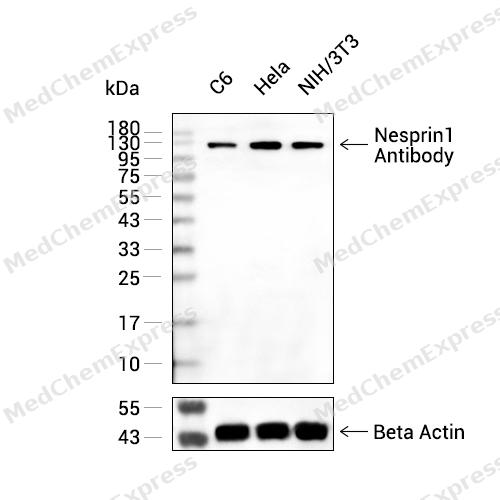 Western blot analysis of extracts from C6(lane 2(20ug) , Hela(lane 3(20ug) and NIH/3T3(lane 4(20ug) using Nesprin1 Antibody (HY-P81624) Rabbit mAb. Proteins were transferred to a PVDF membrane and blocked with 5% non-fat milk in TBST for 2 hour at room temperature. The primary antibody (1/1000) and Loading control antibody (Beta Actin, HY-P80438, 1/10000) was used in 5% non-fat milk in TBST at 4°C overnight. Goat Anti-Mouse/Rabbit IgG-HRP Secondary Antibody (1/10000) was used for 1 hour at room temperature.
 -
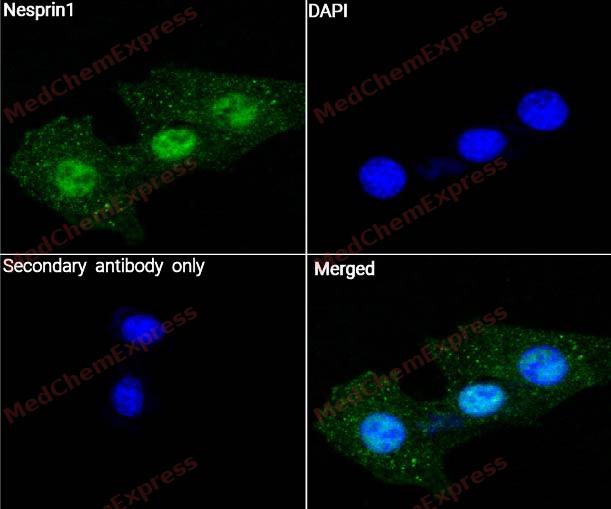 Immunocytochemistry analysis of C2C12 cells labeling Nesprin1 with Nesprin1Antibody (HY-P81624) at 1/50 dilution. Cells were fixed in 4% paraformaldehyde for 15 minutes at room temperature, permeabilized with 0.1% Triton X-100 for 10 minutes at room temperature, then blocked with QuickBlock™ Blocking Buffer for Immunol Staining for 10 min at room temperature. Cells were then incubated Nesprin1 (HY-P81624) at 1/50 dilution in QuickBlock™ Blocking Buffer for Immunol Staining at 4 ℃. Alexa Fluor® 488-conjugated AffiniPure Goat Anti-Rabbit IgG H&L(HY-P8002, Green) was used as the secondary antibody at 1/1,000 dilution. PBS instead of the primary antibody was used as the secondary antibody only control. The Nuclear counterstain was DAPI (Blue).
 -
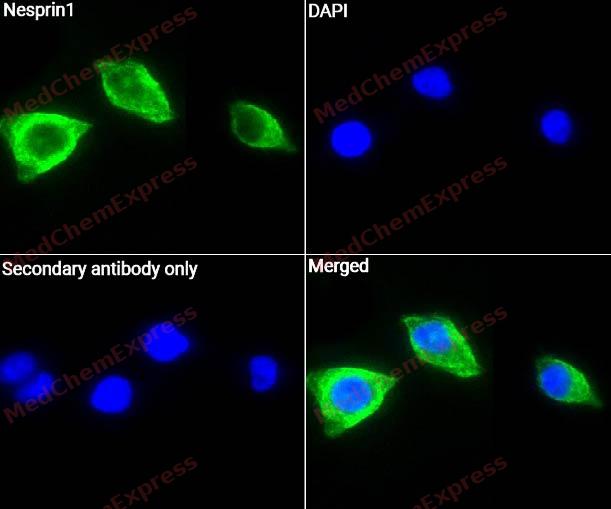 Immunocytochemistry analysis of A549 cells labeling Nesprin1 with Nesprin1Antibody (HY-P81624) at 1/50 dilution. Cells were fixed in 4% paraformaldehyde for 15 minutes at room temperature, permeabilized with 0.1% Triton X-100 for 10 minutes at room temperature, then blocked with QuickBlock™ Blocking Buffer for Immunol Staining for 10 min at room temperature. Cells were then incubated with Nesprin1 (HY-P81624) at 1/50dilution in QuickBlock™ Blocking Buffer for Immunol Staining at 4 ℃. Alexa Fluor® 488-conjugated AffiniPure Goat Anti-Rabbit IgG H&L(HY-P8002, Green) was used as the secondary antibody at 1/1,000 dilution. PBS instead of the primary antibody was used as the secondary antibody only control. The Nuclear counterstain was DAPI (Blue).
 -
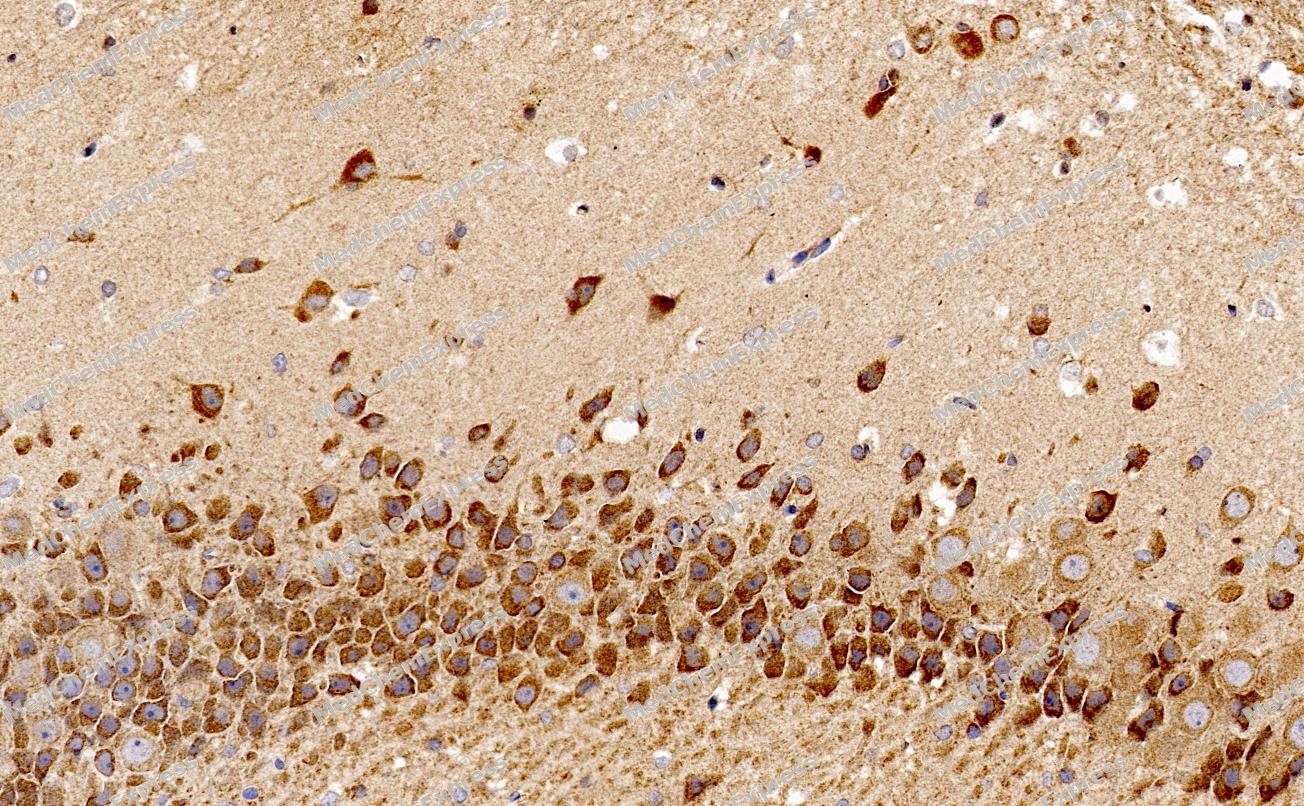 Immunohistochemical analysis of paraffin-embedded Rat brain tissue using Nesprin1 Antibody (YA1369). The section was pre-treated using heat mediated antigen retrieval with Tris-EDTA buffer (pH 8.0) for 8 minutes. The tissues were blocked in QuickBlock for 20 minutes at room temperature, washed with ddH2O and PBS, and then probed with the primary antibody (HY-P81624, 1/100) in 4℃ overnight. The detection was performed using an HRP conjugated compact polymer system. DAB was used as the chromogen. Tissues were counterstained with hematoxylin and mounted with DPX.
 -
Immunohistochemical analysis of paraffin-embedded Rat brain tissue using Nesprin1 Antibody (YA1369). The section was pre-treated using heat mediated antigen retrieval with Tris-EDTA buffer (pH 8.0) for 8 minutes. The tissues were blocked in QuickBlock for 20 minutes at room temperature, washed with ddH2O and PBS, and then probed with the primary antibody (HY-P81624, 1/100) in 4℃ overnight. The detection was performed using an HRP conjugated compact polymer system. DAB was used as the chromogen. Tissues were counterstained with hematoxylin and mounted with DPX.


Background
-
Function
Nesprin1 is a Multi-isomeric modular protein which forms a linking network between organelles and the actin cytoskeleton to maintain the subcellular spatial organization. As a component of the LINC (LInker of Nucleoskeleton and Cytoskeleton) complex involved in the connection between the nuclear lamina and the cytoskeleton. The nucleocytoplasmic interactions established by the LINC complex play an important role in the transmission of mechanical forces across the nuclear envelope and in nuclear movement and positioning. May be involved in nucleus-centrosome attachment and nuclear migration in neural progenitors implicating LINC complex association with SUN1/2 and probably association with cytoplasmic dynein-dynactin motor complexes; SYNE1 and SYNE2 may act redundantly. Required for centrosome migration to the apical cell surface during early ciliogenesis. May be involved in nuclear remodeling during sperm head formation in spermatogenesis; a probable SUN3:SYNE1/KASH1 LINC complex may tether spermatid nuclei to posterior cytoskeletal structures such as the manchette
-
Subcellular Localization
Nucleus outer membrane; Single-pass type IV membrane protein; Cytoplasmic side; Nucleus; Nucleus envelope; Cytoplasm, cytoskeleton; Cytoplasm, myofibril, sarcomere; Golgi apparatus
-
Expression
Tissue_specificity:Expressed in HeLa, A431, A172 and HaCaT cells (at protein level) . Widely expressed. Highly expressed in skeletal and smooth muscles, heart, spleen, peripheral blood leukocytes, pancreas, cerebellum, stomach, kidney and placenta. Isoform GSRP-56 is predominantly expressed in heart and skeletal muscle (at protein level) -
Isoforms & Post-Translational Modification
Q8NF91 has 12 isomers: Q8NF91-1: 1011086 Da (predicted); Q8NF91-2: 380360 Da (predicted); Q8NF91-3: 112393 Da (predicted); Q8NF91-4: 1005239 Da (predicted); Q8NF91-5: 167250 Da (predicted); Q8NF91-6: 199267 Da (predicted); Q8NF91-7: 642672 Da (predicted); Q8NF91-8: 367873 Da (predicted); Q8NF91-9: 111583 Da (predicted); Q8NF91-10: 349010 Da (predicted); Q8NF91-11: 131185 Da (predicted); Q8NF91-12: 54914 Da (predicted).
The disulfid bond with SUN1 or SUN2 is required for stability of the respective LINC complex under tensile forces -
Subunit
Core component of LINC complexes which are composed of inner nuclear membrane SUN domain-containing proteins coupled to outer nuclear membrane KASH domain-containing nesprins. SUN and KASH domain-containing proteins seem to bind each other promiscuously; however, differentially expression of LINC complex constituents can give rise to specific assemblies. At least SUN1/2-containing core LINC complexes are proposed to be hexameric composed of three protomers of each KASH and SUN domain-containing protein. The SUN2:SYNE1/KASH1 LINC complex is a heterohexamer; the homotrimeric cloverleave-like conformation of the SUN domain is a prerequisite for LINC complex formation in which three separate SYNE1/KASH1 peptides bind at the interface of adjacent SUN domains. Self-associates. Interacts with SYNE3. Interacts with SPAG4/SUN4. May interact with MUSK. Interacts with F-actin via its N-terminal domain. Interacts with EMD and LMNA in vitro. Interacts (via KASH domain) with TMEM258 (PubMed:28716842)
-
SwissProt ID
-
Synonyms
ARCA1; C6orf98; CPG2; EDMD4; Enaptin; Myne-1; MYNE1; Nesp1; Nesprin-1; SCAR8; Syne-1; SYNE1
-
Research Field
Tags & Cell Markers


Documentation
-
Data Sheet (234 KB)
-
SDS (252 KB)
- English - EN (252 KB)
- Français - FR (252 KB)
- Deutsch - DE (252 KB)
- Norwegian - NO (252 KB)
- Español - ES (252 KB)
- Swedish - SV (252 KB)
- Italian - IT (252 KB)
- Korean - KR (252 KB)
- Portuguese - PT (252 KB)
-
User Guide for Antibodies (1077 KB)

 Powered by Bioz
