



NR1D1 Antibody (YA1426)
(Synonyms: NR1D1; EAR1; HREV; THRAL; Nuclear receptor subfamily 1 group D member 1; Rev-erbA-alpha; V-erbA-related protein 1; EAR-1)
Based on 1 Customer Validation
NR1D1 Antibody (YA1426) is a Rabbit-derived and non-conjugated IgG monoclonal antibody, targeting to NR1D1.
-
Host:
Rabbit
-
Isotype:
IgG
-
Application:
WB, ICC/IF
-
Reactivity :
Human, Mouse, Rat
-
Formulation:
Supplied in 50mM Tris-Glycine(pH 7.4), 0.15M NaCl, 40% Glycerol, 0.01% Sodium azide and 0.05% BSA
-
Conjugation:
Non-conjugated


To place orders, for customer services and technical support, please contact: MedChemExpress USA
Tel: 609-228-6898 E-mail: [email protected] [email protected]





Applications
| Application |
WB

WB: Western Blot
|
ICC/IF
ICC/IF: Immunocytochemistry/
Immunofluorescence |
|---|---|---|
| Dilution Ratio | 1:500-1:1000 | 1:50-1:200 |


Product Details
NR1D1 Antibody (YA1426) is a Rabbit-derived and non-conjugated IgG monoclonal antibody, targeting to NR1D1.
-
Host Rabbit

-
Clonality Recombinant,Monoclonal

-
Species ReactivityHuman, Mouse, Rat
-
Observed Molecular WeightObserved band size: 67 kDa
Note: Due to possible protein modifications or aggregation, the molecular weight should be confirmed by actual measurement, and the predicted value is for reference only.

-
Calculated Molecular Weight Predicted band size: 67 kDa

Entrez Gene: 9572 Human ; 217166 Mouse ; 252917 Rat
SwissProt: P20393 Human ; Q3UV55 Mouse ; Q63503 Rat
OMIM: 602408 Human
A synthetic peptide of human NR1D1 aa591-605.
Endogenous
Affinity Purified
Non-conjugated
Unmodified
IgG


Product Properties
-
Appearance
Liquid
-
Formulation
Supplied in 50mM Tris-Glycine(pH 7.4), 0.15M NaCl, 40% Glycerol, 0.01% Sodium azide and 0.05% BSA
-
Concentration
Batch-dependent, Please check the COA for the concentration of each lot. Check Lot Concentration
-
Storage & Stability
Stored at -20°C for 1 year. Avoid repeated freeze / thaw cycles.
-
Shipping
Shipping with blue ice.


Verification Images
-
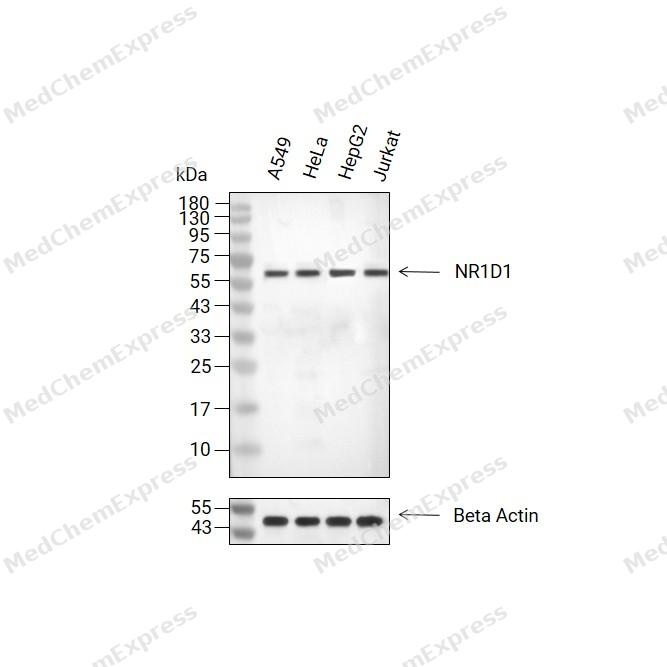 Western blot analysis of extracts from A549(lane 2(20μg), HeLa(lane 3(20μg), HepG2(lane 4(20μg) and Jurkat(lane 5(20μg) using NR1D1 Antibody (HY-P81681). Proteins were transferred to a PVDF membrane and blocked with 5% non-fat milk in TBST for 2 hour at room temperature. The primary antibody (1/1000) and Loading control antibody (Beta Actin, HY-P80993,1/10000) was used in 5% non-fat milk in TBST at 4°C overnight. Goat Anti-Rabbit IgG-HRP Secondary Antibody (HY-P8001,1/10,000) was used for 1 hour at room temperature.
 -
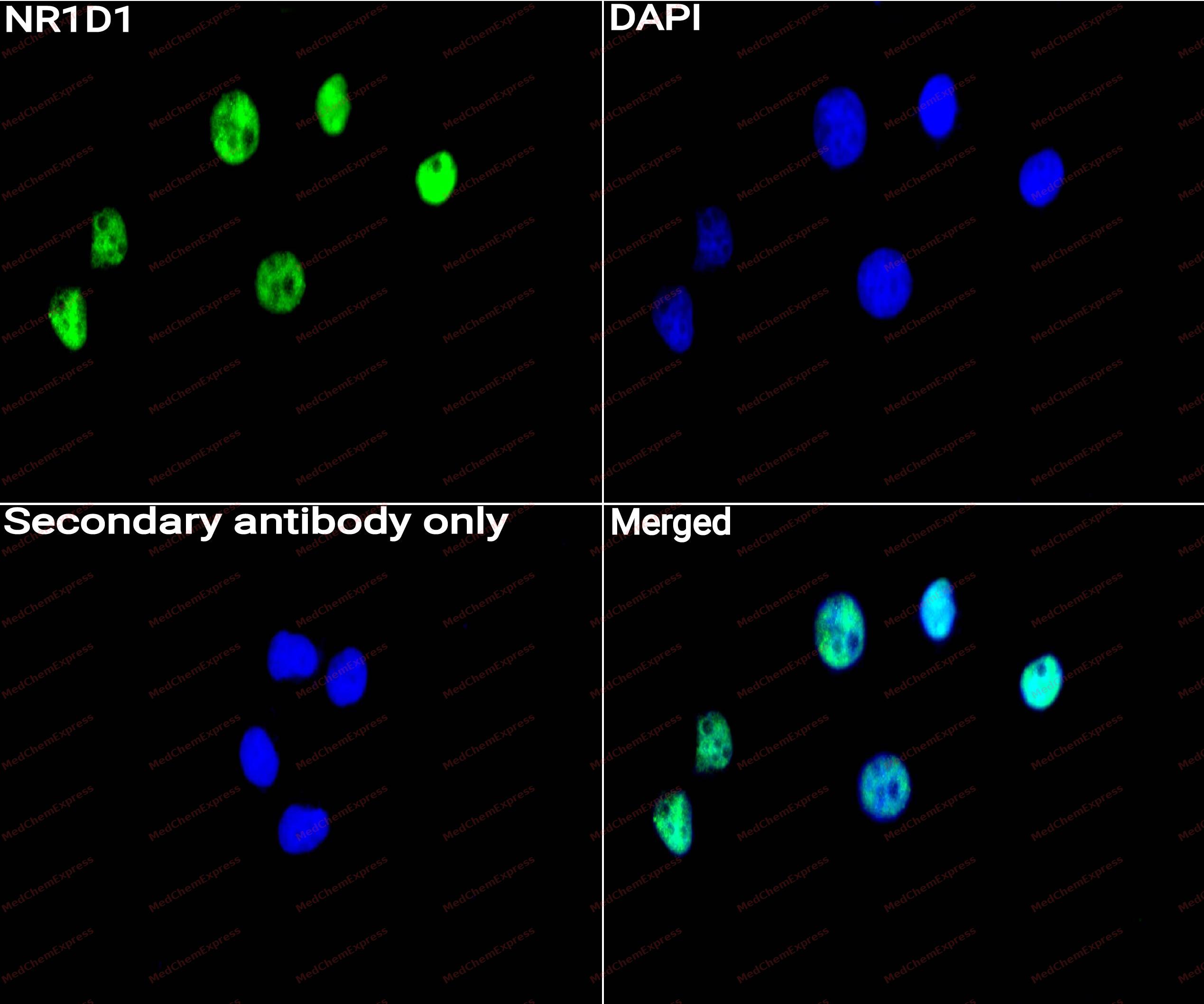 Immunocytochemistry analysis of Hela cells labeling NR1D1 with NR1D1 Antibody (HY-P81681) at 1/50 dilution. Cells were fixed in 4% paraformaldehyde for 15 minutes at room temperature, permeabilized with 0.1% Triton X-100 for 10 minutes at room temperature, then blocked with QuickBlock™ Blocking Buffer for Immunol Staining for 10 min at room temperature. Cells were then incubated with NR1D1 Antibody (HY-P81681) at 1/50 dilution in QuickBlock™ Blocking Buffer for Immunol Staining at 4 ℃. Alexa Fluor® 488-conjugated AffiniPure Goat Anti-Rabbit IgG H&L(HY-P8002, Green) was used as the secondary antibody at 1/1,000 dilution. PBS instead of the primary antibody was used as the secondary antibody only control. The Nuclear counterstain was DAPI (Blue).
 -
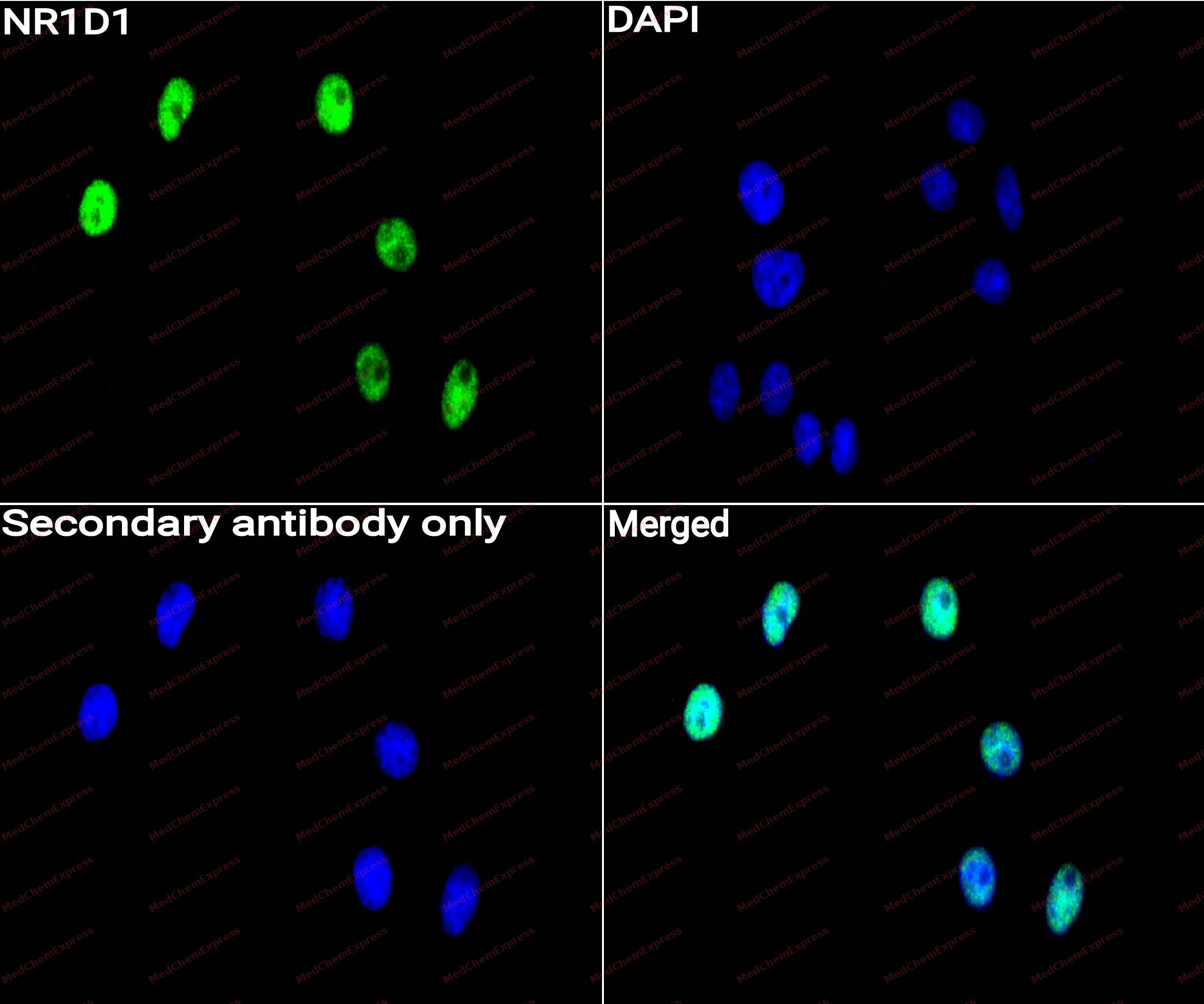 Immunocytochemistry analysis of A431 cells labeling NR1D1 with NR1D1 Antibody (HY-P81681) at 1/50 dilution. Cells were fixed in 4% paraformaldehyde for 15 minutes at room temperature, permeabilized with 0.1% Triton X-100 for 10 minutes at room temperature, then blocked with QuickBlock™ Blocking Buffer for Immunol Staining for 10 min at room temperature. Cells were then incubated with NR1D1 Antibody (HY-P81681)at 1/50 dilution in QuickBlock™ Blocking Buffer for Immunol Staining at 4 ℃. Alexa Fluor® 488-conjugated AffiniPure Goat Anti-Rabbit IgG H&L(HY-P8002,Green) was used as the secondary antibody at 1/1,000 dilution. PBS instead of the primary antibody was used as the secondary antibody only control. The Nuclear counterstain was DAPI (Blue).


Background
-
Function
NR1D1 transcriptional repressor which coordinates circadian rhythm and metabolic pathways in a heme-dependent manner. Integral component of the complex transcription machinery that governs circadian rhythmicity and forms a critical negative limb of the circadian clock by directly repressing the expression of core clock components BMAL1, CLOCK and CRY1. Also regulates genes involved in metabolic functions, including lipid and bile acid metabolism, adipogenesis, gluconeogenesis and the macrophage inflammatory response. Acts as a receptor for heme which stimulates its interaction with the NCOR1/HDAC3 corepressor complex, enhancing transcriptional repression. Recognizes two classes of DNA response elements within the promoter of its target genes and can bind to DNA as either monomers or homodimers, depending on the nature of the response element. Binds as a monomer to a response element composed of the consensus half-site motif 5'-[A/G]GGTCA-3' preceded by an A/T-rich 5' sequence (RevRE), or as a homodimer to a direct repeat of the core motif spaced by two nucleotides (RevDR-2). Acts as a potent competitive repressor of ROR alpha (RORA) function and regulates the levels of its ligand heme by repressing the expression of PPARGC1A, a potent inducer of heme synthesis. Regulates lipid metabolism by repressing the expression of APOC3 and by influencing the activity of sterol response element binding proteins (SREBPs); represses INSIG2 which interferes with the proteolytic activation of SREBPs which in turn govern the rhythmic expression of enzymes with key functions in sterol and fatty acid synthesis. Regulates gluconeogenesis via repression of G6PC1 and PEPCK and adipocyte differentiation via repression of PPARG. Regulates glucagon release in pancreatic alpha-cells via the AMPK-NAMPT-SIRT1 pathway and the proliferation, glucose-induced insulin secretion and expression of key lipogenic genes in pancreatic-beta cells. Positively regulates bile acid synthesis by increasing hepatic expression of CYP7A1 via repression of NR0B2 and NFIL3 which are negative regulators of CYP7A1. Modulates skeletal muscle oxidative capacity by regulating mitochondrial biogenesis and autophagy; controls mitochondrial biogenesis and respiration by interfering with the STK11-PRKAA1/2-SIRT1-PPARGC1A signaling pathway. Represses the expression of SERPINE1/PAI1, an important modulator of cardiovascular disease and the expression of inflammatory cytokines and chemokines in macrophages. Represses gene expression at a distance in macrophages by inhibiting the transcription of enhancer-derived RNAs (eRNAs). Plays a role in the circadian regulation of body temperature and negatively regulates thermogenic transcriptional programs in brown adipose tissue (BAT); imposes a circadian oscillation in BAT activity, increasing body temperature when awake and depressing thermogenesis during sleep. In concert with NR2E3, regulates transcriptional networks critical for photoreceptor development and function. In addition to its activity as a repressor, can also act as a transcriptional activator. In the ovarian granulosa cells acts as a transcriptional activator of STAR which plays a role in steroid biosynthesis. In collaboration with SP1, activates GJA1 transcription in a heme-independent manner. Represses the transcription of CYP2B10, CYP4A10 and CYP4A14. Represses the transcription of CES2. Represses and regulates the circadian expression of TSHB in a NCOR1-dependent manner. Negatively regulates the protein stability of NR3C1 and influences the time-dependent subcellular distribution of NR3C1, thereby affecting its transcriptional regulatory activity. Plays a critical role in the circadian control of neutrophilic inflammation in the lung; under resting, non-stress conditions, acts as a rhythmic repressor to limit inflammatory activity whereas in the presence of inflammatory triggers undergoes ubiquitin-mediated degradation thereby relieving inhibition of the inflammatory response. Plays a key role in the circadian regulation of microglial activation and neuroinflammation; suppresses microglial activation through the NF-kappaB pathway in the central nervous system. Plays a role in the regulation of the diurnal rhythms of lipid and protein metabolism in the skeletal muscle via transcriptional repression of genes controlling lipid and amino acid metabolism in the muscle
-
Subcellular Localization
Nucleus; Cytoplasm; Cell projection, dendrite; Cell projection, dendritic spine
-
Expression
Tissue_specificity:Widely expressed. Expressed at high levels in the liver, adipose tissue, skeletal muscle and brain. Also expressed in endothelial cells (ECs) , vascular smooth muscle cells (VSMCs) and macrophages. Expression oscillates diurnally in the suprachiasmatic nucleus (SCN) of the hypothalamus as well as in peripheral tissues. Expression increases during the differentiation of pre-adipocytes into mature adipocytes. Expressed at high levels in some squamous carcinoma cell lines -
Subunit
Binds DNA as a monomer or a homodimer (PubMed:9660968). Interacts with OPHN1 (via C-terminus) (PubMed:21874017). Interacts with ZNHIT1 (PubMed:17892483).
-
SwissProt ID
-
Synonyms
NR1D1; EAR1; HREV; THRAL; Nuclear receptor subfamily 1 group D member 1; Rev-erbA-alpha; V-erbA-related protein 1; EAR-1
-
Research Field
Signal Transduction


Documentation
-
Data Sheet (258 KB)
-
SDS (252 KB)
- English - EN (252 KB)
- Français - FR (252 KB)
- Deutsch - DE (252 KB)
- Norwegian - NO (252 KB)
- Español - ES (252 KB)
- Swedish - SV (252 KB)
- Italian - IT (252 KB)
- Korean - KR (252 KB)
- Portuguese - PT (252 KB)
-
User Guide for Antibodies (1077 KB)

 Powered by Bioz
