



Protein Jumonji Antibody (YA2010)
(Synonyms: JARD2; JARID2; JMJ)
Based on 1 Customer Validation
Protein Jumonji Antibody (YA2010) is a Rabbit-derived and non-conjugated IgG monoclonal antibody, targeting to Protein Jumonji.
-
Host:
Rabbit
-
Isotype:
IgG
-
Application:
WB, ICC/IF
-
Reactivity :
Human
-
Formulation:
Supplied in rabbit IgG in 10mM PBS, pH 7.4, 150mM sodium chloride, 0.05% BSA, 0.02% sodium azide and 50% glycerol.
-
Conjugation:
Non-conjugated


To place orders, for customer services and technical support, please contact: MedChemExpress USA
Tel: 609-228-6898 E-mail: [email protected] [email protected]





Applications
| Application |
WB

WB: Western Blot
|
ICC/IF
ICC/IF: Immunocytochemistry/
Immunofluorescence |
|---|---|---|
| Dilution Ratio | 1:1000-1:2000 | 1:50-1:200 |


Product Details
Protein Jumonji Antibody (YA2010) is a Rabbit-derived and non-conjugated IgG monoclonal antibody, targeting to Protein Jumonji.
-
Host Rabbit

-
Clonality Recombinant,Monoclonal

-
Species ReactivityHuman
-
Observed Molecular WeightObserved band size: 139 kDa
Note: Due to possible protein modifications or aggregation, the molecular weight should be confirmed by actual measurement, and the predicted value is for reference only.

-
Calculated Molecular Weight Predicted band size: 139 kDa

A synthesized peptide derived from human Jarid2 aa111-186.
Endogenous
Affinity Chromatography
Non-conjugated
Unmodified
IgG


Product Properties
-
Appearance
Solution
-
Formulation
Supplied in rabbit IgG in 10mM PBS, pH 7.4, 150mM sodium chloride, 0.05% BSA, 0.02% sodium azide and 50% glycerol.
-
Concentration
Batch-dependent, Please check the COA for the concentration of each lot. Check Lot Concentration
-
Storage & Stability
Stored at -20°C for 1 year. Avoid repeated freeze / thaw cycles.
-
Shipping
Shipping with blue ice.


Verification Images
-
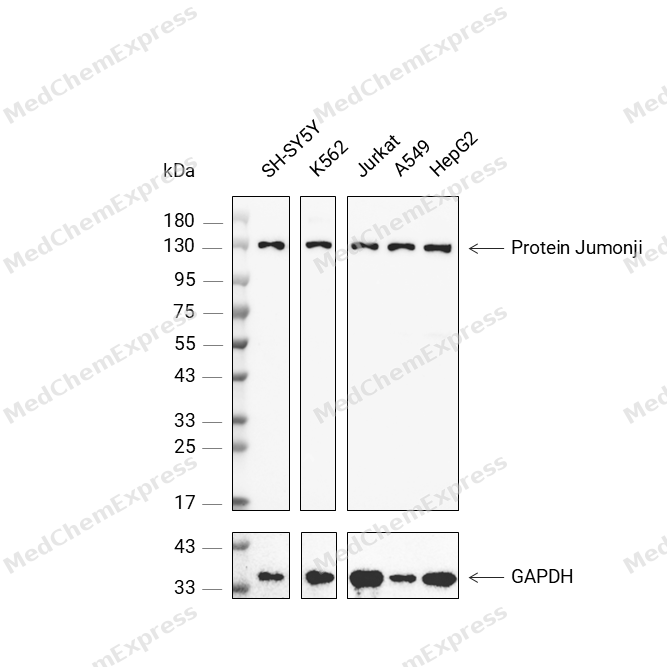 Western blot analysis was performed on protein extracts (25 μg) from SH-SY5Y (lane 2), K562 (lane 3), Jurkat (lane 4), A549 (lane 5), and HepG2 (lane 6) using Protein Jumonji antibody. Proteins were transferred onto a 0.45 μm PVDF membrane using the Trans-Blot® Turbo™ system for 13 min. The membrane was then blocked with 5% nonfat milk in TBST (HY-K1025) for 1 h at room temperature. The primary antibody (1:1000) and loading control antibody GAPDH Antibody (HRP) (HY-P80954A) (1:5000) were diluted in 5% nonfat milk in TBST and incubated with the membrane overnight at 4°C. After washing, the membrane of primary antibody was incubated with HRP-conjugated goat anti-rabbit/mouse IgG secondary antibody (HY-P8001/HY-P8004) (1:5000) diluted in 5% nonfat milk in TBST for 1 h at room temperature. Protein bands were visualized using an Ultra High Sensitivity ECL detection kit (HY-K1005).


Background
-
Function
Protein Jumonji is a Regulator of histone methyltransferase complexes that plays an essential role in embryonic development, including heart and liver development, neural tube fusion process and hematopoiesis. Acts as an accessory subunit for the core PRC2 (Polycomb repressive complex 2) complex, which mediates histone H3K27 (H3K27me3) trimethylation on chromatin. Binds DNA and mediates the recruitment of the PRC2 complex to target genes in embryonic stem cells, thereby playing a key role in stem cell differentiation and normal embryonic development. In cardiac cells, it is required to repress expression of cyclin-D1 (CCND1) by activating methylation of 'Lys-9' of histone H3 (H3K9me) by the GLP1/EHMT1 and G9a/EHMT2 histone methyltransferases. Also acts as a transcriptional repressor of ANF via its interaction with GATA4 and NKX2-5. Participates in the negative regulation of cell proliferation signaling. Does not have histone demethylase activity[1][2][3].
-
Subcellular Localization
Nucleus
-
Expression
Tissue_specificity:During embryogenesis, it is mainly expressed in neurons, especially in dorsal root ganglion cells. -
Isoforms & Post-Translational Modification
Q92833 has 3 isomers: Q92833-1: 138734 Da (predicted); Q92833-2: 106139 Da (predicted); Q92833-3: 119689 Da (predicted).
-
Subunit
Associates with the PRC2 complex, which consists of the core components EED, EZH1 or EZH2, SUZ12, and RBBP4, and various combinations of accessory subunits including AEBP2, JARID2, PHF19, MTF2 and EPOP (PubMed:29499137, PubMed:31959557). Found in a monomeric PRC2.2 (class 2) complex consisting of at least SUZ12, RBBP4, AEBP2 and JARID2 (PubMed:29499137). Facilitates nucleosome binding of the PRC2 complex (PubMed:29499137). Interacts with SUZ12 (via C2H2-type zinc finger domain); the interaction is direct; competes with EPOP for SUZ12 binding (PubMed:29499137). Interacts with histone methyltransferases EHMT1/GLP1 and EHMT2/G9a (By similarity). Interacts with GATA4 (via the N-terminal region) (By similarity). Interacts with NKX2-5 (via the C-terminal region) (By similarity). Interacts with RB1 (By similarity). Interacts with ZNF496 (By similarity). Interacts with ESRRB (By similarity). Interacts with DDX18; this interaction inhibits the PRC2 complex (By similarity)
-
SwissProt ID
-
Synonyms
JARD2; JARID2; JMJ
-
Research Field
Neuroscience


Documentation

 Powered by Bioz
