



RBBP4 Antibody (YA1843)
(Synonyms: NURF55; RBAP48; lin-53)
Based on 1 Customer Validation
RBBP4 Antibody (YA1843) is a Rabbit-derived and non-conjugated IgG monoclonal antibody, targeting to RBBP4.
-
Host:
Rabbit
-
Isotype:
IgG
-
Application:
WB, IHC-F, IHC-P, ICC/IF, IP
-
Reactivity :
Human, Mouse, Rat, Hamster
-
Formulation:
Supplied in 50mM Tris-Glycine(pH 7.4), 0.15M NaCl, 40% Glycerol, 0.01% Sodium azide and 0.05% BSA
-
Conjugation:
Non-conjugated


To place orders, for customer services and technical support, please contact: MedChemExpress USA
Tel: 609-228-6898 E-mail: [email protected] [email protected]





Applications
| Application |
WB

WB: Western Blot
|
IHC-P
IHC-P: Immunohistochemistry-Paraffin
|
IHC-F
IHC-F: Immunohistochemistry-Frozen
|
ICC/IF
ICC/IF: Immunocytochemistry/
Immunofluorescence |
IP
IP: Immunoprecipitation
|
|---|---|---|---|---|---|
| Dilution Ratio | 1:500-1:1000 | 1:50-1:100 | 1:50-1:100 | 1:50-1:200 | 1:20 |


Product Details
RBBP4 Antibody (YA1843) is a Rabbit-derived and non-conjugated IgG monoclonal antibody, targeting to RBBP4.
-
Host Rabbit

-
Clonality Recombinant,Monoclonal

-
Species ReactivityHuman, Mouse, Rat, Hamster
-
Observed Molecular WeightObserved band size: 48 kDa
Note: Due to possible protein modifications or aggregation, the molecular weight should be confirmed by actual measurement, and the predicted value is for reference only.

-
Calculated Molecular Weight Predicted band size: 48 kDa

Entrez Gene: 5928 Human ; 19646 Mouse ; 313048 Rat
SwissProt: Q09028 Human ; Q60972 Mouse ;
OMIM: 602923 Human
A synthetic peptide of human RbAp48
Endogenous
Affinity Purified
Non-conjugated
Unmodified
IgG


Product Properties
-
Appearance
Solution
-
Formulation
Supplied in 50mM Tris-Glycine(pH 7.4), 0.15M NaCl, 40% Glycerol, 0.01% Sodium azide and 0.05% BSA
-
Concentration
Batch-dependent, Please check the COA for the concentration of each lot. Check Lot Concentration
-
Storage & Stability
Stored at -20°C for 1 year. Avoid repeated freeze / thaw cycles.
-
Shipping
Shipping with blue ice.


Verification Images
-
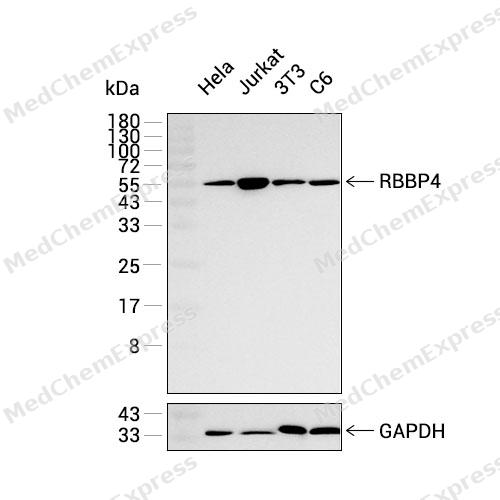
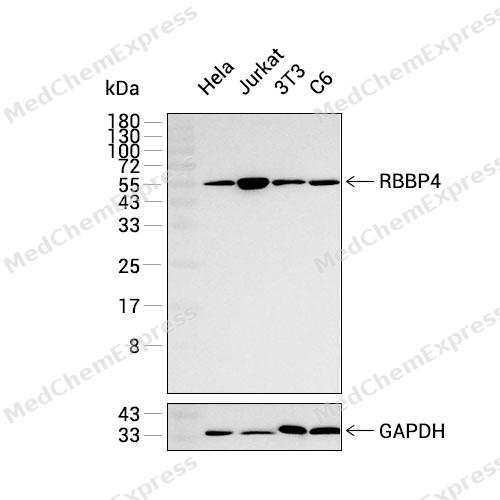 Western blot analysis was performed on extracts from Hela (lane 1, 15 μg), Jurkat (lane 2, 15 μg), 3T3 (lane 3, 15 μg), and C6 (lane 4, 15 μg) using RBBP4 Rabbit mAb.Proteins were transferred to a PVDF membrane and blocked with 5% non-fat milk in TBST at 4°C overnight.The primary antibody (1:1000 dilution) and the loading control antibody (GAPDH, HY-P80137, 1:40000 dilution) were incubated in 5% non-fat milk in TBST for 1 hour at 37°C.Goat Anti-Rabbit IgG-HRP Secondary Antibody (1:20000 dilution) was then applied for 40 minutes at 37°C.
 -
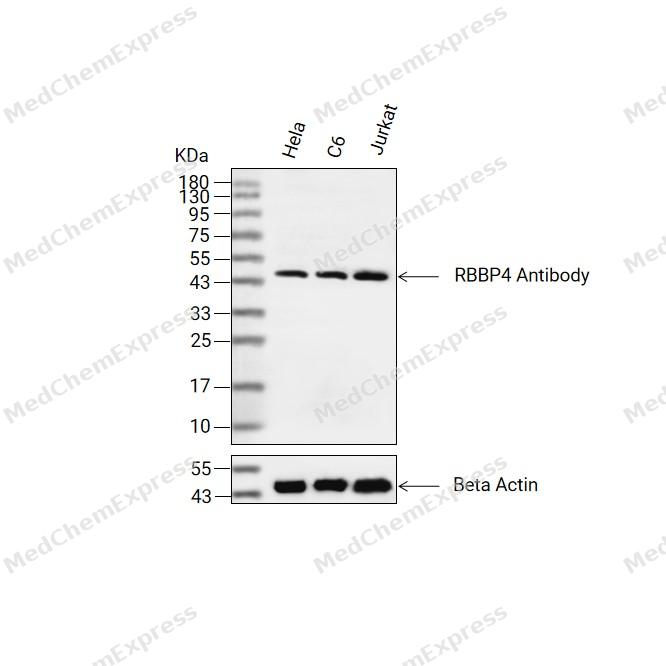 Western blot analysis of extracts from Hela(lane 2(20ug) , C6(lane 3(20ug) and Jurkat(lane 4(20ug) using RBBP4 Antibody(HY-P82098) Rabbit mAb. Proteins were transferred to a PVDF membrane and blocked with 5% non-fat milk in TBST for 2 hour at room temperature. The primary antibody (1/1000) and Loading control antibody (Beta Actin, HY-P83730, 1/10000) was used in 5% non-fat milk in TBST at 4°C overnight. Goat Anti-Mouse/Rabbit IgG-HRP Secondary Antibody (1/10000) was used for 1 hour at room temperature.
 -
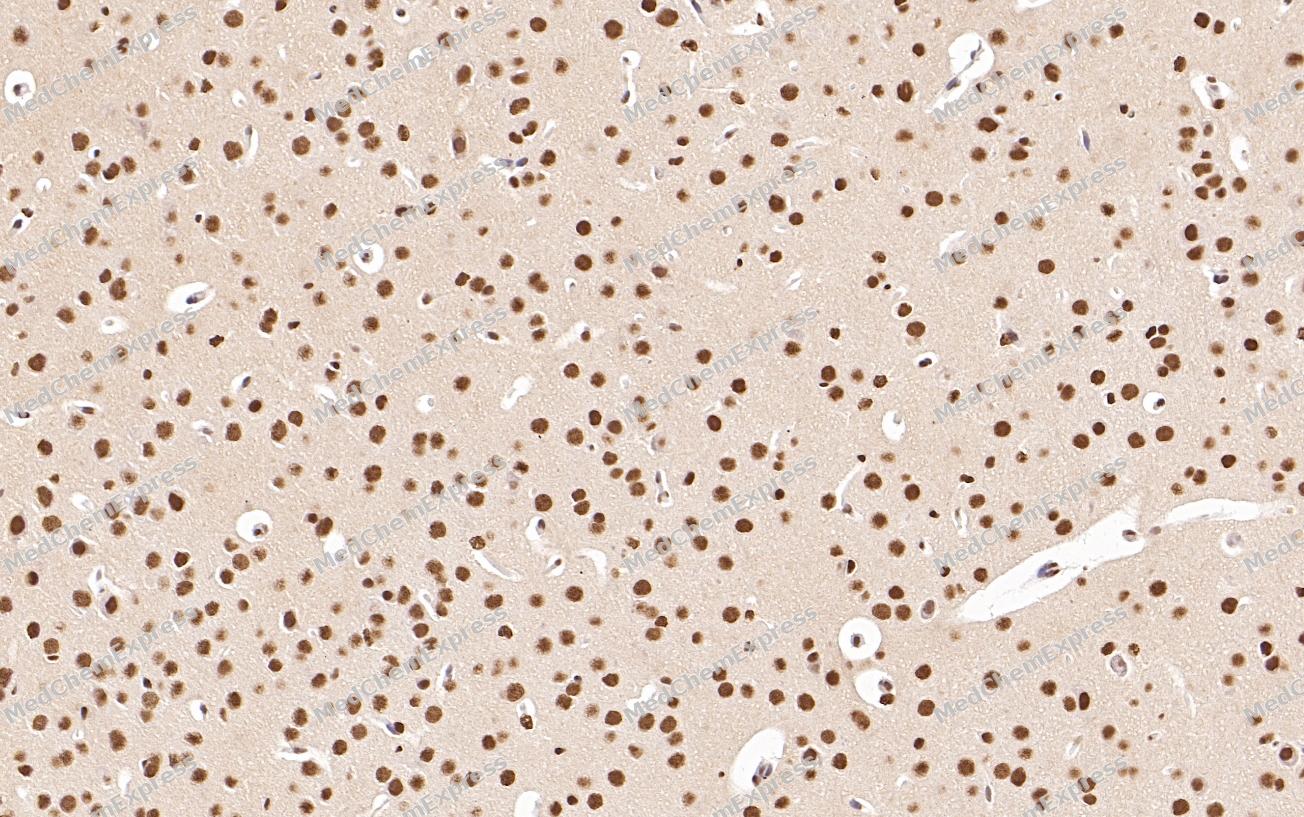 Immunohistochemical analysis of paraffin-embedded Rat brain tissue using RBBP4 Antibody (YA1843). The section was pre-treated using heat mediated antigen retrieval with Tris-EDTA buffer (pH 9.0) for 8 minutes. The tissues were blocked in QuickBlock for 20 minutes at room temperature, washed with ddH2O and PBS, and then probed with the primary antibody (HY-P82098, 1/100) in 4℃ overnight. The detection was performed using an HRP conjugated compact polymer system. DAB was used as the chromogen. Tissues were counterstained with hematoxylin and mounted with DPX.
 -
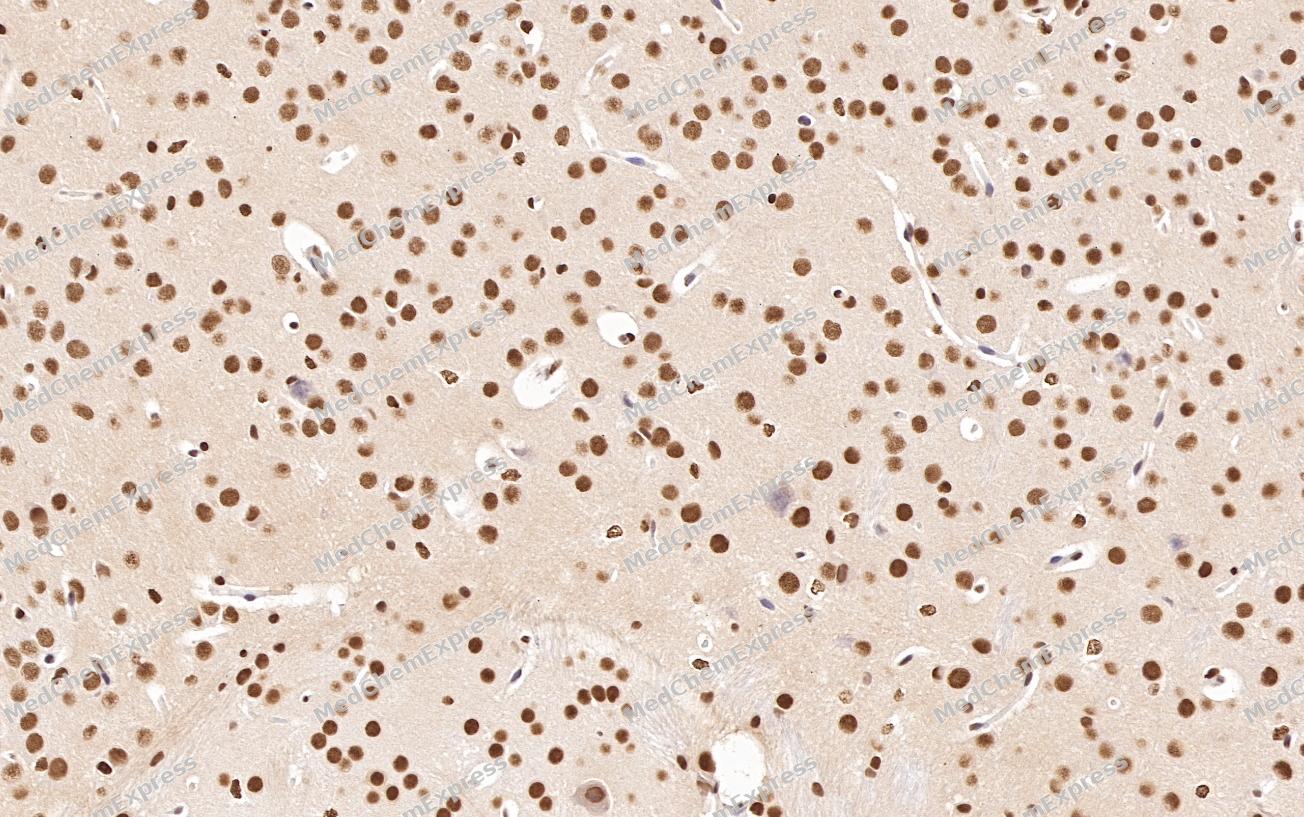 Immunohistochemical analysis of paraffin-embedded Rat brain tissue using RBBP4 Antibody (YA1843). The section was pre-treated using heat mediated antigen retrieval with Tris-EDTA buffer (pH 9.0) for 8 minutes. The tissues were blocked in QuickBlock for 20 minutes at room temperature, washed with ddH2O and PBS, and then probed with the primary antibody (HY-P82098, 1/100) in 4℃ overnight. The detection was performed using an HRP conjugated compact polymer system. DAB was used as the chromogen. Tissues were counterstained with hematoxylin and mounted with DPX.
 -
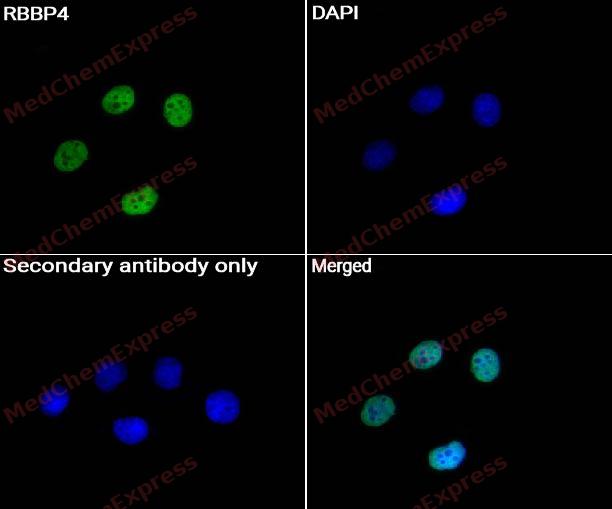 Immunocytochemistry analysis of Hela cells labeling RBBP4 Antibody (YA1843) (HY-P82098) at 1/50 dilution. Cells were fixed in 4% paraformaldehyde for 15 minutes at room temperature, permeabilized with 0.1% Triton X-100 for 10 minutes at room temperature, then blocked with BSA for Immunol Staining for 10 min at room temperature. Cells were then incubated with RBBP4 Antibody (YA1843) (HY-P82098) at 1/50 dilution in BSA for Immunol Staining at 4 ℃ Overnight. AF488-conjugated AffiniPure Goat Anti-Rabbit IgG H&L(HY-P8002, Green) was used as the secondary antibody at 1/1,000 dilution. PBS instead of the primary antibody was used as the secondary antibody only control. The Nuclear counterstain was DAPI (Blue).
 -
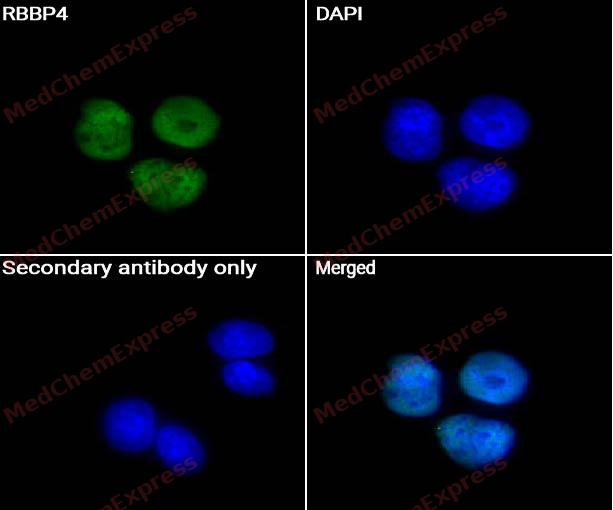 Immunocytochemistry analysis of MCF-7 cells labeling RBBP4 Antibody (HY-P82098) at 1/50 dilution. Cells were fixed in 4% paraformaldehyde for 15 minutes at room temperature, permeabilized with 0.1% Triton X-100 for 10 minutes at room temperature, then blocked with BSA for Immunol Staining for 10 min at room temperature. Cells were then incubated with RBBP4 Antibody (HY-P82098) at 1/50 dilution in BSA for Immunol Staining at 4 ℃ Overnight. AF488-conjugated AffiniPure Goat Anti-Rabbit IgG H&L(HY-P8002, Green) was used as the secondary antibody at 1/1,000 dilution. PBS instead of the primary antibody was used as the secondary antibody only control. The Nuclear counterstain was DAPI (Blue).


Background
-
Function
RBBP4 core histone-binding subunit that may target chromatin assembly factors, chromatin remodeling factors and histone deacetylases to their histone substrates in a manner that is regulated by nucleosomal DNA. Component of the chromatin assembly factor 1 (CAF-1) complex, which is required for chromatin assembly following DNA replication and DNA repair. Component of the core histone deacetylase (HDAC) complex, which promotes histone deacetylation and consequent transcriptional repression. Component of the nucleosome remodeling and histone deacetylase complex (the NuRD complex), which promotes transcriptional repression by histone deacetylation and nucleosome remodeling. Component of the PRC2 complex, which promotes repression of homeotic genes during development. Component of the NURF (nucleosome remodeling factor) complex[1][2][3][4][5][6][7][8][9][10].
-
Subcellular Localization
Nucleus; Chromosome, telomere
-
Expression
Tissue_specificity:Expression in neuroblastoma cells -
Isoforms & Post-Translational Modification
Q09028 has 4 isomers: Q09028-1: 47656 Da (predicted); Q09028-2: 47585 Da (predicted); Q09028-3: 46158 Da (predicted); Q09028-4: 43482 Da (predicted).
-
Subunit
Binds directly to helix 1 of the histone fold of histone H4, a region that is not accessible when H4 is in chromatin (PubMed:24920672, PubMed:8858152, PubMed:9427644). Subunit of the chromatin assembly factor 1 (CAF-1) complex, which is composed of RBBP4, CHAF1B and CHAF1A (PubMed:8858152). Subunit of the core histone deacetylase (HDAC) complex, which is composed of HDAC1, HDAC2, RBBP4 and RBBP7 (PubMed:9150135). The core HDAC complex associates with SIN3A, ARID4B/SAP180, SAP18, SAP30, SAP130, SUDS3/SAP45 and possibly ARID4A/RBP1 and ING1 to form the SIN3 HDAC complex (PubMed:11118440, PubMed:11784859, PubMed:9150135, PubMed:9651585). Component of the nucleosome remodeling and deacetylase (NuRD) repressor complex, composed of core proteins MTA1, MTA2, MTA3, RBBP4, RBBP7, HDAC1, HDAC2, MBD2, MBD3, and peripherally associated proteins CDK2AP1, CDK2AP2, GATAD2A, GATAD2B, CHD3, CHD4 and CHD5 (PubMed:10444591, PubMed:11102443, PubMed:16428440, PubMed:28977666, PubMed:33283408, PubMed:9790534, PubMed:39460621). The exact stoichiometry of the NuRD complex is unknown, and some subunits such as MBD2 and MBD3, GATAD2A and GATAD2B, and CHD3, CHD4 and CHD5 define mutually exclusive NuRD complexes (PubMed:16428440, PubMed:28977666, PubMed:33283408). Interacts with ZNF512B; the interaction is direct and may play a role in repressing gene expression (PubMed:39460621). The NuRD complex may also interact with MBD3L1 and MBD3L2 (PubMed:15456747, PubMed:15701600). Component of the PRC2 complex, which consists of the core subunits EED, EZH1 or EZH2, SUZ12, and RBBP4, and various combinations of accessory subunits including AEBP2, JARID2, PHF19, MTF2 and EPOP (PubMed:12351676, PubMed:12435631, PubMed:29499137, PubMed:31959557). Forms a monomeric PRC2.2 (class 2) complex consisting of at least SUZ12, RBBP4, AEBP2 and JARID2 (PubMed:29499137). Forms a dimeric PRC2.1 (class 1, PRC-PCL) complex consisting of at least SUZ12, RBBP4, and PHF19; PHF19 stabilizes the dimeric structure which enhances PRC2 interaction with chromatin (PubMed:31959557). Component of the NURF-1 ISWI chromatin remodeling complex (also called the nucleosome-remodeling factor (NURF) complex) at least composed of SMARCA1 (isoform 2), BPTF, RBBP4 and RBBP7 (PubMed:14609955, PubMed:15310751). Within the complex interacts with isoform 2 of SMARCA1 (PubMed:14609955, PubMed:15310751). Component of the BPFT-SMARCA1 complex at least composed of SMARCA1 (isoform 1), BPFT, RBBP4 and RBBP7; the complex is catalytically inactive and does not remodel chromatin (PubMed:15310751). Within the complex interacts with isoform 1 of SMARCA1 (PubMed:15310751). Interacts with the ISWI chromatin remodeling complex component SMARCA5; the interaction is direct (PubMed:12198550). Interacts with the viral protein-binding domain of the retinoblastoma protein (RB1) (PubMed:10734134, PubMed:7503932). Component of the DREAM complex (also named LINC complex) at least composed of E2F4, E2F5, LIN9, LIN37, LIN52, LIN54, MYBL1, MYBL2, RBL1, RBL2, RBBP4, TFDP1 and TFDP2 (PubMed:17531812, PubMed:17671431). The complex exists in quiescent cells where it represses cell cycle-dependent genes (PubMed:17531812, PubMed:17671431). It dissociates in S phase when LIN9, LIN37, LIN52 and LIN54 form a subcomplex that binds to MYBL2 (PubMed:17531812, PubMed:17671431). Found in a complex composed of at least SINHCAF, SIN3A, HDAC1, SAP30, RBBP4, OGT and TET1 (By similarity). Interacts with ZNF827; the interaction is direct and recruits RBBP4 to telomeres (PubMed:30045876). Interacts with MTA1; the interaction is direct and mutually exclusive with binding histone H4 (PubMed:12920132, PubMed:24920672). Interacts with ARMC12 (via ARM domains) (PubMed:30026490). Interacts with BRCA1 (PubMed:10220405). Interacts with CDK2AP1 (PubMed:20523938). Interacts with CREBBP, and this interaction may be enhanced by the binding of phosphorylated CREB1 to CREBBP (PubMed:10866654). Interacts with ERCC6 (PubMed:26030138). Interacts with HDAC7 (By similarity). Interacts with PHF6 (PubMed:24554700). Interacts with PWWP2B (By similarity). Interacts with SPEN/MINT (PubMed:11331609). Interacts with SUV39H1 (By similarity)
-
SwissProt ID
-
Synonyms
NURF55; RBAP48; lin-53
-
Research Field
Epigenetics and Nuclear Signaling


Documentation
-
Data Sheet (262 KB)
-
SDS (251 KB)
- English - EN (251 KB)
- Français - FR (251 KB)
- Deutsch - DE (251 KB)
- Norwegian - NO (251 KB)
- Español - ES (251 KB)
- Swedish - SV (251 KB)
- Italian - IT (251 KB)
- Korean - KR (251 KB)
- Portuguese - PT (251 KB)
-
User Guide for Antibodies (1077 KB)
References
[1]. Zhang Q, et al. Histone binding protein RbAp48 interacts with a complex of CREB binding protein and phosphorylated CREB. Mol Cell Biol. 2000 Jul;20(14):4970-8. [Content Brief]
[2]. Verreault A, et al. Nucleosome assembly by a complex of CAF-1 and acetylated histones H3/H4. Cell. 1996 Oct 4;87(1):95-104. [Content Brief]
[3]. Zhang Y, et al. Histone deacetylases and SAP18, a novel polypeptide, are components of a human Sin3 complex. Cell. 1997 May 2;89(3):357-64. [Content Brief]
[4]. Le Guezennec X, et al. MBD2/NuRD and MBD3/NuRD, two distinct complexes with different biochemical and functional properties. Mol Cell Biol. 2006 Feb;26(3):843-51. [Content Brief]
[5]. Hoffmeister H, et al. CHD3 and CHD4 form distinct NuRD complexes with different yet overlapping functionality. Nucleic Acids Res. 2017 Oct 13;45(18):10534-10554. [Content Brief]
[6]. Wunderlich TM, et al. ZNF512B binds RBBP4 via a variant NuRD interaction motif and aggregates chromatin in a NuRD complex-independent manner. Nucleic Acids Res. 2024 Nov 27;52(21):12831-12849. [Content Brief]
[7]. Chen S, et al. Unique Structural Platforms of Suz12 Dictate Distinct Classes of PRC2 for Chromatin Binding. Mol Cell. 2018 Mar 1;69(5):840-852.e5. [Content Brief]
[8]. Chen S, et al. A Dimeric Structural Scaffold for PRC2-PCL Targeting to CpG Island Chromatin. Mol Cell. 2020 Mar 19;77(6):1265-1278.e7. [Content Brief]
[9]. Barak O, et al. Isolation of human NURF: a regulator of Engrailed gene expression. EMBO J. 2003 Nov 17;22(22):6089-100. [Content Brief]
[10]. Barak O, et al. A tissue-specific, naturally occurring human SNF2L variant inactivates chromatin remodeling. J Biol Chem. 2004 Oct 22;279(43):45130-8. [Content Brief]

 Powered by Bioz
