



REA Antibody (YA1848)
(Synonyms: BAP; Bap37; BCAP 37; D prohibitin; p22; Phb2; PNAS 141; Prohibitin 2)Based on 1 publication(s) in Google Scholar
REA Antibody (YA1848) is a Rabbit-derived and non-conjugated IgG monoclonal antibody, targeting to REA.
-
Host:
Rabbit
-
Isotype:
IgG
-
Application:
WB, IHC-F, IHC-P, ICC/IF
-
Reactivity :
Human, Mouse, Rat
-
Formulation:
Supplied in 50mM Tris-Glycine(pH 7.4), 0.15M NaCl, 40% Glycerol, 0.01% Sodium azide and 0.05% BSA
-
Conjugation:
Non-conjugated


To place orders, for customer services and technical support, please contact: MedChemExpress USA
Tel: 609-228-6898 E-mail: [email protected] [email protected]



Publications Citing Use of MedChemExpress (MCE) REA Antibody (YA1848)
More

Applications
| Application |
WB

WB: Western Blot
|
IHC-P
IHC-P: Immunohistochemistry-Paraffin
|
IHC-F
IHC-F: Immunohistochemistry-Frozen
|
ICC/IF
ICC/IF: Immunocytochemistry/
Immunofluorescence |
|---|---|---|---|---|
| Dilution Ratio | 1:500-1:1000 | 1:50-1:100 | 1:50-1:100 | 1:50-1:200 |


Product Details
REA Antibody (YA1848) is a Rabbit-derived and non-conjugated IgG monoclonal antibody, targeting to REA.
-
Host Rabbit

-
Clonality Recombinant,Monoclonal

-
Species ReactivityHuman, Mouse, Rat
-
Observed Molecular WeightObserved band size: 33 kDa
Note: Due to possible protein modifications or aggregation, the molecular weight should be confirmed by actual measurement, and the predicted value is for reference only.

-
Calculated Molecular Weight Predicted band size: 33 kDa

Entrez Gene: 11331 Human ; 12034 Mouse ; 114766 Rat
SwissProt: Q99623 Human ; O35129 Mouse ; Q5XIH7 Rat
OMIM: 610704 Human
A synthetic peptide of human REA
Endogenous
Affinity Purified
Non-conjugated
Unmodified
IgG


Product Properties
-
Appearance
Liquid
-
Formulation
Supplied in 50mM Tris-Glycine(pH 7.4), 0.15M NaCl, 40% Glycerol, 0.01% Sodium azide and 0.05% BSA
-
Concentration
Batch-dependent, Please check the COA for the concentration of each lot. Check Lot Concentration
-
Storage & Stability
Stored at -20°C for 1 year. Avoid repeated freeze / thaw cycles.
-
Shipping
Shipping with blue ice.


Publications (1)
-
Journal Impact Factor
-
Most Recent
-
Cell Death Discov
AURKA/PHB2 signaling drives acquired resistance to KRAS G12C inhibitors in KRAS G12C-mutant NSCLC. [Abstract]2026 Apr 25. PMID: 42031711


Verification Images
-
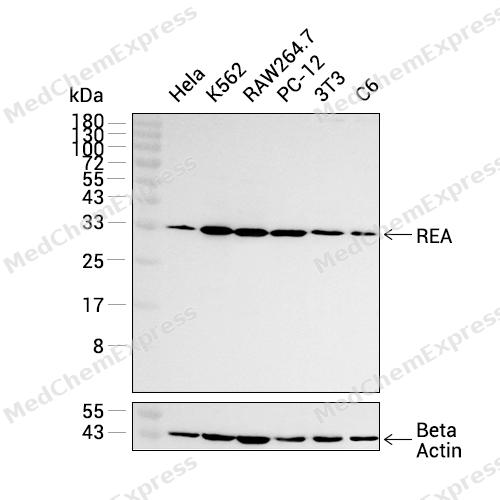
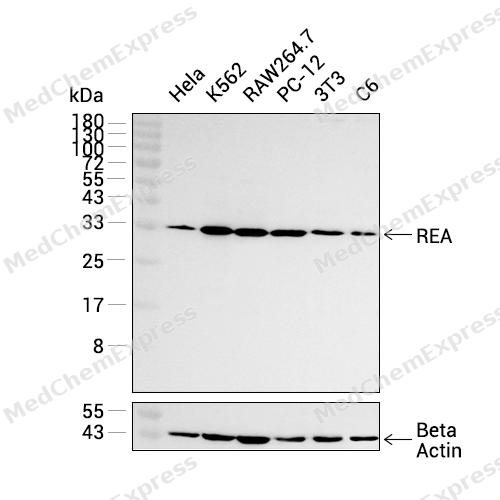 Western blot analysis was performed on extracts from Hela (lane 1, 15 μg), K562 (lane 2, 15 μg), RAW264.7 (lane 3, 15 μg), PC-12 (lane 4, 15 μg), 3T3 (lane 5, 15 μg), and C6 (lane 6, 15 μg) using REA Rabbit mAb.Proteins were transferred to a PVDF membrane and blocked with 5% non-fat milk in TBST at 4°C overnight.The primary antibody (1:2000 dilution) and the loading control antibody (beta-Actin, HY-P83730, 1:20000 dilution) were incubated in 5% non-fat milk in TBST for 1 hour at 37°C.Goat Anti-Rabbit IgG-HRP Secondary Antibody (1:20000 dilution) was then applied for 40 minutes at 37°C.
 -
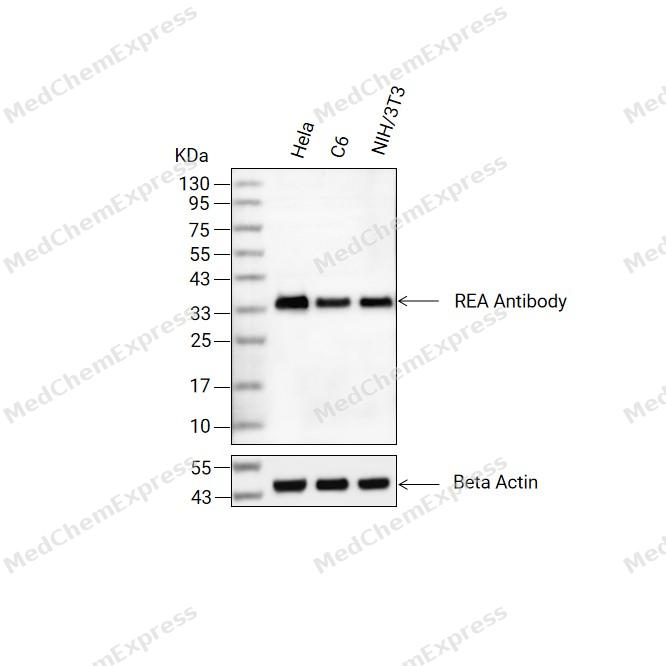 Western blot analysis of extracts from Hela(lane 2(20ug) , C6(lane 3(20ug) and NIH/3T3(lane 4(20ug) using REA Antibody(HY-P82103) Rabbit mAb. Proteins were transferred to a PVDF membrane and blocked with 5% non-fat milk in TBST for 2 hour at room temperature. The primary antibody (1/1000) and Loading control antibody (Beta Actin, HY-P83730, 1/10000) was used in 5% non-fat milk in TBST at 4°C overnight. Goat Anti-Mouse/Rabbit IgG-HRP Secondary Antibody (1/10000) was used for 1 hour at room temperature.
 -
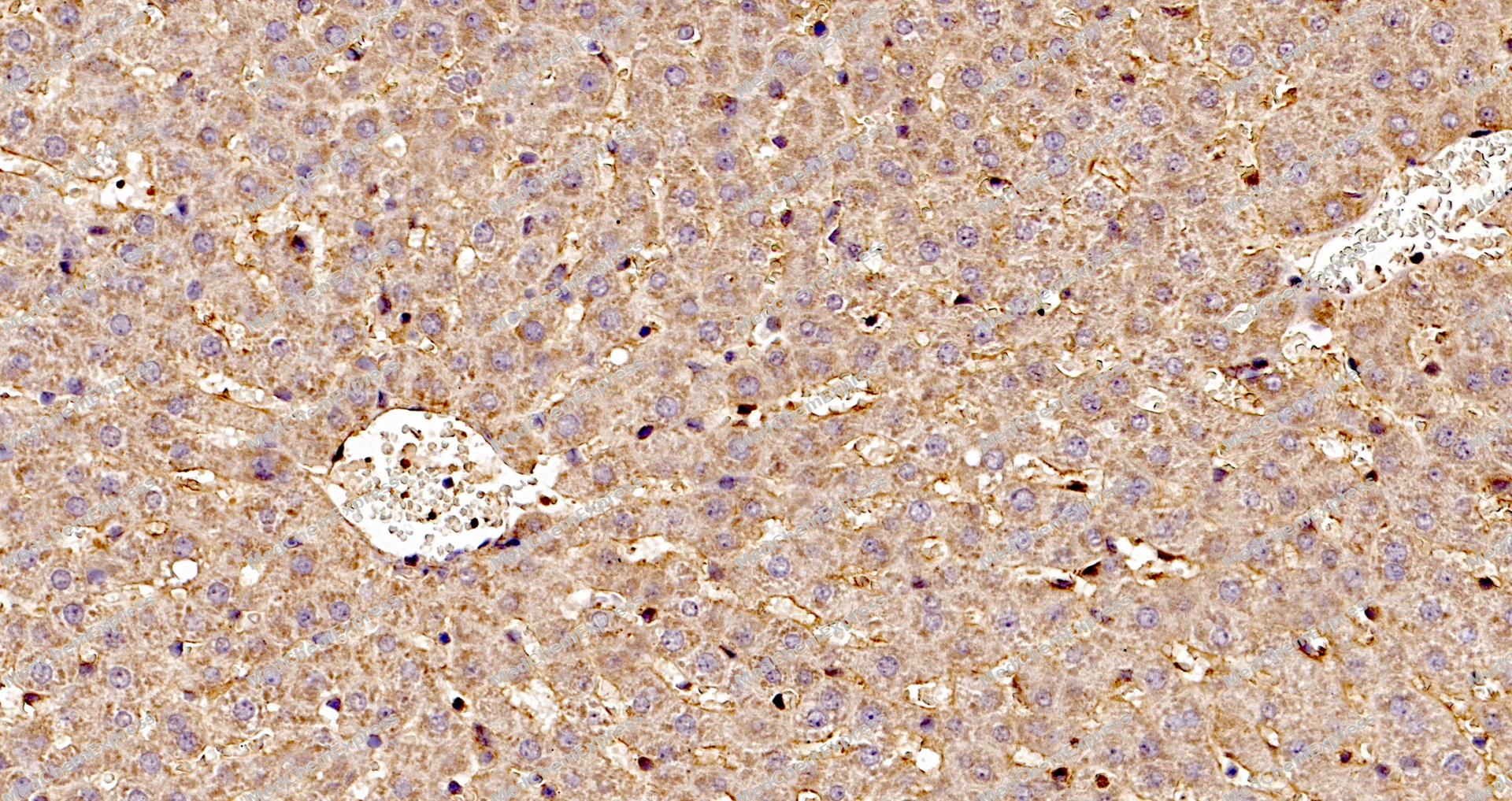 Immunohistochemical analysis of paraffin-embedded Rat liver tissue using REA Antibody (YA1848). The section was pre-treated using heat mediated antigen retrieval with Tris-EDTA buffer (pH 9.0) for 8 minutes. The tissues were blocked in QuickBlock for 20 minutes at room temperature, washed with ddH2O and PBS, and then probed with the primary antibody (HY-P82103, 1/100) in 4℃ overnight. The detection was performed using an HRP conjugated compact polymer system. DAB was used as the chromogen. Tissues were counterstained with hematoxylin and mounted with DPX.
 -
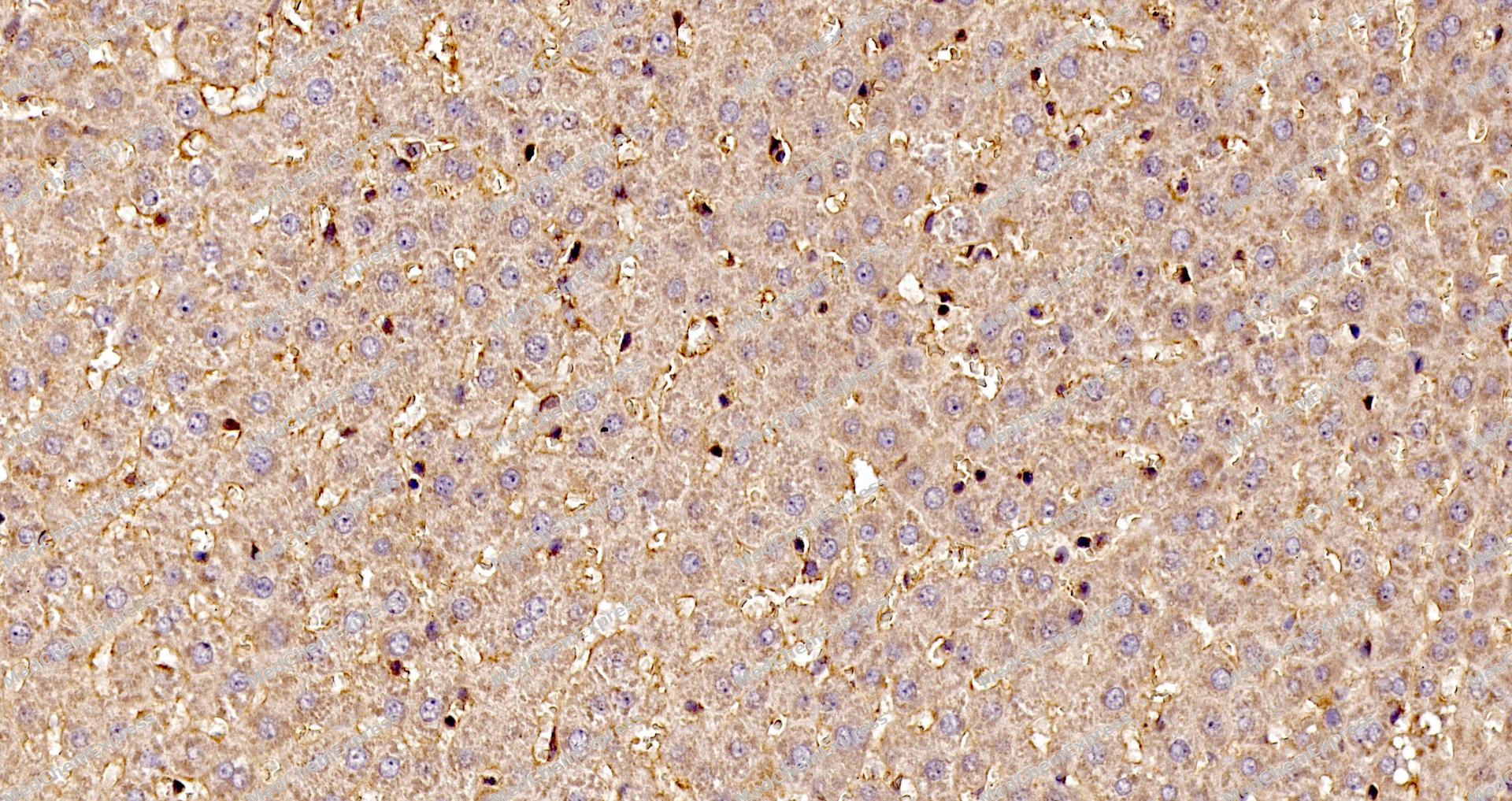 Immunohistochemical analysis of paraffin-embedded Rat liver tissue using REA Antibody (YA1848). The section was pre-treated using heat mediated antigen retrieval with Tris-EDTA buffer (pH 9.0) for 8 minutes. The tissues were blocked in QuickBlock for 20 minutes at room temperature, washed with ddH2O and PBS, and then probed with the primary antibody (HY-P82103, 1/100) in 4℃ overnight. The detection was performed using an HRP conjugated compact polymer system. DAB was used as the chromogen. Tissues were counterstained with hematoxylin and mounted with DPX.
 -
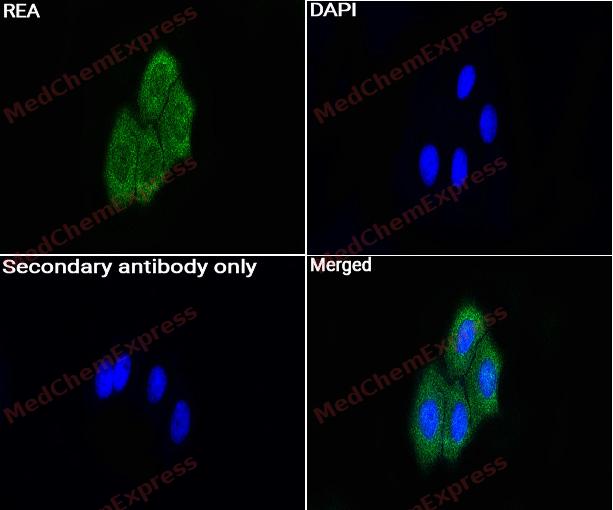 Immunocytochemistry analysis of HeLa cells labeling REA with REA Antibody (HY-P82103) at 1/50 dilution. Cells were fixed in 4% paraformaldehyde for 15 minutes at room temperature, permeabilized with 0.1% Triton X-100 for 10 minutes at room temperature, then blocked with BSA for Immunol Staining for 10 min at room temperature. Cells were then incubated with REA Antibody (HY-P82103) at 1/50 dilution in BSA for Immunol Staining at 4 ℃ overnight. AF488-conjugated AffiniPure Goat Anti-Rabbit IgG H&L(HY-P8002, Green) was used as the secondary antibody at 1/1,000 dilution. PBS instead of the primary antibody was used as the secondary antibody only control. The Nuclear counterstain was DAPI (Blue).
 -
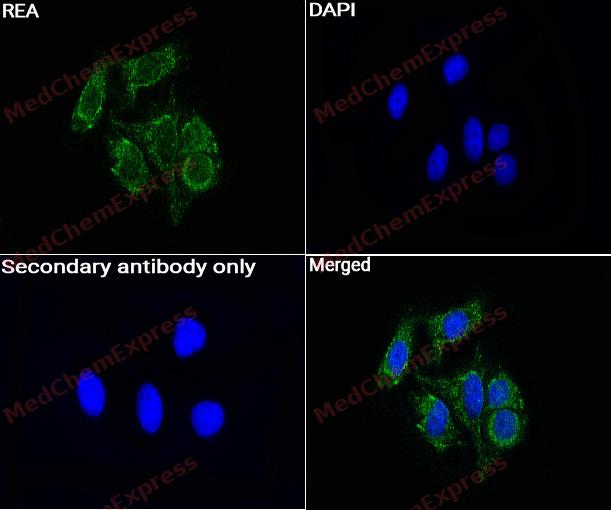 Immunocytochemistry analysis of HepG2 cells labeling REA with REA Antibody (HY-P82103) at 1/50 dilution. Cells were fixed in 4% paraformaldehyde for 15 minutes at room temperature, permeabilized with 0.1% Triton X-100 for 10 minutes at room temperature, then blocked with BSA for Immunol Staining for 10 min at room temperature. Cells were then incubated with REA Antibody (HY-P82103) at 1/50 dilution in BSA for Immunol Staining at 4 ℃ overnight. AF488-conjugated AffiniPure Goat Anti-Rabbit IgG H&L(HY-P8002,Green) was used as the secondary antibody at 1/1,000 dilution. PBS instead of the primary antibody was used as the secondary antibody only control. The Nuclear counterstain was DAPI (Blue).


Background
-
Function
REA is a Protein with pleiotropic attributes mediated in a cell-compartment- and tissue-specific manner, which include the plasma membrane-associated cell signaling functions, mitochondrial chaperone, and transcriptional co-regulator of transcription factors and sex steroid hormones in the nucleus; In the mitochondria, together with PHB, forms large ring complexes (prohibitin complexes) in the inner mitochondrial membrane (IMM) and functions as a chaperone protein that stabilizes mitochondrial respiratory enzymes and maintains mitochondrial integrity in the IMM, which is required for mitochondrial morphogenesis, neuronal survival, and normal lifespan (Probable). The prohibitin complex, with DNAJC19, regulates cardiolipin remodeling and the protein turnover of OMA1 in a cardiolipin-binding manner. Also regulates cytochrome-c oxidase assembly (COX) and mitochondrial respiration. Binding to sphingoid 1-phosphate (SPP) modulates its regulator activity. Has a key role of mitophagy receptor involved in targeting mitochondria for autophagic degradation. Involved in mitochondrial-mediated antiviral innate immunity, activates RIG-I-mediated signal transduction and production of IFNB1 and pro-inflammatory cytokine IL6; In the nucleus, serves as transcriptional co-regulator (Probable). Acts as a mediator of transcriptional repression by nuclear hormone receptors via recruitment of histone deacetylases. Functions as an estrogen receptor (ER)-selective coregulator that potentiates the inhibitory activities of antiestrogens and represses the activity of estrogens. Competes with NCOA1 for modulation of ER transcriptional activity; In the plasma membrane, is involved in IGFBP6-induced cell migration. Cooperates with CD86 to mediate CD86-signaling in B lymphocytes that regulates the level of IgG1 produced through the activation of distal signaling intermediates. Upon CD40 engagement, required to activate NF-kappa-B signaling pathway via phospholipase C and protein kinase C activation; (Microbial infection) Involved in human enterovirus 71/EV-71 infection by enhancing the autophagy mechanism during the infection[1][2][3][4][5].
-
Subcellular Localization
Mitochondrion inner membrane; Cytoplasm; Nucleus; Cell membrane; Mitochondrion inner membrane; Mitochondrion inner membrane
-
Expression
Tissue_specificity:Expressed in myoblasts
Induction:Expression increases approximately 3-fold upon entry into G1 phase compared to other phases of the cell cycle. Also induced following inhibition of mitochondrial protein synthesis by thiamphenicol -
Isoforms & Post-Translational Modification
Q99623 has 2 isomers: Q99623-1: 33296 Da (predicted); Q99623-2: 29044 Da (predicted).
Phosphorylated. Tyrosine phosphorylation is indirectly stimulated by IGFBP6 -
Subunit
The mitochondrial prohibitin complex consists of two subunits (PHB1 and PHB2), assembled into a membrane-associated ring-shaped supercomplex of approximately 1 mDa (PubMed:20959514, PubMed:28017329, PubMed:31522117). Interacts with ESR1, HDAC1 and HDAC5 (By similarity). Interacts with ZNF703 (PubMed:21328542). Interacts with STOML2 (PubMed:21746876). Interacts with ARFGEF3 (PubMed:19496786). Interacts with SPHK2. Interacts with COX4I1; the interaction associates PHB2 with COX (By similarity). Interacts with MAP1LC3B (membrane-bound form LC3-II); the interaction is direct and upon mitochondrial depolarization and proteasome-dependent outer membrane rupture (PubMed:28017329). Interacts with IGFBP6 (via C-terminal domain) (PubMed:24003225). Interacts with CLPB (PubMed:31522117). Interacts with CD86 (via cytoplasmic domain); the interactions increases after priming with CD40 (By similarity). Interacts with AFG3L2 (By similarity). Interacts with DNAJC19 (By similarity). Interacts with AKT2; this interaction may be important for myogenic differentiation (By similarity)
-
SwissProt ID
-
Synonyms
BAP; Bap37; BCAP 37; D prohibitin; p22; Phb2; PNAS 141; Prohibitin 2
-
Research Field
Signal Transduction
Documentation
-
Data Sheet (258 KB)
-
SDS (251 KB)
- English - EN (251 KB)
- Français - FR (251 KB)
- Deutsch - DE (251 KB)
- Norwegian - NO (251 KB)
- Español - ES (251 KB)
- Swedish - SV (251 KB)
- Italian - IT (251 KB)
- Korean - KR (251 KB)
- Portuguese - PT (251 KB)
-
User Guide for Antibodies (1077 KB)

 Powered by Bioz
